The Mystery of Hohei-shi — The Thousand-Year Institution of Imperial Envoys Offering Heihaku to Shrines
Hohei-shi are imperial envoys dispatched as the emperor's representatives to offer heihaku at shrines. Beginning with provisions in the Engishiki, the institution spans more than a thousand years, with reihei-shi sent to Ise Jingu, hohei-shi for the Kanname Festival, and the Kamo Festival imperial messenger forming a circuit of prayer linking the court and the shrines. We unravel the oldest form of prayer linking shrines and the state—why the emperor sends a representative rather than going himself, the robes and procedures of the hohei-shi, the history of interruption by warfare and revival in the Meiji era, and the system of chokusaisha shrines that still survives today.
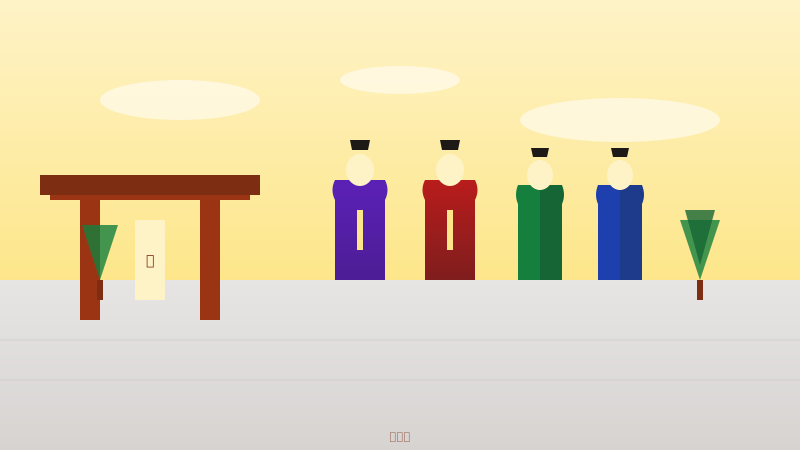
What Is a Hohei-shi — The Institution That Carries the Emperor's Prayers
A hohei-shi is an imperial messenger (chokushi) dispatched as the emperor's representative to offer heihaku (offerings to the kami) at a shrine. The word 'hohei' literally means 'to offer hei,' that is, to present offerings to the deities, and the hohei-shi who acted as messenger has functioned for more than a thousand years as a circuit of prayer linking the imperial court with key shrines across Japan.
At the root of the hohei-shi institution lies the ancient Japanese view of ritual that holds 'the emperor's prayer is delivered to the kami.' The emperor was originally a being who himself prayed to the kami, and since the Nihon Shoki he has been positioned as 'the chief priest of the deities.' But it is physically impossible for the emperor himself to visit every one of the countless shrines scattered across the realm. Hence the institution arose of 'messengers who carry hei to shrines on the emperor's behalf,' and they came to be called hohei-shi.
The hohei-shi was not a mere 'errand-runner.' He was treated as a noble bearer of the emperor's authority, and his dispatch was itself a core element of state ritual. On the shrine side too, the rite of receiving the hohei-shi was of the highest formality: the doors of the main sanctuary were opened, special vestments were prepared, and the messenger was admitted to places normally not permitted.
This article examines from multiple angles how this ancient prayer circuit arose, how it was transmitted through a thousand years, and how it lives on today despite passing through periods of war.
The Engishiki and the Origins of Hohei-shi — A Ritual System Codified by the Ritsuryo State
The systematic form of the hohei-shi institution becomes visible in the Engishiki, whose compilation began in Engi 5 (905) and was completed in Encho 5 (927).
The Engishiki is a compendium of detailed regulations on administration and ritual under the ritsuryo state. Of its fifty volumes, the first ten are devoted to matters of the kami. Within them, the target shrines for annual, seasonal, and special offerings; the contents of those offerings; the composition of the hohei-shi; and the procedures of the rituals are set out in detail.
Especially important is the offering at the Kinen-sai (Toshigoi-no-Matsuri) in February. At this festival, priests gathered from all over at the Jingi-kan, where the emperor's heihaku was distributed. The 2,861 shrines listed in the Engishiki shinmeicho (the so-called shikinaisha) became the recipients of these Kinen-sai offerings, and from there the formal rank of shrines across the country was determined.
Hohei-shi were also dispatched for major rites in the annual cycle: the Tsukinami-no-Matsuri in June and December, the Kanname-sai in September, and the Niiname-sai in November. As extraordinary offerings, special hohei-shi were dispatched on major state occasions such as natural disasters, epidemics, war, or the illness of a member of the imperial family.
In this way, the hohei-shi institution was established as a refined mechanism at the heart of state ritual on both a routine and extraordinary basis.
The Reihei-shi of Ise Jingu — The Most Prestigious Offering Continuing a Thousand Years
Among hohei-shi, the most prestigious and the longest continuing is the reihei-shi dispatched to Ise Jingu.
The reihei-shi is the most formal hohei-shi dispatched by the emperor at the Kanname-sai in September. The Kanname-sai is the most important festival in Ise Jingu's annual cycle, offering the newly harvested rice of the year to Amaterasu Omikami. The emperor performs the Niiname-sai at the palace, and to Ise Jingu he dispatches a reihei-shi to convey the meaning of that new harvest.
The office of reihei-shi was filled by a kugyo (senior noble) of fifth rank or above. The reihei-shi bore the goheihaku (offerings) and gosaibun (norito) entrusted by the emperor and proceeded with solemnity from Kyoto to Ise, about 120 kilometers, over several days. Along the main highway a special road called the 'Reihei-shi Kaido' was maintained, and arrangements for lodging and hospitality were set up.
Upon arrival at Ise Jingu, the reihei-shi performs the rite of offering at both Geku (Toyouke-Daijingu) and Naiku (Kotaijingu). Together with the priests, the reihei-shi enters near the main sanctuary, presents the offerings, and recites the gosaibun. This rite was held to bear weight equal to the emperor's own offering at Ise.
The reihei-shi system was temporarily suspended during the Onin War and the Sengoku era, but it was revived in the Edo period and continued, in modified form, after the Meiji Restoration. Today as well, every October 17—the day of the Kanname-sai—an imperial envoy dispatched by the emperor performs the rite of offering at Ise Jingu, so that a tradition more than a thousand years old still lives.
The Kamo Festival and the Imperial Envoy — A Heian Phantom in the Aoi Matsuri
The Kamo Festival, one of Kyoto's signature festivals (today known as the Aoi Matsuri), is also deeply tied to the hohei-shi system.
The Kamo Festival is held at Kamigamo Shrine and Shimogamo Shrine, with origins reaching back to the sixth century. It flourished in the Heian period as a symbol of court culture, and its scenes appear in The Tale of Genji.
At the heart of the Kamo Festival is the 'Chokushi Procession.' An imperial messenger chosen from kugyo of fifth rank or above, in the most solemn Heian dress, proceeds from the Kyoto Imperial Palace to Shimogamo and then to Kamigamo. The procession of about 500 people—including ox-drawn carts, mounted military officials, court ladies, and musicians—is a 'living scroll of the period' that transmits the courtly culture of the Heian era to today.
At both shrines the imperial messenger performs the rite of offering, presents the offerings, and reads the festival prayer. The sight is a precious ritual scene in which the aristocratic culture of the dynastic era is preserved as a living form in the present.
The 'aoi' (wild ginger) from which the festival takes its name is the futaba-aoi worn by participants, decorating the ox-carts and the sacred horses. The leaf is also the shrine crest of both Kamigamo and Shimogamo, and has long been regarded as a sacred plant linking kami and people.
After being interrupted by the Onin War, the Aoi Matsuri ceased for a long time. It was revived in Genroku 7 (1694) and has continued through the Meiji, Taisho, and Showa eras to the present. That this thousand-year history can be cut and yet reborn speaks to the weight of the hohei-shi institution.
The Vestments and Procedures of Hohei-shi — A Bodily Technique of Ritual Transmitted for a Thousand Years
The ritual of the hohei-shi is governed by strict tradition in both vestments and procedure. These are not mere formalities but a system of techniques that uses the body to express reverence and sincerity of prayer toward the deities.
The formal dress of the hohei-shi is the sokutai, the highest court attire of Heian aristocrats. It consists of many components: kanmuri (crown), ho (outer robe), shitagasane (under-robe), hanpi (short upper garment), uenohakama (outer trousers), shitozu (sock-like footwear), shitozugutsu (low court boot), and shaku (a long flat tablet held in the hand). The color of the ho varies according to court rank, and is chosen to match the rank of the hohei-shi.
The goheihaku carried by the hohei-shi consists of silk cloth, five-colored heihaku, rice, sake, salt, and other items, all placed within a special karabitsu (a lacquered chest) for transport. The offerings were strictly managed so as not to come into contact with defilement, and were guarded with special procedures throughout the journey.
The procedure of offering on arrival at the shrine is also precise. The hohei-shi takes his place at a special seat and, with the priests, faces the main sanctuary in reverence. Each item of the goheihaku is presented before the kami one by one, and finally the festival prayer from the emperor is read aloud. The text is written in ancient Japanese and recited in a distinctive cadence.
These procedures have been passed down both orally and in writing for more than a thousand years. Much of the ritual practice in shrine Shinto can be said to have been shaped on the model of the hohei-shi rite.
Interruption by War and Revival — Why the Thousand-Year Prayer Never Truly Ceased
The hohei-shi institution did not continue smoothly for a thousand years. Within Japan's tumultuous history it faced repeated risks of being cut off, and each time it was revived—an institution remarkable for its tenacity.
The first major crisis came in the political confusion of the late Heian and Kamakura periods. With the rise of warrior governments and pressure on court finances, dispatching hohei-shi became difficult for stretches of time. Even so, the reihei-shi to Ise Jingu was somehow maintained.
The second major crisis came with the Onin War (1467-1477) and the Sengoku period that followed. Kyoto was devastated, the court's authority declined, and hohei-shi dispatches ceased almost entirely. The Kamo Festival was interrupted by the Onin War and did not take place for more than two hundred years.
When the Edo period brought stability under the Tokugawa shogunate, court authority gradually recovered, and the hohei-shi system was revived. The Kamo Festival was restored under the fifth shogun Tsunayoshi, and the reihei-shi system was reorganized.
After the Meiji Restoration, the new government advanced policies placing Shinto at the center of the state, and the hohei-shi system was reorganized on a large scale within this framework. A new category called 'chokusaisha' was established, designating specific shrines whose annual festival would always receive an imperial messenger from the emperor.
Through the upheavals of war, defeat, and the postwar dissolution of State Shinto in the twentieth century, the core of the hohei-shi system was not lost. Under the present symbolic emperor system as well, the dispatch of imperial messengers to Ise Jingu and to chokusaisha continues, and the millennium-long tradition is indeed transmitted to today.
The Modern Chokusaisha System — The Emperor's Prayer Reaching Sixteen Shrines
In contemporary Japan, the hohei-shi institution is carried on through the chokusaisha system.
A chokusaisha is a shrine designated as one whose annual festival is always to receive an imperial messenger (hohei-shi) from the emperor. The system was developed from the Meiji period onward, and sixteen shrines are designated today. Specifically, they are:
Ise Jingu (special class, Mie); Kamo Wakeikazuchi Jinja (Kamigamo Shrine, Kyoto); Kamo Mioya Jinja (Shimogamo Shrine, Kyoto); Iwashimizu Hachimangu (Kyoto); Kasuga Taisha (Nara); Atsuta Jingu (Aichi); Izumo Oyashiro (Shimane); Hikawa Jinja (Saitama); Kashima Jingu (Ibaraki); Katori Jingu (Chiba); Kashihara Jingu (Nara); Heian Jingu (Kyoto); Meiji Jingu (Tokyo); Omi Jingu (Shiga); Yasukuni Jinja (Tokyo); Usa Jingu (Oita); and Kashii-gu (Fukuoka).
At each of these shrines, on the annual festival, an imperial messenger is dispatched from the imperial court, and the offerings and festival prayer are delivered. The messenger enters from the main entrance of the shrine to near the main sanctuary and performs the rite of offering. This is a ritual of the highest formality, not visible to ordinary worshippers.
Even shrines outside the chokusaisha system may receive extraordinary hohei-shi on special occasions. For example, during the Shikinen Sengu rebuilding of Ise Jingu, heihaku is gathered from across the country, and rites of offering are held at many related shrines.
What Hohei-shi Teaches About a Uniquely Japanese View of Ritual — The Spirituality of 'Representation'
The long continuation of the hohei-shi institution rests on a uniquely Japanese view of ritual: a way of thinking that 'recognizes the spiritual weight of representation.'
In a Western sensibility, 'doing something oneself, directly' is often considered most valuable, and 'delegation' tends to be treated as a second-best option. In the Japanese hohei-shi system, by contrast, the very fact that the emperor does not go to the shrine but dispatches a messenger in his place becomes a ritual of the highest formality.
Why does 'representation' carry such spiritual weight? One interpretation is the belief that 'the emperor's prayer itself reaches the shrine through the messenger.' The hohei-shi was positioned not as a mere physical messenger but as a kind of vessel (yorishiro) carrying the emperor's spirit. The emperor's prayer reached the kami through the body of the messenger—this idea resonates deeply with the fundamental structure of Japanese shrine ritual, in which the enshrined deity itself is a 'representation (yorishiro) of the kami.'
The hohei-shi system was also a device for maintaining 'spiritual ties between the center and the regions.' The emperor dwelt in the palace in Kyoto, yet his prayer reached every part of the realm through the hohei-shi. With this circuit in place, the entire Japanese archipelago could be consciously imagined as a single community of prayer.
Once while staying in Kyoto on an autumn trip, I went for a walk from my hotel and happened upon priests cleaning up after a festival at Kamigamo Shrine. They were quietly walking through the precincts, holding their shaku in their vestments, and seemed completely unconcerned with passers-by like myself. 'Ah, this rite isn't performed to be shown to anyone—it has been continuing as a real offering to the kami,' I realized, and I remember feeling as if I had quietly slipped into a place I hadn't been invited to, almost apologetic. It wasn't a festival as a tourist resource; it was a moment of touching the very form of prayer carried on for a thousand years.
What the Hohei-shi Tradition Asks of the Present
The hohei-shi institution may at first glance look like an ancient relic remote from contemporary society. But the fundamental idea at its root—'entrusting one's prayer to another' and 'representation that carries one's spirit'—still lives in our daily lives.
Consider the bond of trust when one delegates an important role to another in business, the diplomatic wisdom of conveying important intentions through a messenger, or the fundamental structure of democracy in which the representatives of local communities gather residents' voices and bring them to the administration—all of these carry the ancient Japanese idea of 'sending a representative.'
The hohei-shi institution has continued for a thousand years not as a mere religious rite, but because it functioned as 'a circuit of trust linking person to person, person to kami, and center to region.' When you visit a shrine—especially one designated as a chokusaisha—remember that invisible threads of prayer from the emperor are connected even to those precincts. The thousand-year circuit of prayer is still quietly at work.
About the Author
Shrine Secrets Editorial TeamWe uncover the hidden secrets of Japanese shrines and Shinto, making them accessible to everyone.
View author profile →Related Articles
The Mystery of Kanayamahiko-no-Mikoto — Why the God of Mines and Forges Has Been Enshrined at Nangu Taisha for a Thousand Years
The Mystery of Uneme-no-Sai — The Thousand-Year Festival Mourning a Court Lady's Lost Love
The Mystery of Takenouchi no Sukune — Why the Long-Lived Minister Who Served Five Emperors Became a Shrine Deity
The Mystery of Hashihime Belief — Why Jealousy and Curses Became Bound to the Goddess Who Guards Bridges