The Mystery of Shrine Curtains — The Sacred Boundary Woven into White Fabric
The white curtains draped across shrine halls carry a profound meaning as barriers between the divine and human worlds. Discover the hidden symbolism of sacred shrine curtains.
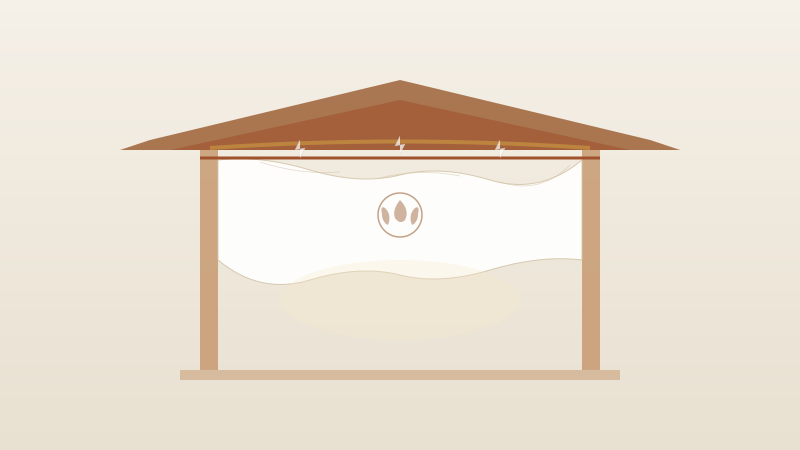
The Ancient Origins of Sacred Shrine Curtains — Cloth and Spiritual Power in Early Japan
Since ancient times, the Japanese have believed that cloth possesses spiritual power. Archaeological evidence from sites dating to the late Jomon and Yayoi periods reveals traces of plant-fiber textiles used in ritual contexts. In these early ceremonies, fabric was hung to create sacred boundaries — kekkai — that separated divine space from the everyday world. Priests would drape cloth around a designated area to welcome the kami, effectively transforming ordinary ground into consecrated territory. This practice is the direct ancestor of the curtains seen in modern Shinto shrines.
The mythology recorded in the Kojiki offers what may be the earliest literary reference to this custom. When the sun goddess Amaterasu retreated into the Rock Cave of Heaven, the myriad deities gathered before the cave to perform rituals and coax her out. Some scholars interpret this scene as describing cloth being stretched across the cave entrance to define the ritual space, suggesting that sanctifying an area with fabric is one of Shinto's most ancient practices. By the Nara period, court ceremonies employed formal draperies called ichou to partition ritual spaces within the imperial palace. During the Heian period, as shrine architecture grew more elaborate, the custom of hanging curtains in worship halls and main sanctuaries became firmly established.
The deep connection between cloth and the divine is preserved in the word heihaku, which refers to offerings presented to the gods. Originally, heihaku meant simply "cloth." Hemp and silk were among the most valuable commodities in ancient Japan, rivaling rice in importance. Offering these precious textiles to the kami was an act of supreme reverence. In this sense, cloth served as the most primordial medium connecting humans and gods, and shrine curtains represent the architectural embodiment of that ancient faith.
Types and Classification — Understanding Shrine Status Through Agemaku, Kabeshiro, and Micho
Several distinct types of curtains are used in Shinto shrines, each with a specific location and purpose. The most commonly encountered is the agemaku, a white cloth hung horizontally across the front of the worship hall. The agemaku is the first curtain worshippers see upon approaching, and it communicates a clear visual message: "Beyond this point lies sacred ground." Typically, the agemaku consists of a single rectangular sheet of fabric, fastened along its upper edge with cords and allowed to hang freely.
The kabeshiro is an inner curtain installed within the innermost sanctuary. It functions as the final barrier preventing anyone — even most priests — from directly viewing the shintai, the sacred object that serves as the physical vessel of the enshrined deity. At Ise Grand Shrine, multiple layers of kabeshiro shield the sacred mirror with extraordinary care, heightening the aura of mystery surrounding the holiest space in Shinto.
The micho is a canopy-like curtain suspended from above that conceals the divine seat. This type is also used in the Imperial Palace's Kashikodokoro sanctuary, where it screens the sacred mirror venerated by the emperor. Additionally, during festivals, jinmaku — field curtains — are stretched along pathways and around stages within shrine precincts to demarcate ritual zones and create an atmosphere of sacred spectacle. Each type of curtain is selected according to the shrine's rank and the character of its enshrined deity, making curtains an integral element of shrine architecture.
The Spiritual Meaning of Colors and Crests on Sacred Curtains
The color of a shrine curtain is far more than an aesthetic choice — it carries deep spiritual significance. White is the most sacred color in Shinto, symbolizing purity, innocence, and primordial beginnings. A white curtain represents "untainted purity" and has been the predominant color for shrine fabrics since antiquity. The same philosophy explains why white vestments are standard attire for Shinto rituals.
Purple curtains signify the highest rank and formality. The reverence for purple originated in ancient Chinese color theory and was adopted in Japan's Twelve Level Cap and Rank System, where purple occupied the supreme position. In shrine settings, purple curtains are generally reserved for imperially designated shrines, ichinomiya provincial shrines, and sanctuaries enshrining deities closely linked to the imperial lineage. Spotting a purple curtain is a reliable indicator of a shrine's exceptional historical prestige.
Red-and-white curtains are associated with celebrations. They adorn shrine precincts during festivals and joyous occasions, adding a festive vibrancy to the atmosphere. The red-and-white color combination is a distinctly Japanese symbol of good fortune, deeply intertwined with Shinto festivities. In contrast, ceremonies related to mourning may employ curtains in white and black or muted gray tones.
The crests dyed into curtain fabric serve as important identifiers of the enshrined deity and the shrine's lineage. The tomoe crest — especially the triple tomoe — is closely associated with Hachiman shrines and is said to represent the motion of a dove's wings or the spiral of water. The chrysanthemum crest signals a connection to the imperial household, while the paulownia crest appears at shrines influenced by the Toyotomi clan. Inari shrines often display rice-sheaf or fox motifs, and Izumo-lineage shrines favor the tortoiseshell pattern. Learning to read these crests on shrine curtains provides valuable insight into a shrine's spiritual genealogy.
Materials and Craftsmanship — The Evolution from Silk and Hemp to Synthetic Fibers
The materials used for shrine curtains have evolved over the centuries, but each material carries its own spiritual associations. Silk is considered the most prestigious fabric. Silk thread spun from silkworm cocoons has been regarded as sacred since antiquity. The Nihon Shoki describes Amaterasu herself weaving cloth in the High Plain of Heaven, indicating that the act of producing silk was considered a divine endeavor. Prominent shrines such as Ise Grand Shrine and Meiji Shrine continue to use silk curtains to this day.
Hemp also holds a profound connection to Shinto. The hemp plant — taima — has long been indispensable to sacred rites, and cloth woven from hemp fibers was believed to possess purifying power. This sacred quality is reflected in the name Jingu Taima, the term for the talisman distributed from Ise Grand Shrine. Hemp curtains have a coarser texture compared to silk, but this very rusticity evokes an atmosphere of ancient authenticity.
Since the modern era, synthetic fibers such as polyester and nylon have become widespread in shrine curtain production. Synthetic materials offer superior durability and resist degradation from rain and wind, making them practical for outdoor use. They are also significantly less expensive than silk or hemp, which has led to their adoption at shrines throughout the country. Nevertheless, shrines that place a premium on tradition and important ritual occasions continue to use curtains made from natural fibers. Shrine curtains are crafted by specialized ritual-implement workshops, where techniques such as stencil dyeing and hand-painting are passed down through generations. It is not uncommon for a single curtain to require several weeks to complete.
Curtains and Kekkai — The Relationship with Shimenawa and Shide
Shrine curtains stand alongside shimenawa (sacred ropes) and shide (zigzag paper streamers) as fundamental components of Shinto's system of kekkai — sacred barriers. While shimenawa function as markers that declare "this is a sacred place," curtains play a more active role by physically concealing the sacred space from view. In other words, shimenawa indicate a boundary, whereas curtains create one.
Shide are white paper strips attached to shimenawa and curtains, cut in a shape resembling lightning bolts. When shide are affixed to a curtain, the fabric transcends its status as mere cloth and takes on the character of a spiritually charged barrier device. During major rituals, curtains, shimenawa, and shide may be combined to construct a triple-layered kekkai. This multilayered structure reflects the Japanese concepts of kegare (impurity) and kiyome (purification). The idea of erecting multiple barriers to prevent the pollution of the outer world from penetrating the divine realm is rooted in a uniquely Japanese sense of spiritual cleanliness.
The misu, or bamboo blind, is a closely related sacred implement. Woven from thin strips of bamboo, the misu blocks the line of sight while allowing air to circulate — a distinctive function that separates the sacred from the profane in a manner different from opaque curtains. Beyond shrines, misu were long employed in the imperial court to screen the emperor from the view of his subjects, reinforcing the principle that sacred authority should remain partially hidden.
The Practical Role of Curtains in Festivals and Architectural Rituals
Shrine curtains appear not only within shrine precincts but across many facets of Japanese cultural life. Perhaps the most familiar example is the jichinsai, the ground-purification ceremony performed before constructing a building. At a jichinsai, bamboo poles are erected at the four corners of the site, shimenawa are strung between them, and white curtains are hung to enclose the ritual space. Through this simple arrangement, an empty plot of land is temporarily transformed into a consecrated zone. The same practice is observed at jotoshiki, the ridge-raising ceremony marking the completion of a building's structural frame.
Curtains are equally indispensable at major festivals. At Kyoto's Gion Matsuri, elaborate tapestries and curtains are draped on the towering yamaboko floats, and entire streets are decorated with fabric during the grand procession. At Osaka's Tenjin Matsuri, red-and-white curtains are stretched across the boats that carry portable shrines along the river, creating a floating ritual space on the water. In these large-scale celebrations, curtains contribute enormously to the spatial staging of the festival — without them, the extraordinary atmosphere that distinguishes festival time from ordinary life would be impossible to achieve.
Shinto wedding ceremonies also rely on curtains to establish the proper atmosphere. Special white curtains are hung in the shrine hall where the ceremony takes place, lending solemnity to the space where the bride and groom stand before the gods. These curtains visually express that the couple's new beginning is taking place under divine watch and blessing.
Sacred Curtains in the Modern Era — Japanese Wisdom for Making the Invisible Visible
In contemporary Japan, shrine curtains remain as vital as ever. From small urban neighborhood shrines to grand rural sanctuaries, the tradition of draping white cloth across worship halls has been maintained without interruption. This persistence speaks to the fact that curtains are not mere ornaments but physical embodiments of the Shinto worldview itself.
In Shinto theology, the kami are invisible beings. To enshrine and honor deities without form, the Japanese devised a method of implying divine presence through spatial division. The curtain is precisely this device — it communicates "a god dwells beyond this cloth" without the need for words. When worshippers catch sight of a curtain, they instinctively sense that they are approaching a special place. This psychological effect is the essential function of the shrine curtain.
Remarkably, the concept of using fabric to define sacred space is not unique to Japan. Judaism's Tabernacle employed curtains to separate the Holy of Holies, mosques use curtains in various ritual contexts, and Christian cathedrals historically featured veils before the altar. Yet the distinctively Shinto approach — dividing sacred and secular with a single sheet of white cloth while attributing spiritual power to the fabric itself — possesses a purity of concept that sets it apart from these parallels.
Shrine curtains are crystallizations of the Japanese capacity for giving visible form to the invisible. Even in an age of advanced science and technology, the sight of a white curtain stirring in the breeze before a shrine evokes a quiet sense of reverence in the hearts of those who behold it. This faith — at once simple and profoundly deep, capable of separating the sacred from the secular with nothing more than a single piece of cloth — will continue to serve as a vital bridge connecting shrines and the daily lives of the Japanese people for generations to come.
About the Author
Shrine Secrets Editorial TeamWe uncover the hidden secrets of Japanese shrines and Shinto, making them accessible to everyone.
View author profile →Related Articles
The Mystery of Genbu Faith: Why the Turtle-Serpent Guardian of the North Appears in Shrines
The Mystery of Shimekiri Rituals: The Sacred Act of Cutting the Shimenawa
The Mystery of Karakuri Puppets: Mechanical Marvels Offered to the Gods
The Mystery of Gokoku Shrines: Enshrining the War Dead as Deities in Modern Japan