The Mystery of Shrine Plaques — Word Spirits and Authority Inscribed on the Hengaku Above Torii and Halls
The hengaku plaque mounted above a torii or shrine hall is far more than a signboard — it is a sacred object that materializes the word spirit and authority residing in the very name of the shrine. From rank determined by the calligrapher's status, to the special meaning of imperial chokugaku plaques, to the symbolism of script styles, to celebrated examples surviving today, we uncover the other face of the shrine inscribed on its plaque.
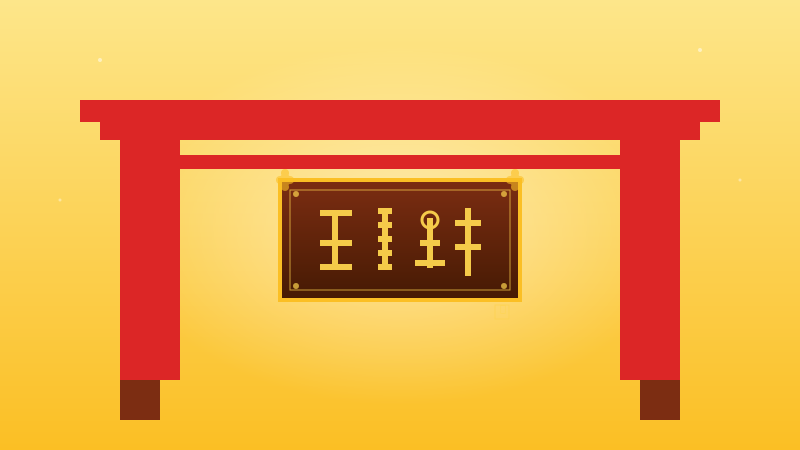
What Is a Hengaku — A Sacred Object That Embodies a Shrine's Name
Above the upper beam of a torii, on the front facade of a worship hall, or at the entrance of a main hall, you will almost always see a horizontally formatted plaque mounted in a place of importance. This is the hengaku, also called shingaku, on which the shrine's name (shago), enshrined deity, or honored phrase is inscribed. At first glance it might appear to be merely a "shrine signboard," but the hengaku is in fact an object of religious significance in its own right — a sacred body that condenses the formal rank, lineage, and authority of the shrine.
The hengaku has its origins in ancient China, where plaques mounted on palace gates and city walls evolved as devices that displayed the authority of the imperial court. This tradition was transmitted to Japan during the Asuka and Nara periods, where it first spread on the temple gates of Buddhist institutions as the sango plaque, the "mountain name" sign that named the temple's mountain identity. Hengaku began to be used at shrines from the Heian period onward, and from the medieval into the early-modern period the form spread widely across Japan.
Most hengaku are made of wood, with characters carved into high-quality boards of zelkova, cherry, hinoki cypress, or cedar. There are two principal carving techniques: inkoku (incised) and youkoku (raised). Inkoku carves the characters into the surface; youkoku removes the surrounding area so that the characters stand in relief. After carving, the characters are finished with gold leaf, gold powder, or ink, and over the years a hengaku gradually takes on its own distinctive bearing. Some hengaku are made of metal or stone, particularly those at shrines associated with Ise Jingu and other ancient high-ranking institutions.
Rank Determined by the Status of the Calligrapher
One of the most fascinating features of the hengaku is that its formal rank is determined by who wrote the characters. In Japan, where the tradition of calligraphy runs deep, kigou — the very act of writing — has been regarded as a sacred gesture, and the social standing and moral character of the writer are believed to enter into the strokes. This is a culture in which the philosophy of word spirit (kotodama) and the aesthetic of "calligraphy is the person" combine in a uniquely Japanese way.
The highest rank of hengaku is the shinpitsu, the inscription written by the emperor himself. Just below this stand inscriptions by members of the imperial family, then chokugaku — plaques created on imperial command. After these come inscriptions by chancellors, regents, and other senior court officials, by the Tokugawa shoguns, by daimyo lords of the various domains, and by celebrated calligraphers. A hierarchy of formal rank thus structures the world of hengaku. By tracing the calligraphers of a shrine's hengaku, one can read the political and cultural position the shrine has occupied in history.
For example, the hengaku reading "Tenmangu" mounted on the rohmon gate of Kitano Tenmangu in Kyoto is said to be the personal calligraphy of Emperor Gokoumyo, marking it as a hengaku of the highest rank. The hengaku reading "Yasaka Jinja" on the south gate of Yasaka Shrine, also in Kyoto, is by a Shoren-in monzeki, reflecting the rank of an imperial-lineage temple. At regional shrines, by contrast, hengaku are often inscribed by famous calligraphers of the Meiji or Taisho era, or by local literati and politicians, carrying their own significance as documents of regional cultural history.
The first time I encountered the existence of a chokugaku was while reading the explanatory panel at an old shrine in Kyoto. "This plaque was inscribed in the early Edo period at the imperial command of an emperor." I tilted my head almost involuntarily and looked up at the plaque above the torii. Characters written more than three hundred years ago still hang in the same place, weathered by rain and wind, still greeting worshippers — that simple fact gave me a sense of the temporal weight pressed into a hengaku. When you realize how much layered history and authority is inscribed on a single plaque you might otherwise glance past, the experience of worship itself begins to look different.
The Special Meaning of the Chokugaku — A Symbol Linking Emperor and Shrine
Among hengaku, the chokugaku occupies a special position. The chokugaku is a hengaku created by imperial command, and to receive one is regarded as the highest of honors for a shrine. The chokugaku is no mere ornament — it functions as material evidence that the shrine has received formal recognition from the imperial court and bears a part in national-level ritual.
The chokugaku system was organized between the Nara and Heian periods. The kansha (state shrines) listed in the Engishiki Jinmyocho held the right to receive heihaku offerings from the court, and among these the most important shrines were sometimes granted a chokugaku. In the medieval period, as the authority of the imperial court declined, the bestowal of chokugaku diminished. With the Edo period, however, the chokugaku system was reactivated as a device symbolizing the renewed authority of the court.
During the Meiji era the shrine system was extensively reorganized, and ranks such as kanpei-taisha and kokuhei-taisha were institutionalized. Accompanying this, instances in which the imperial household bestowed plaques again increased, and major shrines including Ise Jingu, Izumo Taisha, Yasukuni Jinja, and Meiji Jingu came to mount plaques associated with the imperial household. These hengaku are not merely material ornaments but precious heritage symbolizing the relationship between imperial household and shrine in modern Japan, carefully preserved to this day.
Chokugaku share several typical features. First, the plaque itself is large. Second, gold leaf and gold powder are used generously, and the ornament is splendid. Third, the frame carries imperial crests such as the chrysanthemum. Fourth, the back or sides of the plaque often record the date of bestowal and the circumstances of the imperial command. Observing a hengaku with these features in mind helps you guess whether it might be a chokugaku, and offers a clue to reading the historical position of the shrine.
Symbolism in Script Style — How Kaisho, Gyosho, and Tensho Are Chosen
The characters on a hengaku carry symbolic meaning through the script style. Japanese calligraphy uses five principal scripts — kaisho (regular), gyosho (semi-cursive), sosho (cursive), tensho (seal), and reisho (clerical) — and a hengaku selects from these according to context.
The most formally elevated script is tensho. Close to the pictographic forms of ancient Chinese characters, tensho prizes ornament and mystery over modern legibility, and is widely used on the shago plaques of shrines and the sango plaques of temples. Tensho is hard to read, but precisely because of this difficulty the script functions as a "sacred pattern" — the characters lift the worshipper's awareness out of the ordinary.
Kaisho is the most standard script and appears widely on hengaku at shrines built during and after the Meiji era. The characters are easy to read, reflecting the modern character of "a shrine where citizens are broadly invited to worship." Gyosho, an intermediate script between kaisho and sosho, combines flowing motion with legibility and is often chosen for inscriptions by celebrated calligraphers.
The choice of script can also relate to the character of the enshrined deity. At Tenmangu shrines, which enshrine Sugawara no Michizane, the deity himself was renowned as a literary figure and calligrapher. As a result, flowing gyosho or sosho is often chosen, and the script can be read as a reflection of the deity's own personality. The fact that the highest reaches of calligraphy are selected for shrines enshrining a god of learning shows that the hengaku is more than a sign — it carries the meaning of an offering to the deity.
Famous Hengaku Across Japan — Plaques That Speak History
Across Japan, many shrines preserve hengaku of extraordinary value in the history of calligraphy. The hengaku reading "Romon" on the romon gate of Fushimi Inari Taisha in Kyoto is said to be by an Edo-period master, and although countless visitors look up at it, few register its quality — a hidden masterpiece in plain sight.
The hengaku reading "Kasuga Taisha" on the south gate of Kasuga Taisha in Nara is the work of Kusakabe Meikaku, a famous calligrapher of the Meiji era, and is indispensable to the modern history of Japanese calligraphy. Kusakabe was a leading calligrapher of the Meiji period, on close terms with politicians such as Ito Hirobumi and Okuma Shigenobu, and his inscriptions remain on plaques across Japan's shrines and temples.
The plaque of the south torii at Meiji Jingu in Tokyo was bestowed by the imperial household at the time of the shrine's founding and is a symbol of the relationship between the imperial household and Shinto in modern Japan. Each New Year's Day, vast numbers of worshippers pass beneath it. The plaque "Tosho Daigongen" on the Yomeimon gate of Nikko Toshogu is said to be the work of a master in the time of Tokugawa Iemitsu, holding a vital place within the architectural beauty of the entire Toshogu.
In the regions, plaques inscribed by Meiji-era politicians, military figures, and literati abound. Shrines in Yamaguchi (former Choshu) carry inscriptions by Ito Hirobumi; shrines in Kagoshima carry inscriptions by Saigo Takamori; the shrines of Ueno in Tokyo carry inscriptions by Nogi Maresuke. The figures who shaped modern Japan continue to leave their names through these hengaku. Visiting them in turn becomes, in itself, a journey through modern Japanese history.
Preservation and Restoration — Sacred Objects That Endure Wind and Rain
Because hengaku are most often mounted outdoors, deterioration from wind, rain, ultraviolet light, temperature changes, and insects is unavoidable. Preserving and restoring hengaku of cultural value is an essential responsibility for shrines, and continuous care by specialists is required.
In traditional restoration, the plaque is first carefully removed, and surface contamination is cleaned by both dry and wet methods. Lost gold leaf is supplemented with new gold leaf, and missing carved sections are repaired with the same wood. Coatings often use natural lacquer, and even today craftsmen of Kyoto's lacquer trade and Tokyo's miyadaiku temple-shrine carpenters continue to inherit the traditional techniques. Full-scale restoration may require months to over a year of work and costs ranging from several million to several tens of millions of yen.
In recent years, the practice of "doubling the hengaku" has grown — the original is preserved indoors while a replica is mounted outdoors. Major shrines such as Ise Jingu and Meiji Jingu have implemented this practice to keep originals from direct exposure to the elements. The replicas are crafted with such precision that they are nearly indistinguishable from the originals, an excellent strategy for protecting cultural assets without compromising the worshipper's experience.
Advances in digital technology have also enabled high-resolution recording through 3D scanning. The Kyoto National Museum and the Tokyo National Research Institute for Cultural Properties continue projects to scan important hengaku across the country and preserve them as a digital archive. Should an original ever be lost, accurate replicas can now be produced.
The Pleasure of Reading a Hengaku — A Gaze That Adds Depth to Worship
For worshippers, paying attention to the hengaku is one of the surest ways to enrich the experience of a shrine visit. Pausing briefly before passing under the torii, looking up at the plaque, and observing its characters, the calligrapher's seal, and the ornament of the frame allows you to infer something about the historical and cultural position of the shrine.
There are several useful points for "reading" a hengaku. First, identify the script style. Tensho suggests an old shrine of high formal rank; kaisho suggests construction from the Meiji era onward; gyosho suggests inscription by a modern calligrapher. Second, look for the calligrapher's name. The signature or seal mark in small characters at the lower right or left of the plaque is a key clue to identifying the writer. Third, observe the ornament of the frame. Crests such as the chrysanthemum or paulownia, associated with the imperial family or court nobility, indicate elevated rank.
On an evening commute home, I once happened to stop at a small neighborhood shrine and looked up at its hengaku, dimly illuminated by a streetlight. The script was an old gyosho, and the calligrapher's name had faded almost beyond reading. Yet the flow of the strokes still carried the warmth of "someone wrote this." Whether centuries or only decades ago, there had truly been a moment when a person took up a brush and bore down on this board. Just imagining that moment, the small neighborhood shrine I passed every day suddenly stood up in time, gathering the depth of years. The hengaku is also a window through which the breath of past human beings still reaches us.
Word Spirit and Authority — What Hengaku Carry Forward Today
The reason a hengaku is more than a signboard is that it materializes the word spirit. In Japan's ancient kotodama thought, words themselves were believed to hold spiritual power, and to speak, write, or even see the name of a god was itself an act invested with sacred force. The shrine name written on a hengaku functions as a device that calls forth the very deity of the shrine and lowers divine authority over those who look up at it.
At the same time, the hengaku is a symbol of authority. A plaque whose rank is determined by the status of its calligrapher is material evidence of the position the shrine has occupied in relation to the state, the imperial court, and the local community. A single plaque condenses more than a millennium of relationships between a shrine and political authority, and reading it amounts to reading Japanese history itself.
Those of us alive today have undergone a profound shift in our relationship with the written word. In an age of overflowing digital characters, opportunities to encounter handwritten script are startlingly rare, and the chance to bring our awareness to characters carved by human hand into a wooden plaque is rarer still. The hengaku is precious cultural heritage that conveys, against the contemporary sense, the memory of a time when written characters were sculptural beings bearing material, authority, and prayer all at once.
The next time you visit a shrine, pause for a moment before passing under the torii and look up at the plaque mounted above. There, layered in quiet silence, lie not only the name of the shrine but the life of the person who wrote it, the prayers of those who dedicated it, the texture of wood that has endured centuries of weather, and the power of the word spirit that calls forth the deity. The story a single plaque tells will speak more eloquently than almost any other element of shrine architecture about the history of that shrine.
About the Author
Shrine Secrets Editorial TeamWe uncover the hidden secrets of Japanese shrines and Shinto, making them accessible to everyone.
View author profile →Related Articles
The Mystery of Shrine Ceiling Paintings — Dragons and Flowers Above Worshippers and the Faith They Carry
The Mystery of Yabusame — Prayers and History Embedded in the Sacred Ritual of Mounted Archery
The Mystery of White Snake Worship — Why the White Serpent Is Seen as a Divine Messenger of Wealth and Renewal
The Mystery of Human Sacrifice — Legends of Lives Offered to the Gods and Their Traces Across Japan