The Mystery of Yabusame — Prayers and History Embedded in the Sacred Ritual of Mounted Archery
Yabusame is the sacred ritual in which a galloping rider shoots three targets with whistling kabura arrows. Tracing its revival by Minamoto no Yoritomo, its role in divining the harvest, the symbolism of the rider's costume, and the traditions preserved at Tsurugaoka Hachimangu and Shimogamo Shrine, we uncover the essence of yabusame not as martial display but as prayer.
What Is Yabusame — Mounted Archery as Offering to the Gods
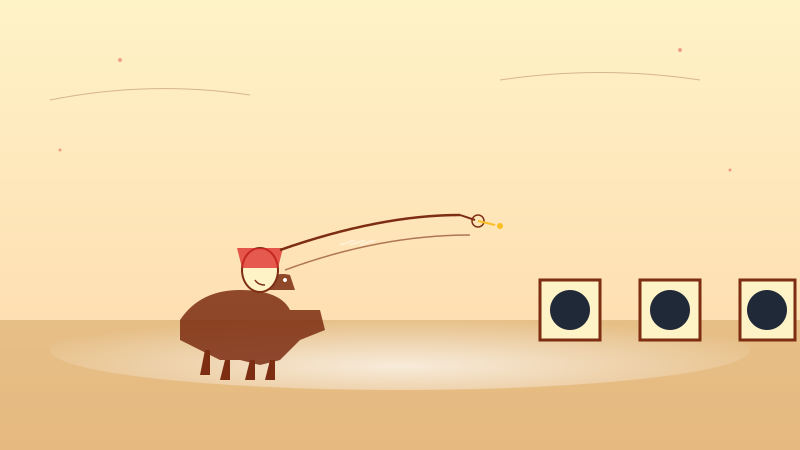
Yabusame is a sacred ritual in which an archer shoots three targets in sequence from atop a galloping horse. The rider charges down a straight track approximately 255 meters long, called the baba, and looses kabura whistling arrows at three targets arranged on the left side. The kabura arrow has a hollow sound device attached to its head, and as it cuts through the air it produces a piercing whistle. This sound itself has been believed since ancient times to possess the power to drive away evil. Yabusame has been preserved not as a martial display but as a solemn ritual that combines an offering to the gods with the purification of the community.
In modern Japan, yabusame is transmitted at several dozen shrines, including Tsurugaoka Hachimangu in Kamakura, Shimogamo Shrine in Kyoto, Towada Shrine in Aomori, and Miyajidake Shrine in Fukuoka. Each shrine maintains slight differences in timing and procedure, but the core structure is essentially shared: a horse runs at full speed, kabura arrows pierce wooden targets, and the resulting hits are interpreted as expressions of divine will. Since the 1990s, revival movements have spread across the country, and yabusame is now widely known not only to martial-arts practitioners but also to a broad public of visitors.
Several theories explain the etymology of yabusame. The most widely accepted is that the word derives from yahaseuma — "the horse that drives the arrow" — which over time contracted into yabusame. Another reading interprets ya-busame as "the kabura arrow that flows," emphasizing how the running horse causes the arrow to streak across the air. In either case, the dynamic union of running horse and flying arrow is inscribed in the very name.
Ancient Origins — Empress Jingu and the Tradition of Ceremonial Archery
The origins of yabusame trace back to ancient ceremonial archery rites. The Nihon Shoki records that Empress Jingu loosed an arrow to pray for victory before her expedition to Silla — one of the oldest references to archery as religious ritual in Japan. By the reign of Emperor Kinmei in the mid-sixth century, court archery had been formally institutionalized, with nobles gathering each New Year to shoot ceremonial bows and divine the year's fortune from their hits.
Mounted archery itself appears in Nara-period documents. The Shoku Nihongi records that during Emperor Shomu's reign, shaki (mounted archery) was performed at the imperial riding grounds, and this is regarded as the direct ancestor of yabusame. The shaki of that era incorporated elements of Tang-dynasty Chinese court ceremony, blending military training with rituals praying for abundant harvests.
In the Heian period, court archery became increasingly ceremonialized, while regional shrines began developing their own forms of mounted archery. At the Kamo shrines in Kyoto, the kamo-yabusame was performed alongside the kamo-kurabeuma horse race, becoming an essential ritual praying for harvest abundance and national peace. During this period, detailed conventions were established regarding the speed of the horse, the precision of the arrow, and the formality of the costume — and yabusame crystallized into a ritual that was simultaneously martial and highly ceremonial.
Minamoto no Yoritomo's Revival — Establishment as a Spiritual Discipline of the Warrior Class
The figure most responsible for establishing yabusame as a nationwide ritual was Minamoto no Yoritomo (1147–1199), founder of the Kamakura shogunate. Soon after entering Kamakura, in 1187 (Bunji 3), Yoritomo had yabusame offered at the principal festival of Tsurugaoka Hachimangu Shrine. This is regarded as the origin of Kamakura yabusame, and it continues today as the yabusame ritual at the shrine's September festival.
The deep reason Yoritomo prized yabusame lay in his need to construct a spiritual foundation for the warrior government. The essence of the samurai was said to lie in the way of bow and horse — the martial path of archery and equestrianism — and Yoritomo, by elevating this way as a religious offering, sought simultaneously to establish the sanctity of the warrior code and the legitimacy of warrior rule. The Kamakura-period chronicle Azuma Kagami records repeatedly how Yoritomo demanded rigorous yabusame practice from his retainers and dispensed rewards and punishments based on the accuracy of their shots.
Yoritomo is also credited with establishing the two great yabusame schools, Ogasawara-ryu and Takeda-ryu, both of which continue today as major lineages of transmission. The Ogasawara school traces its origins to the Ogasawara family of Shinano, and the Takeda school to the Takeda family of Kai. Each preserves its own conventions for the details of costume, the manner of holding the bow, and the technique of nocking the arrow. From the Kamakura through the Muromachi periods, yabusame functioned not merely as martial training but as a vital cultural form that expressed the rank of one's house and the dignity of the samurai.
What the Three Targets Mean — Targets That Divine the Year's Fortune
The most distinctive feature of yabusame is the structure of the course, with three targets arranged along its length. The archer calls the first target ichi-no-mato (the first target), the next ni-no-mato, and the last san-no-mato. They are placed approximately 45 meters apart, and the rider must shoot each in sequence as the horse charges past. The symbolic meaning of the three targets varies among shrines and schools, but the most widely transmitted reading interprets them as "heaven, earth, and humanity," or as "past, present, and future."
The results of the shooting have long been received as expressions of divine will regarding the year ahead. At some shrines, hitting all three targets is read as a sign of bountiful harvests and national peace; hitting two as a normal year; one, as a warning of misfortune; and missing all three as an indication that grave purification is required. At Tsurugaoka Hachimangu, the moment a target is struck the crowd erupts in great applause, and when one is missed a deep silence falls — a tension that preserves, almost without change, the awe before divine will that the people of Kamakura must have felt nearly a millennium ago.
The material of the target also carries religious meaning. The standard target is a square of cedar board roughly 55 centimeters on each side, with a black circle on its surface and sometimes the character oni ("demon") or another distinctive design at the center. Fragments of broken targets are said to "share the fortune of the hit" and are sometimes distributed to spectators by the shrines. People place these fragments on household shrines or in their wallets, treating them as guarantees of safety for the coming year.
When I first watched the yabusame at Tsurugaoka Hachimangu, the moment when the sound of hooves striking the gravel overlapped with the sharp whistle of the kabura arrow, I realized I had stopped breathing. An older man standing beside me quietly murmured, "That was a fine sound." The phrase stayed with me. Looking into it later, I learned that the quality of the kabura's whistle reflects the very way the archer draws the bow, and the spectators are themselves drawn into the ritual through the air. It is not so much watching as praying alongside — and there really is, at the site of yabusame, that strange shared quality.
The Symbolism of the Costume — The Pinnacle of Samurai Dress
The yabusame archer wears a distinctive costume that seems to step out of a medieval scroll painting. The basic elements include the ayaigasa, a hat woven from rush, the suikan, an upper garment in the style of Heian aristocracy, the natsukage or mukabaki — leg coverings made of deerskin — and revival riding boots called monoigutsu. Colors vary with school and rank, but white and purple often dominate, expressing simultaneously "the purity of one who serves the gods" and "the dignity of the warrior."
The mukabaki are particularly striking. These are protective coverings of deerskin extending from leg to hip. They serve practical purposes, shielding the rider from the horse's sweat and from thorns of grass, but they also carry sacred meaning rooted in the ancient belief that "deer are messengers of the gods." The color and pattern of the deer fur indicate the archer's school and rank, and even the direction in which the hairs lie at the edge of the garment is governed by formal convention.
The bow used is the traditional Japanese shigeto-yumi, approximately 220 centimeters in length and shaped to be manageable on horseback. The arrows include the kabura whistling arrow as well as the sesshou-ya, a sharp-tipped war arrow used in martial competition. Religious rituals use the kabura, while special martial trials use the sesshou-ya. The material of the arrowhead, the species of bird whose feathers form the fletching, and the wood of the shaft are all minutely prescribed by school, and a single arrow can take days to complete.
Yabusame Across Japan — Diverse Local Traditions
Yabusame has developed in distinctive ways across regions, taking on the character of each locale. At Tsurugaoka Hachimangu in Kamakura, the orthodox conventions of the Ogasawara school are maintained, and the ritual is celebrated as the flowering of warrior culture. At Shimogamo Shrine in Kyoto, by contrast, yabusame is performed as the prelude to the Aoi Festival on May 3, dressed in costumes that retain the elegant atmosphere of the Heian aristocracy.
At Towada Shrine in Aomori, the uranai-ba yabusame is preserved with strong elements of divination, in which the hits foretell the year's harvest of fish and crops. At Miyajidake Shrine in Fukuoka, the ritual is descended from a distinct Kyushu equestrian tradition that predates samurai society, and is associated with the legends of Empress Jingu. Other Kyushu yabusame, including those at Yutoku Inari Shrine in Saga and Udo Shrine in Miyazaki, preserve their own local conventions.
In eastern Japan, yabusame is performed at Imizu Shrine in Toyama, Tomisato-Katori Shrine in Chiba, and Nasu Shrine in Tochigi. Each preserves a distinct meaning rooted in samurai genealogy, regional history, and agricultural ritual. Rather than a single centralized convention, this rooted diversity is the deep wealth of Japanese yabusame culture.
Yabusame Today — Both Martial Discipline and Prayer
Modern yabusame combines two faces: a sacred ritual transmitted through the shrines, and a martial art and sport that continues to develop. As martial discipline, yabusame is organized through bodies such as the Japan Equestrian Federation and the All Japan Kyuba Society, which hold regular competitions and examinations. The archers who appear at the rituals at Kamakura and Kyoto have trained for many years within these organizations and have been selected through rigorous evaluation.
Training the horse takes equally long. A yabusame horse must do more than gallop — it must be trained not to react to the whistle of arrows or the cheers of crowds, and to run straight down the course without deviation. The trust between horse and archer cannot be built quickly, and competing archers ordinarily train with a single horse for years. Without aligned breath between rider and mount, no hit is possible. Here crystallizes the distinctive Japanese philosophy of jin-ba ittai — "horse and human as one body."
Since the 2020s, yabusame has drawn increasing international attention, with growing numbers of visitors and martial-arts practitioners participating from abroad. Research and enthusiast groups have been founded in the United States, France, Germany, and elsewhere, and members of these groups regularly travel to Japan for training. Yabusame has come to symbolize "Japanese samurai culture" and stands as a cultural asset projecting Japan to the world.
What Yabusame Tells Us Today — Concentration and Prayer Compressed Into a Single Shot
The essence of yabusame lies not in the technique of hitting a target but in the discipline of compressing everything into a single shot. The horse moves at thirty to forty kilometers per hour, the target stands only a few meters away, and the window of decision is roughly three-tenths of a second. In this extreme compression, the archer steadies the breath, clears the mind, fixes attention on a single point, and lets the arrow fly. Hit or miss is decided in the instant where skill, fate, and divine will intersect.
This discipline of "the single shot" carries unexpected wisdom for those of us living in the present age. In an era of overwhelming information and constant multitasking, opportunities to pour ourselves entirely into one act have become startlingly rare. Yabusame archers train for months in preparation for the few annual ritual occasions, condensing all that practice into mere tens of seconds of performance. This extreme discipline of focus shares its underlying structure with Zen's ichi-go ichi-e, the temae of tea ceremony, and the zanshin of martial arts — a spiritual structure common to Japanese culture as a whole.
On nights when work has stalled and I have stayed at my desk into the small hours, I sometimes find myself thinking of the yabusame archer. They too, after months of practice, stand at the head of the course for a single shot. What lies before that shot is not technique, not competition, but the resolve to offer up everything they have prepared. Surely our daily lives, too, contain moments that deserve to be called "a single shot." Yabusame is a cultural inheritance that has, for more than a millennium, kept alive in the form of religious ritual the very gesture we so easily lose in modern life — the gesture of staking everything.
The rhythm of hooves, the whistle of the kabura, the dry sound of a target splitting — this sequence of sounds resonates today in shrine precincts across Japan exactly as it resonated in the ears of Kamakura's people a thousand years ago. Yabusame is more than traditional performance. It is a uniquely Japanese form of prayer, in which human, horse, arrow, and god become, for a single instant, completely one.
About the Author
Shrine Secrets Editorial TeamWe uncover the hidden secrets of Japanese shrines and Shinto, making them accessible to everyone.
View author profile →Related Articles
The Mystery of White Snake Worship — Why the White Serpent Is Seen as a Divine Messenger of Wealth and Renewal
The Mystery of Human Sacrifice — Legends of Lives Offered to the Gods and Their Traces Across Japan
The Mystery of the Kuniumi Myth — The Deep Meaning Behind Izanagi and Izanami Birthing the Japanese Islands
The Mystery of Tezutsu Hanabi — The Fiery Shrine Offering Where a Single Worshipper Holds a Cylinder of Sparks