The Mystery of Kakebotoke — The Circular Metal Plaques That Preserve the Memory of Shinto-Buddhist Fusion
Circular metal plaques called kakebotoke, quietly displayed in shrine halls, are crystallized memories of the era when gods and buddhas were one. Discover this rare heritage that survived the Meiji separation.
What Are Kakebotoke? Sacred Implements That Engrave Divine Forms into Metal
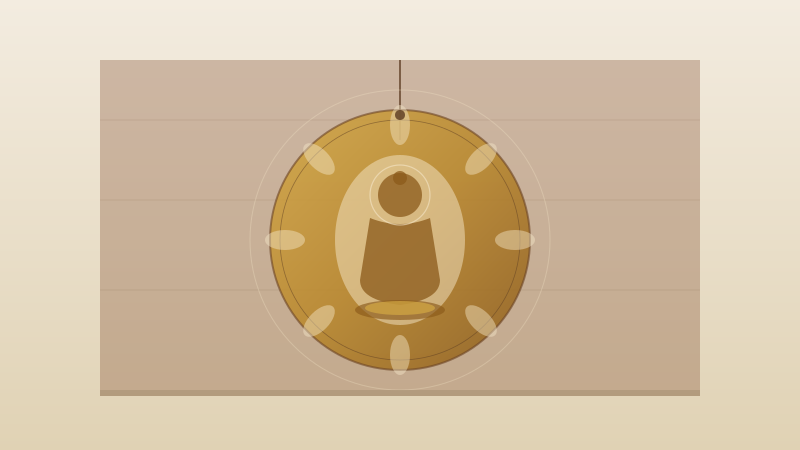
Kakebotoke are circular plaques — typically made of copper or iron — bearing embossed images of buddhas or bodhisattvas, mounted inside shrine halls or Buddhist sanctuaries as objects of worship. Their diameters range from a modest ten centimeters to nearly a meter in impressive examples. At the center, a honjibutsu — an "original ground buddha" — is either chased directly into the plate with a chisel or cast separately and affixed to the disc. The outer rim often features lotus or scrolling vine motifs, a design vocabulary drawn from temple architecture and bronze mirrors.
Kakebotoke are not simply works of art. They were treated as the shintai — the divine embodiment of a kami itself — or as objects second only in sanctity to the shintai. In Shinto, the kami have no inherent physical form, but during the long era of Shinto-Buddhist syncretism, the doctrine of honji suijaku emerged, holding that the kami were in fact manifestations of buddhas who had appeared in Japan to save its people. Based on this doctrine, the buddha's true form could be engraved in metal and hung within a shrine, allowing worshippers to venerate both kami and buddha simultaneously through a single object.
Most surviving kakebotoke date from the late Heian, Kamakura, and Muromachi periods. Many are designated as Important Cultural Properties or even National Treasures. Examples preserved at Kumano Nachi Taisha, Kumano Hongu Taisha, Kasuga Taisha, and Iwashimizu Hachimangu offer first-rate testimony to the refined metalwork and profound faith of medieval Japan.
From Mishotai to Kakebotoke — The Fusion of Mirror Worship and Buddhist Art
Tracing the origins of kakebotoke leads back to ancient Japanese mirror worship. In Shinto, mirrors have long served as shintai. The Yata no Kagami, symbol of the sun goddess Amaterasu, is the most famous example, but countless shrines throughout Japan have enshrined bronze mirrors as vessels for the divine spirit. When Buddhism took deep root in the Heian period, a novel form of expression emerged: the kyozo, or "mirror image," in which a buddha figure was incised on the reverse of a bronze mirror.
The kyozo was a remarkable innovation that united the spiritual power of the mirror with the salvific promise of the buddha. From the mid-Heian period onward, this form developed further — the central portion of the mirror was hammered outward to create a three-dimensional buddha image. This intermediate form, known as mishotai, became the direct ancestor of kakebotoke.
During the Kamakura period, mishotai grew even more sculptural, with buddha figures projecting dramatically from the disc. It also became common to cast a buddha image separately and attach it to the center of the plate. This later form is what is generally called kakebotoke today. In other words, kakebotoke represent a uniquely Japanese religious art that emerged from the fusion of indigenous mirror worship with Buddhist iconography imported from the continent. The roughly five-century evolution from bronze mirrors to kakebotoke offers a precious record of how the Japanese absorbed foreign religions and wove them seamlessly into their own spiritual fabric.
The Philosophy of Shinto-Buddhist Syncretism
To understand kakebotoke, one must grasp the philosophy of Shinto-Buddhist syncretism — shinbutsu shugo — that lies behind them. When Buddhism arrived in Japan in the sixth century, it initially clashed with the indigenous veneration of kami. By the Nara period, however, the two traditions began to merge. Eminent monks such as Gyoki, Kukai, and Saicho established the institution of jingu-ji — "shrine temples" built within shrine precincts where sutras were chanted on behalf of the kami.
In the Heian period, the theory of honji suijaku became fully articulated. According to this doctrine, the kami of Japan were in fact buddhas and bodhisattvas who had taken on local forms — suijaku-shin, "trace deities" — in order to save the beings of this land. Their true, original nature — honji — was that of a buddha. The great Kami Ketsumiko of Kumano Hongu Taisha was identified with Amida Buddha; Amaterasu of Ise was paired with Dainichi Nyorai; Hachiman was linked to Amida; and so on. For every major kami, a corresponding honjibutsu was established.
This framework did not pit Shinto kami against Buddhist deities but rather integrated them as "two manifestations of a single reality." For the Japanese, it meant that neither rejecting the foreign buddhas nor abandoning the ancestral kami was necessary. Both could be revered together. Kakebotoke are perhaps the most direct and visible artistic expression of this honji suijaku philosophy.
Craftsmanship and Artistic Value — The High Art of Chisel and Lost-Wax
The creation of kakebotoke demanded highly advanced metalwork. The base disc was most commonly copper, though iron and — rarely — gilded bronze examples also survive. The plate was hammered out to a thickness of a few millimeters, a preliminary design was drawn upon it, and the technique of uchidashi — chiseled repoussé — was used to raise the patterns from behind. Dozens of specialized chisels were employed to control line thickness, depth, and subtle expressive details.
The central buddha figure was rendered either in high relief rising directly from the plate or cast separately and welded or riveted into place. In Kamakura-period kakebotoke, separate cast figures became increasingly common, reflecting both the advancement of bronze casting technology and an evolving aesthetic that prized three-dimensional presence. The lost-wax casting method — roogata — allowed for remarkably fine detail.
Surface finishes sometimes included gilding or lacquer work. Kakebotoke that today appear muted and dark were often originally gleaming gold. Illuminated by oil lamps in the darkened interior of a shrine hall at night, such gold-surfaced kakebotoke must have created an overwhelming visual experience, evoking an intense sense of divine presence in worshippers.
I remember one early morning at an old regional shrine when a round shadow in the dim worship hall caught my eye and made me stop. Moving closer, I realized it was a kakebotoke. It must have hung on that pillar for centuries, and the sheer quietness of it struck me in an unexpected way. I was going through a stretch of feeling stuck at work, and that small recognition — that my troubles were a blink in the long patience of things — stayed with me for days.
The Meiji Separation and the Fate of Kakebotoke — What Was Lost and What Was Saved
The thousand-year tradition of Shinto-Buddhist syncretism came to an abrupt institutional end with the Meiji government's Separation Edict of 1868. Seeking to establish Shinto as the core of state ritual, the new regime moved systematically to purge Buddhist elements from shrines. During the resulting frenzy of anti-Buddhist destruction — haibutsu kishaku — many shrine-temples were demolished, and Buddhist images and ritual implements were burned, sold off, or thrown into rivers.
No category of object was more gravely endangered than kakebotoke. Though enshrined within Shinto sanctuaries, their visible form was unmistakably Buddhist. Across Japan, countless kakebotoke were removed and either destroyed or transferred to Buddhist temples. Fortunately, at some shrines, chief priests and lay parishioners quietly protected these objects. They were hidden in the depths of treasure halls, and local traditions tell of kakebotoke buried in the earth to preserve them until safer times.
The kakebotoke visible today in museums, art galleries, and a handful of shrine treasure houses are precious survivors of this ordeal. The Kumano Sanzan, Iwashimizu Hachimangu, Matsunoo Taisha, and Hiyoshi Taisha preserve significant collections of kakebotoke rated as Important Cultural Properties, offering vivid windows into the rich spiritual world of the age of syncretism.
How to Appreciate Kakebotoke — Reading Region, Era, and Form
Thousands of kakebotoke survive across Japan, each region displaying distinctive characteristics. Kumano-lineage kakebotoke frequently feature Amida Nyorai as the honjibutsu of Ketsumiko, Yakushi Nyorai for Hayatama, and Senju Kannon for Musubi — a pattern that reflects the nationwide reach of Kumano devotion. Hachiman-lineage kakebotoke typically show Amida or Hachiman Daibosatsu, reflecting the medieval warrior class's embrace of the deity.
The period of production also affects appearance. Heian-era kakebotoke feature relatively shallow relief and gentle, serene expressions. Kamakura-era examples are bolder, with figures projecting dramatically and adopting a more realistic sculptural vocabulary. Muromachi-period kakebotoke tend toward increased ornamentation and elaborate border designs. Edo-period works occasionally show signs of standardization and workshop production.
When you encounter a kakebotoke in a shrine's treasure hall, try first to identify the central buddha. Mudras (hand positions), attributes (such as the medicine pot of Yakushi or the lotus of Kannon), and headdresses all provide clues to the figure's identity — and by extension, to the kami whose original form is represented. Once you decode the iconography, the medieval spiritual lineage of the shrine becomes surprisingly legible.
The Enduring Significance of Kakebotoke — Forerunners of Multicultural Coexistence
More than a century and a half after the separation of Shinto and Buddhism, it now feels entirely natural that shrines and temples are distinct institutions in modern Japan. Yet standing before a kakebotoke, one cannot help but realize how flexibly the Japanese once received religious traditions and sublimated them into unique forms. The wisdom of accepting Buddhism without surrendering Shinto — of placing the two in dialogue rather than in conflict — deserves to be reevaluated in our globalized age as a pioneering model for coexistence among different cultures and faiths.
Once, over dinner, I mentioned kakebotoke to a relative who knows little about Japanese religion. Their reaction — "Wait, those still exist today?" — was almost exactly my own reaction when I first learned what kakebotoke were. The textbook version of history collapses a century of religious complexity into a single sentence: "In the Meiji era, Shinto and Buddhism were separated." But behind that sentence, actual physical objects — quietly persistent, stubbornly material — tell a far richer story that only reaches you when you see them in person.
Kakebotoke also serve as tangible evidence that Japanese religion is fundamentally non-exclusive. Rather than the exclusivist framework typical of monotheism, Japanese faith has long layered multiple divine presences in flexible combinations. The kakebotoke is perhaps the most vivid symbol of that flexibility. Next time you visit a shrine, look carefully at the walls within the main hall or the objects displayed in the treasure house. The buddha figures quietly chiseled into circular metal plates have spoken across a thousand years, and they still have much to tell us about the depth of Japanese spirituality.
About the Author
Shrine Secrets Editorial TeamWe uncover the hidden secrets of Japanese shrines and Shinto, making them accessible to everyone.
View author profile →Related Articles
Voices of the Age of Gods — How Sound and Vibration Reveal Shinto Cosmology
The Mystery of Kishōbun — Sacred Oaths Sealed with Blood Before the Gods
The Mystery of Obake-Tourou: The Giant Stone Lanterns That Tower Over Shrine Grounds
The Mystery of Light in Shrines — Hidden Illumination Design in Sacred Architecture