The Mystery of Light in Shrines — Hidden Illumination Design in Sacred Architecture
Why are shrine interiors kept dim? Discover the deliberate spatial design of light and shadow in Shinto architecture that creates an atmosphere of the sacred.
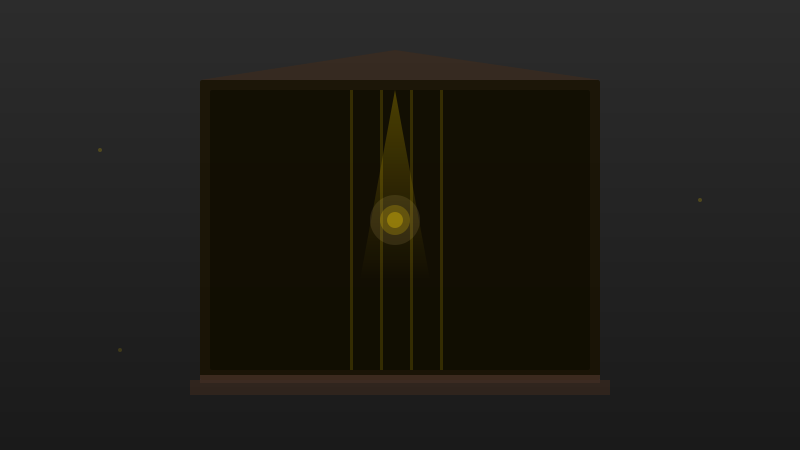
Darkness Is Where Gods Reside — Sacredness Within Dimness
In the Shinto tradition, gods — or kami — are inherently invisible beings. When we look to the myths of the Kojiki and Nihon Shoki, we find that when Amaterasu, the sun goddess, hid in the Ama-no-Iwato cave, the world was plunged into darkness, and it was within that darkness that the presence of the divine became most acutely felt. This principle of 'feeling what cannot be seen' is precisely what shrine architecture recreates through its deliberately dim interiors.
The honden, the innermost sanctuary behind the haiden (worship hall), is designed to be especially dark. This is a method of expressing divine invisibility as physical space. Ise Grand Shrine's shoden represents the ultimate example: ordinary visitors can barely see inside its structure. Surrounded by four layers of fences, the interior remains dim even at midday, and the sacred mirror Yata no Kagami rests in complete darkness. Sumiyoshi Taisha's honden likewise maintains extreme darkness through its distinctive Sumiyoshi-zukuri style. The gable-entry structure of its kirizuma roof minimizes light penetration, leaving worshippers to sense only the presence of the divine in the dark space beyond.
Psychological research has confirmed that dark spaces heighten feelings of awe in humans. When visual information is restricted, our other senses sharpen, making us more attuned to the atmosphere of a space and the subtle movement of air. A 2014 experiment conducted at the University of Amsterdam found that subjects placed in dimly lit rooms were approximately 40 percent more likely to report sensing a 'transcendent presence' compared to those in brightly lit rooms. The darkness of shrines functions as a device that heightens visitors' perceptual awareness and guides them into a psychological state removed from the everyday. It is precisely because one cannot see that awe is born, and because awe exists that faith deepens. Darkness is not fear — it is the condition for encountering the divine.
The Optics of Lattices and Gaps — Calculated Light Direction
The lattice doors and gaps in the plank walls of shrine architecture are not mere structural byproducts. They function as precisely engineered lighting instruments. Ancient shrine builders possessed deep knowledge of solar movement and incorporated seasonal variations in solar altitude into their architectural designs.
Consider a specific example. During the spring and autumn equinoxes, the sun rises due east and sets due west. Many shrine main halls are oriented to face east or south, and this directional alignment means that on specific days, light passing through lattices is calculated to illuminate the sacred object or mirror within. At Omiwa Shrine, where Mount Miwa itself serves as the shintai (sacred object), the arrangement ensures that morning sunlight streams into the haiden at the precise moment the sun crests the summit. At Usa Jingu as well, the axis of the main hall aligns with the direction of sunrise on the summer solstice, creating a phenomenon where light illuminates a specific position within the inner sanctuary only once a year.
The honden of Izumo Taisha stands approximately 24 meters tall — a massive structure — yet its interior is surprisingly dim. Light entering through narrow gaps creates a mysterious gradient of shadow across the vast space. This light shifts with the passage of time, presenting entirely different expressions in morning and evening. Ancient miyadaiku are said to have practiced 'hiyomi' — a multi-day solar observation — when determining the orientation of a building, meticulously recording the trajectory of light.
The depth of roof eaves is another critical element controlling illumination. Shrine eaves are typically far deeper than those of ordinary residential architecture, sometimes reaching 1.5 to 2 meters in projection. These deep eaves completely block direct sunlight while channeling only reflected light from the ground and white gravel (indirect light) into the building's interior. Indirect light is soft and even, gently moderating shadow contrast. In technical lighting terminology, shrine eaves function as massive louvers. This soft light is the key to producing the solemn atmosphere unique to shrines.
Gold and Vermillion Reflection — The Science of Materials That Shine in Darkness
The extensive use of gold leaf and vermillion lacquer in shrine interiors carries sound optical reasoning. Gold leaf achieves a reflectance of approximately 90 percent in the visible light spectrum, efficiently reflecting and radiating brilliance from even the faintest light. In a dim honden, gold leaf captures the slightest beam filtering through lattices and diffuses a gentle glow throughout the space. The lavish gold leaf ornamentation of Nikko Toshogu's Yomeimon Gate is designed so that even minimal reflected light causes the entire gate to glow golden, and its reflective effect achieves its most ethereal beauty on overcast days.
Vermillion pigment — composed primarily of mercuric oxide or iron oxide — strongly reflects red light at wavelengths above 600 nanometers. In dark environments, while rod cells dominate human vision, the sensitivity of cone cells to red wavelengths becomes relatively more pronounced, which means that vermillion appears more vivid than it would in bright conditions. The vermillion-lacquered pillars and railings that seem to float in the darkness exploit this visual characteristic. The sea corridors of Itsukushima Shrine achieve their deepest vermillion hues during the twilight hours of dawn and dusk, combining with reflected light off the water surface to produce an otherworldly spectacle.
Furthermore, lacquer coating possesses a distinctive deep luster. When dried, lacquer forms a micro-textured surface that reflects and refracts light in complex patterns, producing a luminous depth quite different from mirror reflection. Scientific analysis reveals that the surface of lacquer film contains regularly arranged microparticles measuring tens of nanometers in diameter, generating optical effects similar to structural coloration. The maki-e technique — sprinkling gold powder over lacquer and polishing it smooth — creates dynamic decorative effects that change expression with the angle of light. These material choices are rooted in a uniquely Japanese aesthetic sensibility: the understanding that certain materials reveal their true beauty in darkness rather than in brightness.
The Play of Light and Shadow Along the Sando — Spatial Design for Sacred Transition
The light design of shrines extends far beyond the buildings themselves, encompassing the entire sando, or approach path. At many shrines, the moment one passes through the torii gate, the light environment changes dramatically. Great trees planted along both sides of the path form dense canopies, creating a tunnel-like space where only dappled sunlight — komorebi — reaches the ground.
Meiji Shrine's sando is a quintessential example. Passing through the torii from the bustle of Harajuku, visitors enter an artificial forest of approximately 700,000 square meters that screens out the city's light and noise. As one advances along the path, the trees grow denser and the light progressively diminishes. Measured with a light meter, illumination near the first torii registers approximately 10,000 lux, but drops to below 2,000 lux as one approaches the main hall. This gradual transition into dimness has the psychological effect of incrementally shifting visitors' mental state from the ordinary to the extraordinary.
In the field of environmental psychology, this kind of gradual change in light environment is known to function as a 'transitional space.' Humans can prepare themselves psychologically more effectively through gentle change than through abrupt environmental shifts. The light gradient created by the trees along the sando is the architectural realization of this principle. With each step forward, worshippers distance themselves from the secular world and prepare to enter sacred ground. Along the Daimon-zaka slope of the Kumano Kodo pilgrimage route, giant cedar trees over 800 years old line both sides of the path, and as pilgrims ascend the approximately 600-meter stone stairway, the light level changes in stages, guiding them toward the sacred precinct of Kumano Nachi Taisha.
Paths paved with white gravel also play a vital role in light design. White gravel efficiently reflects sunlight, creating sharp contrast against the surrounding dark groves. The reflected light illuminates the undersides of eaves and pillars from below, producing an inverted lighting effect that gives the architectural structures a sense of floating weightlessness. The tamajari gravel laid along the approach to Ise Grand Shrine achieves a reflectance of approximately 60 percent, functioning as a natural reflector that channels soft indirect light beneath the deep eaves.
In Praise of Shadows Made Architecture — Tanizaki and the Shrine Aesthetic
Tanizaki Jun'ichiro's 1933 essay In Praise of Shadows is a celebrated work examining the importance of darkness in traditional Japanese aesthetics. Contrasting Western culture's pursuit of brightness, Tanizaki illuminated the essence of beauty that the Japanese have found within shadow. The purest archetype of this aesthetic survives in shrine architecture.
What particularly fascinated Tanizaki was the concept of 'awai' — the liminal zone between light and darkness, the gradient space that defies clear demarcation. Shrine architecture is a device that intentionally creates this 'awai.' Near the entrance of the honden, faint exterior light creates a twilight space; as one proceeds deeper, the darkness intensifies. This graduated transition of light physically embodies the boundary between sacred and profane. Tanizaki wrote in his essay, 'I think beauty is not in the objects themselves but in the patterns of shadow and light between objects,' a passage that precisely captures the essence of shrine architecture. It is not the shintai itself but the interplay of light and darkness enveloping it that generates the sense of the sacred.
In the modern field of lighting design, this Japanese approach to light has been reappraised. In contrast to Western lighting design that aims for uniform brightness, the technique of intentionally creating contrasts of light and dark — sometimes called 'shadow lighting' — has attracted international attention as a method for giving spaces depth and character. Finnish architect Alvar Aalto is said to have studied the indirect lighting techniques of Japanese shrine architecture and applied them to his own church designs. The light design of shrine architecture may well be the world's oldest practice of illumination design, continuously refined for over a thousand years.
Shrines at Night and Sacred Bonfires — The Role of Flame in Completing Darkness
No discussion of light design in shrines would be complete without addressing nighttime rituals and the presence of kagaribi — sacred bonfires. In the era before electric lighting, the only illumination in a shrine at night came from the flickering flames of bonfires and stone lanterns. This unstable, wavering light creates a spatial experience entirely different from the static light of the sun.
At Shimogamo Shrine in Kyoto, the Mikage Festival held each May features sacred rites performed in pre-dawn darkness illuminated only by bonfires. The fluctuation of flame follows what is known as 1/f noise — a rhythm unique to natural phenomena — which has been scientifically demonstrated to produce a calming effect on the human autonomic nervous system. Shrine buildings illuminated by bonfires create the illusion of the architecture itself breathing, as shadows shift in constant subtle motion. Candle flames lit within stone lanterns likewise cast irregular shadow patterns along the approach path, creating an atmosphere that is at once tranquil and alive.
Kasuga Taisha's Mantoro festival is renowned as an event in which approximately 3,000 lanterns are simultaneously lit. Held twice a year during Setsubun and Obon, the ceremony bathes the entire shrine complex in soft amber light from both stone and hanging lanterns. Though each individual flame is small, thousands of lights gathered together conjure a realm of yugen — profound, ethereal beauty — utterly unlike the shrine's daytime appearance.
The Light of Shrines Lives On — Inheriting and Innovating Traditional Techniques
The lighting techniques of shrine architecture have been passed down without interruption to the present day. At Ise Grand Shrine, which is rebuilt every 20 years through the Shikinen Sengu ceremony, ancient illumination techniques are faithfully transferred to each new structure. Master shrine carpenters — miyadaiku — reproduce not only the physical dimensions from plans but also the precise way light enters the space, measuring solar angles as construction proceeds. Even the grain direction of the hinoki cypress used in construction affects light reflection, meaning that illumination design is considered from the very stage of timber selection.
At the same time, some newly constructed shrines have begun reinterpreting traditional lighting techniques within the context of contemporary architecture. Across Japan, shrines built with modern materials such as concrete and glass still incorporate indirect lighting through lattice work and deep eaves. The escalator approach at Hie Shrine in Akasaka, while thoroughly modern in structure, recreates the traditional light gradient of a sando through its tunnel-like spatial design. Though materials change, the design philosophy that prioritizes the relationship between light and darkness remains constant.
Understanding the secrets of light in shrines fundamentally transforms the experience of worship. The next time you visit a shrine, pause before entering a building and allow your eyes to adjust to the dimness. Full dark adaptation in the human eye takes 10 to 30 minutes, but even a few minutes will make a noticeable difference. Then observe where the beams of light through the lattices fall, how the gold leaf gathers and disperses light, and how vividly the vermillion emerges from the surrounding darkness. The art of light and shadow — born of a thousand years of accumulated wisdom — will unfold before your eyes.
About the Author
Shrine Secrets Editorial TeamWe uncover the hidden secrets of Japanese shrines and Shinto, making them accessible to everyone.
View author profile →Related Articles
The Mystery of Hollow Sacred Trees — Why Gods Dwell in Empty Ancient Trunks
The Mystery of Shrine Gardens and Water — Nature Worship Encoded in Sacred Landscaping
The Mystery of Shrine Curtains — The Sacred Boundary Woven into White Fabric
The Mystery of Genbu Faith: Why the Turtle-Serpent Guardian of the North Appears in Shrines