The Mystery of Kuwabara, Kuwabara — The Charm Against Lightning, Sugawara no Michizane, and the Shrine Belief Behind It
When thunder cracks across the sky in Japan, many people still mutter "kuwabara, kuwabara." Behind this seemingly playful phrase lies a thousand-year story of Sugawara no Michizane, a place called Kuwabara, and the shrine prayers offered to soothe the thunder god. Here is what those words really mean.
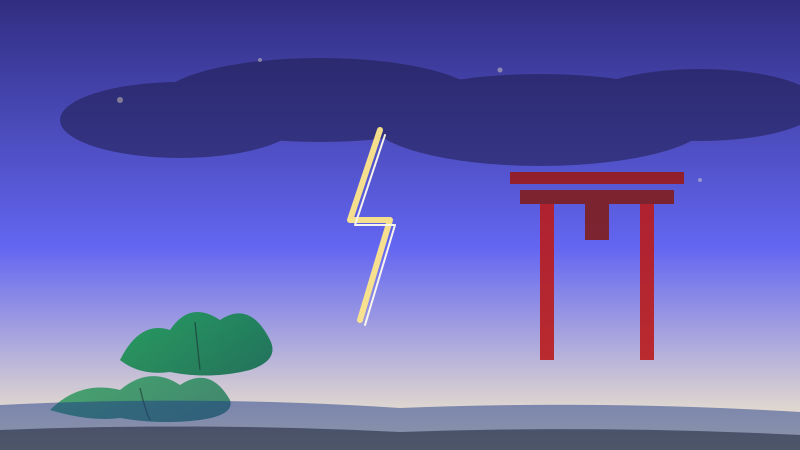
What Does "Kuwabara, Kuwabara" Mean? A Folk Charm Against Lightning
"Kuwabara, kuwabara." If you've spent time around an older Japanese household during a summer thunderstorm, you may have heard someone whisper this phrase under their breath. For more than a thousand years it has lived on as a quiet charm against being struck by lightning. Many people grew up hearing it from a grandparent and repeated it as children without ever stopping to ask what the words actually meant.
Written in characters, the phrase becomes "mulberry field, mulberry field." Why on earth would invoking a mulberry field ward off a lightning strike? Behind this question lies a deep entanglement of three threads: the wrathful spirit of a Heian-period nobleman whose grief shook the imperial court, an actual place called Kuwabara that was said to lie in his estate, and the long tradition of shrines that pacified the thunder god. The shrine, the power of words, and an honest fear of lightning are all folded into a single short phrase.
It would be too easy to wave the saying off as superstition. Its background is far richer than that. In what follows we'll trace the origins of "kuwabara, kuwabara" all the way back to the legend of Sugawara no Michizane, ask why the word "mulberry" was chosen, see how shrines that worship the thunder god became involved, and consider what this thousand-year-old phrase might still offer us today.
Sugawara no Michizane and the Thunder God — The Heian Story That Made a Spirit Into a Deity
No telling of the kuwabara story can avoid the Heian-period courtier Sugawara no Michizane. Michizane rose to prominence in both scholarship and politics, was favored by Emperors Uda and Daigo, and reached the high office of Minister of the Right. Through the political maneuvering of Fujiwara no Tokihira and others, however, he was demoted and exiled to Dazaifu in 901, where he died two years later, broken in heart and spirit.
In the years that followed, Kyoto was rocked by a string of disasters. Tokihira himself died young, a crown prince fell ill and died, and in 930 came the famous Seiryoden lightning incident, in which courtiers in the emperor's own audience hall were struck by lightning and killed. The people of the time understood these events as the wrath of Michizane's spirit, now transformed into a thunder god, taking revenge.
It was to soothe this terror that Kitano Tenmangu was founded. Michizane was elevated to the status of a deity, "Tenjin," and worshipped both as a thunder god and as a patron of learning. Shrines dedicated to him spread across the country. Turning a vengeful spirit into a kindly deity, so that harm might become blessing, is a textbook case of the goryo-shinko (wrathful spirit) cult that runs distinctively through Japanese religion. The phrase kuwabara, kuwabara grew out of this same soil.
Where Was "Kuwabara"? Michizane's Estate and the Place Lightning Spared
There are several theories of how the word "kuwabara" came to be invoked, but the most widely told is this: there was once a place called Kuwabara in Kyoto that belonged to (or was associated with) Sugawara no Michizane, and the thunder-god version of his spirit refused to strike his own estate. By telling the lightning, in effect, "You are over Kuwabara now — your own land — please do not strike here," people hoped to be spared.
A neighborhood named Kuwabaracho still exists just to the north of the Kyoto Imperial Palace, and a tradition holds that no lightning has ever fallen there in over a thousand years. Whether literally true or not, the persistence of that tradition shows how seriously the place was held in folk memory.
A second strong line of explanation focuses on the mulberry tree itself. In the sericulture culture imported from China, the mulberry was a sacred tree, and various local legends tell of a thunder god falling into a mulberry grove and being trapped there. Folk tales in Wakayama and Kyoto speak of "thunder-sealing wells" in which a captured lightning bolt was chained inside a well dug among mulberry trees. The legend of the place name and the sacred standing of the mulberry tree converge in this short phrase.
The Power of Words — Why It Must Be Said Twice
"Kuwabara" is never said only once. It is always doubled — kuwabara, kuwabara. This too reflects the ancient Japanese belief in kotodama, the spirit that lives within words. Words were thought to carry their own power, and repetition was a common way of strengthening that power, a pattern visible in Shinto norito (ritual prayers) and in many forms of supplication.
In the Oharae no Kotoba (the Great Purification Liturgy), the line "sweep us clean, make us pure" recurs in cycles. Sumo wrestlers cry "yo-i, yo-i" as they stamp on the ring; ritual hand-clapping is performed in twos, threes, or fours. The deeper logic — that doubling and repetition complete a sacred act — is woven through the whole of Japanese culture.
"Kuwabara, kuwabara" is the case where this sacred logic of repetition slipped quietly into daily life. The words take only a heartbeat to say. But by repeating them once, you draw a small ring of protection around yourself and tell the thunder god, "This is Kuwabara." A thousand years of belief is folded into the brief sound of a doubled word.
Kitano Tenmangu and the Twelve Thousand Tenjin Shrines
The thunder god / Tenjin worship that lies behind kuwabara, kuwabara spread out across Japan from Kitano Tenmangu, founded in 947, where Sugawara no Michizane is the principal deity, and which still stands today as one of Kyoto's most important historic shrines. The medieval picture scroll Kitano Tenjin Engi Emaki vividly tells, in painted scenes, Michizane's life, his transformation into a vengeful spirit, and his eventual enshrinement, and through it the fear and the faith of that age still come through.
Kitano Tenmangu, together with Dazaifu Tenmangu and Hofu Tenmangu, is counted among the "three great Tenjin shrines." The connected network of Tenmangu and Tenjin shrines is said to number around twelve thousand across the country. With their plum blossoms (the famous tobiume, "flying plum"), bovine messengers, and exam-pass votive plaques, they have grown a culture of devotion all their own and continue today to receive the prayers of students and of those who fear the thunder.
Even small rural villages almost always had a small shrine to Tenjin-sama, and on summer evenings children would dash past it murmuring "kuwabara, kuwabara" — a scene one could still find in many places up to the years of postwar high-growth Japan. The cult of the thunder god scattered itself between the great shrine of Kitano, countless small village halls, and the short charm whispered in any home, weaving a thin web of devotion across the entire archipelago.
From Personal Experience — A Quiet Voice on a Train in a Summer Storm
I remember once riding a local train through a summer evening when, all at once, the sky darkened outside the windows and phones across the carriage chimed in unison. The Japan Meteorological Agency had pushed out a thunderstorm warning. Soon a heavy roll of thunder reached us from far away, and shortly after that, a fork of lightning ripped a vivid white line across the view from the window.
In that moment, an older woman seated across from me, speaking to no one in particular, breathed out the smallest "kuwabara, kuwabara." Her companion laughed gently and teased her — "Oh, grandma, really" — and I, too, smiled despite myself. But there was something oddly reassuring in the sound of her voice. Whether or not the words had any real power to deflect lightning was, in the end, beside the point. Just by saying an old phrase, the agitated mood inside the carriage seemed to ease. A quiet softening passed through the train.
From that small moment on, I stopped thinking of the saying as a superstition and began to receive it instead as a tiny ritual for steadying oneself with words. On nights when work has stalled, I find that if I exhale long and quietly murmur "kuwabara, kuwabara" in my head, my shoulders, almost without my permission, drop. Perhaps these words exist less to keep lightning away from the body than to keep panic away from the heart, I thought to myself, watching the lightning continue beyond the carriage windows.
The Science of Lightning and the Wisdom of the Old Folks — Why a Mulberry Field Was Actually Safer
Modern meteorology tells us that lightning is a massive electrostatic discharge inside cumulonimbus clouds and that, on the ground, the most exposed targets are tall, isolated objects: a single tree on an open plain, a person standing in the middle of a rice field, a metal pole.
What is interesting is that mulberry fields, by their nature, were comparatively poor lightning targets. Mulberries are pruned to a low, shrubby height, and a mulberry field has no towering trees rising above the rest. Such fields were also typically planted at the margins of cultivated land, away from houses, so even a strike there did relatively little human harm. The empirical observation that you might be safer in a mulberry field, when combined with religious narrative, may well have crystallized into "kuwabara, kuwabara."
Modern lightning safety follows a few clear rules: get indoors, avoid open spaces, do not stand directly under a tall tree, do not move while holding metal, and stay inside for at least thirty minutes after the last roll of thunder. The wisest practice is probably to whisper kuwabara, kuwabara if you wish, but to move to safe shelter at the same time — to keep both the old prayer and the new science alive, side by side, like two wheels of one cart.
"Kuwabara, Kuwabara" Today — When Words Steady the Heart
Fewer young people in modern Japan whisper this old saying. When the thunder rolls, they check the weather on a smartphone, unplug the appliances, and stay indoors — and rightly so. But it would be a small loss if a thousand-year-old phrase disappeared completely.
There is something more in "kuwabara, kuwabara" than a fear of the thunder god. There is also a kind of breathing exercise embedded in it, a way of settling the mind. When a sudden clap of thunder makes the body flinch and breath catch, saying a short phrase twice gives the body something simple to do — and that, in itself, is a quiet practice of mindfulness handed down from a thousand years ago.
In an age of mounting natural disasters and sharper uncertainty, perhaps it is worth borrowing back, for a little while, the steadying power of these old words. The next time lightning splits the sky beyond your window, try whispering "kuwabara, kuwabara" — just once, just under your breath. The thin thread of a thousand-year story will, I think, knot itself, even if briefly, to that single moment.
About the Author
Shrine Secrets Editorial TeamWe uncover the hidden secrets of Japanese shrines and Shinto, making them accessible to everyone.
View author profile →Related Articles
The Mystery of Tebasami — The Tiny Carvings Wedged Beside Shrine Pillars and the Quiet Prayer of the Master Carpenters
The Mystery of the Omizutori Rite — Drawing Sacred Water Once a Year and the Prayer That Calls in the Spring
The Mystery of Jinguji — A Thousand Years of Shinto-Buddhist Fusion in Temples Built Inside Shrine Grounds
The Mystery of Tasuki and Hachimaki — The Purifying Cloths That Transform the Body for Sacred Service