The Mystery of Tebasami — The Tiny Carvings Wedged Beside Shrine Pillars and the Quiet Prayer of the Master Carpenters
Quietly nestled beside the pillars that support the front roof of a shrine's haiden are small carved members called tebasami. Often overshadowed by kaerumata and kibana, they fuse structure and prayer in one. Discover their origins, meaning, and how to identify them.
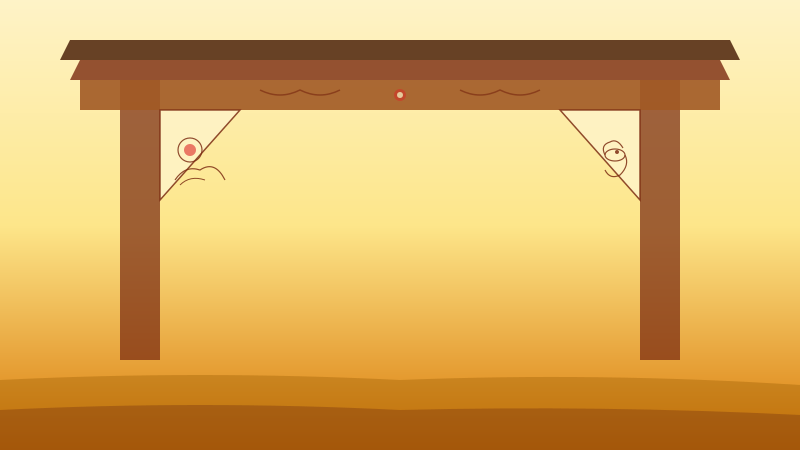
What Is a Tebasami? A Carving "Wedged" Between Pillar and Beam
In the architecture of Japanese shrines and temples, a tebasami is a decorative carved member set diagonally into the gap between a pillar at the front of a haiden or a kohai (the projecting frontal roof) and the beam or purlin that runs above it. The name itself — literally "hand-pinched" — describes the way it is gently slid into place, as if held in by hand.
From the perspective of someone arriving to worship, when you look up just beneath the eaves at the base of the beam, you'll see — left and right — small carved boards traced with the supple curves of flowers, birds, or dragons. If a kaerumata is the ornament that "sits" atop a beam, and a kibana is the ornament that "juts out" of a pillar's side, the tebasami is the ornament that "settles into" the wedge between pillar and beam. Together these three form a kind of trio of ornamental carvings in shrine architecture, each occupying its own position and role.
A tebasami is not mere decoration. Structurally, it ties pillar to beam, and helps spread the load of the roof so that no single point of the pillar bears the whole weight. Beauty and strength meet in a single piece. The unobtrusive yet refined craft of Japan's master shrine carpenters, refined over many centuries, is concentrated in this small member.
Origins — A Continental Form That Found Its Own Path in Japan
The roots of the tebasami trace back to the palatial and temple architecture of China and the Korean peninsula, which arrived in Japan in the Nara period. In the ornate timber buildings of China, a diagonal reinforcing piece called jiakti filled the corner between pillar and beam, often richly carved. Once introduced to Japan, this element first appeared in Buddhist temples, then gradually entered shrine architecture from the Heian and Kamakura periods onward.
Within Japan, the tebasami took its own path. Whereas the Chinese jiakti tended toward weighty, realistic carving, the Japanese tebasami evolved toward something lighter, with plants, birds, and auspicious creatures (dragons, phoenixes, qilins) rendered in flowing lines. This evolution can be seen as the result of pouring a Japanese aesthetic — "to convey presence through lightness rather than overwhelm with weight" — into a foreign style.
From the Muromachi through the Azuchi-Momoyama eras, shrine architecture entered a golden age of decoration. The tebasami became indispensable to the heavily ornamented kohai and eaves. By the Edo period, under Tokugawa patronage, master carpenters around the country competed in skill, producing extraordinarily intricate examples such as those at Nikko Toshogu. The history of the tebasami is, in miniature, a history of Japanese woodcarving itself.
Structural Role — A Diagonal That Distributes the Load
It's worth pausing to understand that a tebasami is more than ornament. The kohai of a shrine is a projecting frontal roof that welcomes visitors, and its weight rests on a few pillars and beams. The heavier the roof, the greater the force concentrated at the corners where pillars meet beams, increasing the risk of deformation or fracture.
By slipping diagonally into that very corner, the tebasami spreads the load over a face rather than letting it stab into a point. Physically, it belongs to the same family of bracing as the houzue (knee brace) and hiuchi-bari (corner tie-beam), guiding the weight from the roof smoothly down into the pillar. It quietly comes into its own when irregular forces — earthquakes or strong winds — strike the building.
One reason that old shrine buildings have endured the seismic and typhoon-prone climate of Japan is precisely that such inconspicuous members carry both structural and decorative work at once. The tebasami folds technique and a concern for long-term durability into a piece that, on its surface, simply looks beautiful. It is a crystallization of the master carpenter's wisdom.
Carving Motifs — Flowers, Birds, Auspicious Creatures, and the Prayers They Hold
The motifs carved into a tebasami follow conventions polished over generations. Plant motifs are most common: peonies, chrysanthemums, wisteria, pine, bamboo, and plum, rendered in flowing curves. Each carries a layered meaning — abundance, longevity, prosperity, fidelity — and is, in effect, a prayer for the shrine's deity given visible form.
Among animals, dragons, phoenixes, qilins, lions, cranes, doves, and sparrows are favored. The dragon stands for water and harvest, the phoenix for peace, the qilin for a virtuous ruler, the crane for long life, the sparrow for good crops — each one a symbol of what the shrine prays for. At Nikko Toshogu and Ueno Toshogu, the tebasami bear exquisitely paired carvings of dragon and phoenix, the Tokugawa shogunate's prayer for prosperity inscribed directly into the architecture.
The tendency varies by region and deity. Inari shrines often feature rice ears and foxes; Hachiman shrines, doves; Tenjin shrines, plums and oxen; coastal shrines, waves and fish. Reading the carvings of a tebasami can therefore be a small but rich way of reading the deity and history of the shrine itself.
The Hand of the Master Carpenter — Drawing a Three-Dimensional Form From a Single Plank
The making of a tebasami has long fallen to a particularly skilled subset of master carpenters known as horimono-daiku, the carving-carpenters. The wood is usually keyaki (zelkova), hinoki (cypress), or kusu (camphor) — hard, fine-grained timbers. The deeper the carving, the finer the sensitivity needed to follow rather than fight the grain.
The craftsman starts with a thick plank, transfers the design, then proceeds through ara-bori (rough cutting), naka-bori (mid-range modeling), and shiage-bori (the finishing carving in which the smallest expressions are coaxed out). Even an experienced carver may need weeks or months for a single tebasami; the most demanding pieces can take more than half a year.
A fascinating detail: tebasami are often deliberately not perfectly symmetrical. The left member may show a flower bud while the right shows the flower in bloom, or seasons may move from spring on one side to summer on the other. The flow of time, or the contrast of yin and yang, is woven between the two carvings. This embeds Shinto's "philosophy of the pair" — harmonizing two opposites and drawing motion out of the space between — into the very form of the carving.
From Personal Experience — A Small Bird Noticed Beneath a Rain-Soaked Eave
One autumn afternoon, I stopped at a small countryside shrine. The rain had only just stopped, the smell of wet earth was rising from the ground, and pools of water still lay between the stones of the approach. I climbed up to the empty haiden, finished my prayer, and was about to turn back when, by complete chance, I happened to look up into the corner of the kohai overhead. There, a single small carved bird was looking down at me.
At first I thought, every shrine has its decorative birds. But this one wasn't quite a sparrow or a crane. I couldn't tell what species it was — it simply had round, alert eyes and folded wings, and it seemed to be watching me quietly in the rain-washed light. Looking more carefully, I realized that the bird was tucked into the triangular space between pillar and beam, set as a left-and-right pair as if pressed gently into place. It would be much later before I learned that the part was called a tebasami.
What rose to mind, almost without my asking it, was a simple question: "For whom did the carver carve this bird?" It sat in a half-shadowed nook beneath the eave, where most worshippers would walk past without ever noticing. And yet, along the fine grain of the wood, somebody had clearly cut every line with care. From the bird's expression alone, that much could not be doubted. The instruments of ritual do not have to be conspicuous. Even if no human notices, it is enough that the kami sees. That afternoon, in a small, rain-soaked precinct, this thought reached me with unusual quietness.
Three Ways to Spot a Tebasami
If you'd like to start noticing tebasami when you visit shrines, here are three simple pointers. First, look for the position. Stand directly in front of the haiden or kohai, and look for the diagonal gap formed where the top of a pillar meets the beam above. A small carved board fitted into that wedge is almost certainly a tebasami. Kaerumata sit directly atop a beam, and kibana protrude from the side of a pillar, so the position alone usually tells you which is which.
Second, look at the shape. A tebasami follows the angle between pillar and beam, so its outline is roughly triangular. One edge meets the top of the pillar, another runs along the underside of the beam, and the diagonal third edge faces the viewer. Carvings cluster on this diagonal face.
Third, look for pairs. In most cases, the pillars on either side of the front bear a left-right pair of tebasami, with motifs that respond to one another. Comparing the pair often reveals a hidden message — a thought of the carpenter, or a layered prayer. The next time you visit an old shrine, please stand directly beneath the kohai, tilt your head back slightly, and let your eyes settle into the gap between pillar and beam. A small offering, carved by a master who never expected to be noticed, will be there waiting.
What Lives in the Details — A Philosophy of Caring for the Unseen
A distinctly Japanese principle runs through shrine architecture: "Don't pour the most ornament into what people see; pour the most care into what they don't." The way roof beams interlock above the ceiling, the way pillars are supported under the floor, the way grain is selected for the unseen ceiling boards — the highest skill and the deepest prayer are most often given to parts that the visitor will never directly see.
The tebasami is one of the clearest expressions of this principle. Unless you look up, you'll miss it. Unless you peer carefully, you can't make out its details. And yet, in just such a place, dragons dance, phoenixes spread their wings, sparrows hold rice ears in their beaks. They are pure ornaments — carved not for any human gaze, but solely for the kami. That is the essence of tebasami.
Most buildings we live in today prize efficiency and function, and ornament is often the first thing to go. But human life is not sustained by efficiency alone. Heartfelt work, lodged in places no one looks, accumulates quietly across centuries — and it is exactly such accumulations that have kept buildings standing, given land its sacred character, and held communities together for a thousand years. If, on your next visit, you happen to find a small carving wedged beneath a kohai, that tebasami may well be one of the last living witnesses to the silent prayers of a thousand years of master carpenters.
About the Author
Shrine Secrets Editorial TeamWe uncover the hidden secrets of Japanese shrines and Shinto, making them accessible to everyone.
View author profile →Related Articles
The Mystery of the Omizutori Rite — Drawing Sacred Water Once a Year and the Prayer That Calls in the Spring
The Mystery of Jinguji — A Thousand Years of Shinto-Buddhist Fusion in Temples Built Inside Shrine Grounds
The Mystery of Tasuki and Hachimaki — The Purifying Cloths That Transform the Body for Sacred Service
The Mystery of Kiyari-uta — The Sacred Work Song That Carries the Gods Into Shrine Timbers