The Mystery of Miare-no-Shinji — The Midnight Rite at Kamo Shrine That Renews the Birth of the Kami
Miare-no-Shinji is an extremely secretive rite held at midnight in the Miare-no field of Kamigamo Shrine in Kyoto, on the eve of the Aoi Matsuri. We unravel the mysteries of this rite—a tradition continuing for more than a thousand years—including why the kami must be 'reborn' each year, the reason participants must utter no sound at all, the mechanism by which the divine spirit descends into the sakaki branch called areki, and the uniquely Japanese cosmology that 'kami too grow old.'
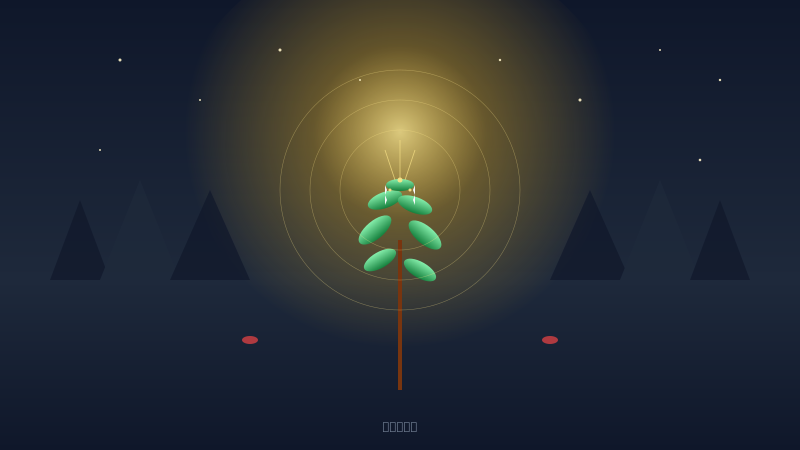
What Is Miare-no-Shinji — The Heart of the Kamo Secret Rite
Miare-no-Shinji is an extremely important and highly secretive rite performed each year at midnight on May 12 at Kamigamo Shrine (Kamo Wakeikazuchi Shrine) in the Kita Ward of Kyoto. It is the eve-of-festival rite of the Aoi Matsuri (Kamo Matsuri), one of Japan's three great festivals, and is positioned as the ritual that supports the very root of the Aoi Matsuri.
The word 'arehi' (or 'are') in classical Japanese means 'to appear' or 'to be born.' Miare-no-Shinji is therefore 'the rite in which the kami is newly born and made to appear.' The shrine's deity, Kamo Wakeikazuchi-no-Okami, descends to a sacred space called Miare-no-no, separate from the main hall, and there clothes himself with new spiritual power before going forth to the Aoi Matsuri the next day—this is the core of the rite.
No one outside the priesthood is permitted to attend, and worshippers may not even approach. The location, the gestures, and the words chanted are all held as secret transmissions and have been strictly preserved for more than a thousand years. Even people of Kyoto know only that 'something is being done on the night before Aoi Matsuri'—few can speak in detail of what it is.
This article explores from multiple angles why this rite has been protected for more than a millennium, why the kami must be 'reborn' each year, and the role that Miare-no-Shinji has played within Japanese religious life.
A Uniquely Japanese Cosmology: 'Even Kami Grow Old' — The Idea of Tokowaka
The greatest key to understanding Miare-no-Shinji is the uniquely Japanese cosmological view—rare even among the world's religions—that 'kami too grow old.'
In Western monotheism, God is an eternal, unchanging transcendent being unaffected by time. In Japanese Shinto, however, kami have long been thought to exist within the flow of time, much as humans do: their power may wane, impurities may attach to them, or they may be renewed with fresh spiritual power. This is the thought of tokowaka, 'ever-young.'
Tokowaka means 'always being young,' and reframes eternity not as 'never changing' but as 'being continually reborn.' The twenty-year cycle of the Ise Shrine's shikinen sengu rests on this same idea. The buildings themselves age, but by rebuilding them anew every twenty years, the dwelling of the kami is kept perpetually young.
Miare-no-Shinji is grounded in the same conception. Over a year of ritual life, Kamo Wakeikazuchi-no-Okami hears the prayers of worshippers, receives impurities, and accumulates a certain weariness in his spiritual power. As things are, he could not perform the rites of the coming year—and so each May a rite is required to 'rebirth' the kami.
Without fearing old age, to be ceaselessly renewed: this resonates deeply with what we today call 'sustainability.' Just as a forest repeats falling leaves and budding shoots, just as a river keeps flowing through the same place while its water is constantly exchanged, the kami too maintain eternity by being reborn.
Miare-no-no — A Sacred Space Open Only at Midnight
The Miare-no-no, where the Miare-no-Shinji is performed, is said to be a sacred area near a small auxiliary shrine, somewhat removed from the main hall of Kamigamo. It is ordinarily enclosed by a fence, and entry is strictly forbidden to all but priests.
The place has been held sacred since ancient times as 'a field where the kami descends.' According to Kamo myth, Kamo Wakeikazuchi-no-Okami was born from a vermilion-painted arrow that his mother Tamayori-hime picked up in the river, and after later ascending to the heavenly Takamagahara, he descended once again to this place. The Miare-no-no symbolizes that 'place of descent,' a boundary point where the kami passes between heaven and earth.
On the day of the rite, when the night of May 12 deepens, priests robed in white vestments enter the Miare-no-no barefoot, having removed their straw sandals so as not to make a sound. Moonlight and braziers alone serve as light; no electric lamps are used. This follows the tradition that 'the kami descends into the darkness of antiquity.'
In the center of the Miare-no-no, a young branch of sakaki called the areki is set up. This areki becomes the yorishiro (the receiving vessel) for the divine spirit, and at a certain moment in the depths of the night, Kamo Wakeikazuchi-no-Okami, clothed with new spiritual power, is said to enter the areki.
The priests stand in a circle and offer deep bows. The words chanted are never spoken before anyone outside, and have been transmitted to the present day as complete secret tradition. They are said to contain ancient layers of norito recorded in the Engishiki, but there is no way to verify this.
The Mystery of the Areki — How the Kami Descends into a Sakaki Branch
The central implement of Miare-no-Shinji is the sakaki branch called areki. Why is sakaki chosen, and how does the divine spirit come to dwell in it? This is the deepest mystery of the rite.
Sakaki is regarded in Shinto as the most sacred evergreen. The very character for sakaki combines 'tree' and 'kami,' and from antiquity it has served as a yorishiro that joins kami and people. Its evergreen nature symbolizes 'eternal life,' and the youthful blue-green of its leaves resonates with the thought of tokowaka.
The areki used at Miare-no-Shinji is chosen and prepared by special procedures. A few days before the rite, a priest enters the precinct's sacred grove and cuts a single straight branch of young sakaki. He may speak no word in doing so; he must inwardly ask permission as he receives the branch.
The cut sakaki is cleansed with sacred water, and a five-colored heihaku (offering cloth) is bound to it. This is the areki. The areki is set up at midnight in the Miare-no-no and functions like an antenna for the descending divine spirit.
In the belief of ancient Japan, the kami had no form, but was thought to appear in the human world through specific yorishiro: mountains, great stones, great trees, swords, mirrors. All these could become yorishiro of the kami. The areki preserves the most ancient layer of this 'yorishiro belief' and conveys to us the form of primal worship before the development of shrine architecture.
The moment the divine spirit enters the areki, the priests quietly bow, then carefully carry the areki to the main hall. Through this, the spirit of the main hall is renewed as 'something new,' and the Aoi Matsuri the following day begins as a festival that walks the reborn kami through the capital.
The Discipline of Silence — Why No Sound May Be Made
One of the most distinctive practices of Miare-no-Shinji is its 'absolute silence.' During the rite, priests are careful not to cough, not even to make a footstep. Why is silence so deeply valued?
The answer is rooted in ancient Japanese 'kotodama' (word-spirit) belief and in the thought of imi (taboo).
Kotodama belief holds that words carry spiritual power and that what is spoken takes effect in reality. To utter unnecessary words at a sacred moment scatters that spiritual power and was considered an act that disturbs the descent of the kami. In ancient rites, only the minimum necessary norito were chanted in strict cadence, and all other speech was forbidden.
Imi means keeping a sacred state by separating oneself from daily life and avoiding impurity. The very daily act of speaking was thought capable of bringing 'kegare'—drained spirit—into a sacred space.
A deeper reason is that Miare-no-Shinji is a rite in which 'the kami is newly born,' and this symbolizes a sacred process of regeneration within the womb. The womb is a space of stillness and darkness—to reproduce its mystery, the Miare-no-no must likewise be wrapped in darkness and silence.
The priests who attend enter 'betsubi' (separate-fire) purification several days before the rite. Betsubi means eating only food cooked over a fire separate from one's family, avoiding meat and strongly scented foods, keeping body and mind pure. The discipline of silence is another method of purification on the same continuum as this fasting and purification.
The Connection with Aoi Matsuri — Miare-no-Shinji Supporting a Thousand-Year Festival
Miare-no-Shinji is not a self-contained rite. It is inseparably linked to the Aoi Matsuri (Kamo Matsuri) held the next day. Understanding the relationship between the two reveals the true meaning of Miare-no-Shinji.
Aoi Matsuri is a festival with more than a thousand years of history, known for its splendid royal procession from the Kyoto Imperial Palace to Shimogamo and Kamigamo shrines. It was one of the most important rituals of the court in the Heian period, symbolically depicted in The Tale of Genji's famous 'carriage rivalry' scene.
The center of the Aoi Matsuri is to have Kamo Wakeikazuchi-no-Okami appear before the people of the capital, and to pray for the peace of the dynasty and the prosperity of the realm. But if the kami were left in a state of spent power from a year of ritual, he would not be able to fully receive the prayers of the people.
So on the eve of Aoi Matsuri, Miare-no-Shinji rebirths the kami, and he comes forth to the next day's rite endowed with youthful spiritual power. This is the relationship between the two rites. Miare-no-Shinji is not a 'preparation' for the Aoi Matsuri but a foundational rite that is the precondition of the great festival.
In the early morning of Aoi Matsuri, the kami clothed with new spiritual power sits quietly in the main hall. No one in the procession—the imperial messenger, the saio-dai, or the participants in their finery—is told the details of Miare-no-Shinji, but the festival begins solemnly on the premise that 'the kami has been reborn during the night.'
The Spread of 'Re-Birthing the Kami' Rites Across Japan
The conception of 'rebirthing the kami each year' represented by Miare-no-Shinji is not unique to Kamo Shrine but is deeply rooted in shrine ritual throughout Japan.
The shikinen sengu of the Ise Shrines is the largest-scale 'renewing the dwelling of the kami,' held once every twenty years. If Miare-no-Shinji is a small-scale annual rebirth, the shikinen sengu can be called its large-scale version once every twenty years.
At Izumo Taisha, the Kamiari-sai is held each year in the tenth month of the lunar calendar. Kami from across Japan gather in Izumo, and the 'kami-hakari'—a council in which they reweave next year's affinities—is held. This too can be called a kind of 'renewal of the kami.'
The Kasuga Wakamiya On-Matsuri at Kasuga Taisha is a rite that renews the spiritual power of the Wakamiya deity once a year, and the 'Senko-no-Gi' (rite of removal) is performed at midnight each December. In its midnight setting and complete absence of electric light, it shares an extremely similar structure with Miare-no-Shinji.
What these rites have in common is a uniquely Japanese view of the kami—not as 'eternal, unchanging beings' but as 'dynamic beings continually being reborn.' Precisely because the kami live within time, humans feel intimacy with them and can walk through time together with them. That sensibility may be the spirit that flows beneath Japanese belief.
One May some years ago, while staying in Kyoto on business, I happened to drop by Kamigamo Shrine a few days before the Aoi Matsuri. The precincts were wrapped in a quiet tension of preparation, and tourists were few. A signboard told me I could not approach the Miare-no-no, and I could only gaze toward the forest from a distance through the fence. That night, in my hotel, the thought 'tomorrow at midnight, deep in that forest, a secret rite continuing for a thousand years will be performed' kept me strangely awake. The feeling that an unseen ritual is moving the world from a place I cannot see—it left a quiet ripple deep in my heart. In ordinary life I tend to trust only 'what I can see'; that night alone, I felt, however dimly, the meaning of 'what cannot be seen.'
What Miare-no-Shinji Asks of Us Today — The Value of the Unseen
Miare-no-Shinji has continued for more than a thousand years while most Japanese have not even known of it in detail. Why has so deeply hidden a rite been transmitted, generation after generation, to the present?
The answer perhaps lies in a uniquely Japanese aesthetic in which 'being unseen' and 'being unknown' have value in themselves.
In modern society, 'visibility,' 'transparency,' and 'disclosure of information' are taken as goods, and the unseen is often suspected, the hidden assumed to contain a problem. Yet Miare-no-Shinji embodies the inverse: precious because unseen, protected because unknown.
Miare-no-Shinji teaches that showing everything and speaking of everything does not necessarily create richness. A prayer offered deep in a forest at a time no one sees; a gratitude not put into words; a dialogue with the kami exchanged in the dark—such 'unseen activities' may quietly support our world.
The next time you watch footage of the Aoi Matsuri, or visit Kyoto, please bring to mind for a moment that something is taking place deep in the forest of Kamigamo Shrine at midnight on May 12. Even if you do not know what exactly it is, the simple fact that a silent prayer continued for over a thousand years is being offered now will make our everyday lives look just slightly different. Miare-no-Shinji continues, quietly, to put to our present age the question of the value of what cannot be seen but surely exists.
About the Author
Shrine Secrets Editorial TeamWe uncover the hidden secrets of Japanese shrines and Shinto, making them accessible to everyone.
View author profile →Related Articles
The Mystery of Aouma-no-Sechie — A Thousand-Year Court Belief That Seeing White Horses in the New Year Dispels Evil
The Mystery of Hohei-shi — The Thousand-Year Institution of Imperial Envoys Offering Heihaku to Shrines
The Mystery of Kanayamahiko-no-Mikoto — Why the God of Mines and Forges Has Been Enshrined at Nangu Taisha for a Thousand Years
The Mystery of Uneme-no-Sai — The Thousand-Year Festival Mourning a Court Lady's Lost Love