The Mystery of Bowing at Shrines — The Shinto Philosophy of Reverence Hidden in a Simple Gesture
Bowing is deeply embedded in Japanese daily life. We explore how this simple gesture originated from Shinto worship and the profound meanings behind its angles and repetitions.
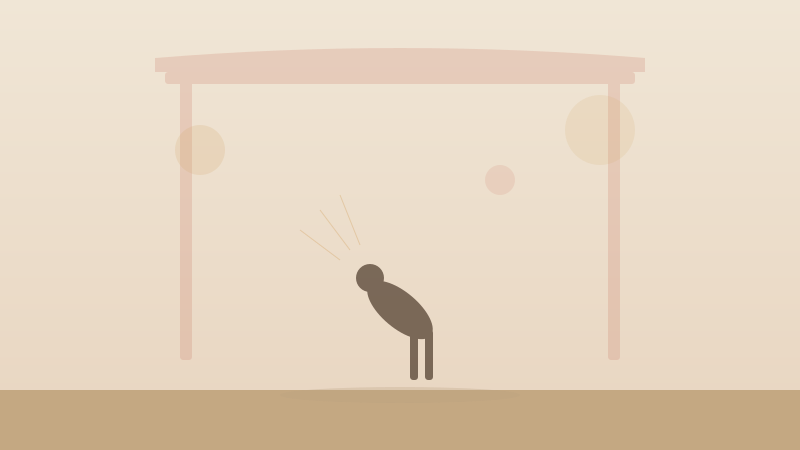
The Origin of Bowing — How Sacred Worship Became Daily Practice
In Japanese, a deep bow is called 'hai' (拝), the same character used for worship, revealing that bowing originated as an act of reverence before the gods. Ancient Japanese saw divinity in the sun, mountains, great stones, and towering trees, and bowed before them. In the Kojiki's account of the descent of the heavenly grandson, Ame-no-Uzume approaches Sarutahiko by 'turning her face downward' — perhaps the oldest recorded bow in Japanese literature.
The Nihon Shoki similarly describes Emperor Jimmu bowing to the heavenly deities during his eastern expedition, demonstrating that physical expressions of reverence were already deeply rooted in Japan's founding mythology. Archaeological evidence supports this as well: among the haniwa clay figures from the Kofun period, some depict figures with hands clasped together and torsos inclined forward, confirming that bowing was part of ritual practice long before written records.
When the ritsuryō legal codes were established in the Nara period, court ceremonies strictly codified the angles and frequency of bowing. The ceremonial provisions of the Yōrō Code specified that bowing to the emperor required 'sahai' — two deep bows — with the depth of the bow precisely regulated according to the rank of the official. These court protocols were adopted into shrine rituals, then spread through the warrior class to common people, forming the foundation of Japanese etiquette as we know it. In other words, every business bow, every unconscious nod during a phone call, traces its roots to the sacred 'hai' before the gods.
Different Angles, Different Meanings — The Shinto Structure of the Bow
There are three primary angles of bowing: the eshaku (about 15 degrees), the keirei (about 30 degrees), and the saikeirei (45 degrees or more). In shrine worship, the 'hai' in 'ni-hai ni-hakushu ichi-hai' (two bows, two claps, one bow) is a saikeirei — the torso bent nearly 90 degrees. This angle is no accident. The deeper one bows, the more the visible world disappears from sight and awareness turns inward.
In the deepest bow, a person becomes physically vulnerable, exposing their defenselessness before the divine. In Shinto, this vulnerability is considered the highest form of respect. This is why a samurai who removed his armor to stand before the gods was regarded as offering the purest form of worship. The Sengoku-period warlord Uesugi Kenshin is said to have removed his armor each morning and bowed deeply in plain clothing before the Bishamonten hall within Kasugayama Castle.
Conversely, a light eshaku is a gentle expression of 'I acknowledge your presence,' and greeting a stranger in passing is an extension of this Shinto-rooted reverence. In business settings, the approximately 30-degree keirei performed during the exchange of business cards reflects the Shinto principle of 'honoring the other as an equal' translated into social convention. The difference in angles is not merely a matter of manners — it is a Shinto-derived communication system that physically expresses the depth of respect and the nature of one's relationship with the other person.
Two Bows, Two Claps, One Bow — The Cosmology Within Worship Etiquette
The standard shrine worship sequence of 'ni-hai ni-hakushu ichi-hai' (two bows, two claps, one bow) may appear to be a simple series of repeated movements, but it encapsulates the Shinto view of the cosmos. The initial two bows are said to represent reverence for paired forces — heaven and earth, yin and yang. In Shinto, all things are born through the power of 'musubi' (creative spirit), where two different forces come together to generate something new. The two bows physically embody this dualistic cosmic principle.
The two claps that follow carry multiple layers of meaning. On a practical level, producing sound draws the deity's attention and announces one's presence. At the same time, the act of striking both hands together is interpreted as a symbol of harmonizing the left hand (the spiritual hand) with the right hand (the physical hand), thereby uniting spirit and body. The fact that Izumo Grand Shrine requires four claps while Usa Jingū also uses four claps demonstrates that worship etiquette evolved according to the character of the enshrined deity and each shrine's unique traditions.
The final single bow is a conclusive gesture imbued with prayer. While the first two bows serve as a 'declaration of reverence,' the final bow carries the stronger connotation of 'gratitude and commitment.' Through this sequence of movements, the worshipper completes a dialogue with the divine.
How the Body Changes — The Psychological and Physiological Effects of Bowing
Recent psychological research has scientifically demonstrated that physical actions like bowing influence mental states. Research by Professor Amy Cuddy and colleagues at Harvard University reported that body posture affects hormone secretion. Postures that make the body smaller, like bowing, have been associated with changes in cortisol (the stress hormone) and are thought to have the effect of temporarily suppressing the ego.
Japanese Zen Buddhism understood this intuitively. Dōgen Zenji, the founder of the Sōtō school, taught in his Shōbōgenzō that physical actions themselves constitute the practice of enlightenment. The insight that the physical act of lowering one's head transforms one's mental state is wisdom that Eastern thought had grasped centuries ago.
In practice, performing a deep bow naturally deepens one's breathing. Bending at the waist compresses the diaphragm, and upon rising, one takes in a large breath. This deep breathing activates the parasympathetic nervous system, lowers the heart rate, and induces a state of relaxation. The distinctive sense of refreshment felt after worshipping at a shrine is not solely due to the atmosphere of the place — the physiological effects of the bowing motion itself also contribute. Furthermore, the correct posture of bowing — keeping the spine straight and bending from the waist — engages the muscles around the spinal column moderately, helping to align the body's overall posture.
Bowing in Martial Arts and Traditional Arts — Spirituality Within Form
In martial arts, practitioners always bow to their opponents before and after a match. In kendo, the 'sonkyo' is a distinctive form of greeting where practitioners lower their hips while holding their bamboo swords in position to show respect to their opponent — a posture derived from the stance Shinto priests assume before the gods during rituals. Kanō Jigorō, the founder of judo, stated that 'judo begins and ends with a bow,' but this 'bow' is not mere formality — it is the practice of Shinto reverence that recognizes divinity within the opponent.
In the tea ceremony, host and guest place their hands on the tatami and bow deeply. In the tea practice established by Sen no Rikyū, anyone entering the tea room must lower their head to pass through the small entrance called the 'nijiriguchi,' regardless of their social rank. This embodies the principle that all people are equal within the tea room — a concept that resonates deeply with the Shinto principle that distinctions of rank dissolve before the divine.
In Noh theater as well, performers always bow toward the front of the stage when entering and exiting. At the back of the Noh stage is painted a pine tree called the 'kagami-ita,' which is modeled after the sacred 'yōgō no matsu' pine at Kasuga Grand Shrine — the Noh stage itself is designed as an extension of sacred space. Bowing in the traditional arts reflects an awareness of offering one's art to the gods, embodying the uniquely Japanese artistic philosophy that all creative expression is ultimately a sacred act.
Bowing in Modern Society — A Thousand Years of Faith Carried in the Unconscious
What is fascinating is that modern Japanese people are almost entirely unaware of the religious origins of their bowing. Yet it is precisely in the unconscious that the essence of culture resides. When bowing to someone on the phone who cannot see you, or slightly nodding to a stranger in an elevator, Japanese people are unknowingly embodying Shinto's fundamental belief that 'divinity dwells within every being.'
A convenience store clerk bowing while saying 'thank you'; soccer players bowing toward the stands after a match; a student bowing before the podium at a graduation ceremony before receiving their diploma — all of these scenes testify to how deeply Shinto reverence has permeated every corner of Japanese society.
Overseas, Japanese bowing is sometimes humorously portrayed as 'excessive politeness.' But understanding its true nature reveals bowing to be a remarkably rational means of communication. Without exchanging a single word, the body alone can precisely convey the degree of respect one feels. This is a system of physical communication unparalleled anywhere in the world, born from a culture that believes in eight million gods and pays respect to all existence.
The next time you visit a shrine, bow with full awareness. In that moment, your body is carrying forward a thousand years of faith. Bowing is an invisible bridge connecting humans and gods, person and person, people and nature.
About the Author
Shrine Secrets Editorial TeamWe uncover the hidden secrets of Japanese shrines and Shinto, making them accessible to everyone.
View author profile →Related Articles
The Mystery of Tachimono: Why Japanese Worshippers Give Up What They Love to Pray at Shrines
Ghost Stories of Shrines: The Eerie Legends Born Where the Sacred Meets the Supernatural
The Mystery of Momote-shiki — The Sacred Shrine Archery Rite That Pierces Evil with a Hundred Arrows
The Mystery of Funadama Belief — A Thousand-Year Prayer of Fishermen Who Believed a Goddess Dwells in the Hull