The Mystery of Momote-shiki — The Sacred Shrine Archery Rite That Pierces Evil with a Hundred Arrows
Momote-shiki is a traditional rite in which numerous archers draw their bows in unison at the New Year, loosing a total of one hundred arrows to drive away evil. We unravel the mysteries of this thousand-year-old archery rite, including why the number 'one hundred' was chosen, the meaning of the character for 'demon' written at the center of the target, the differences from yabusame and hamaya, and the structure of this distinctive ritual fusing warrior culture with Shinto.
What Is Momote-shiki — The Archery Rite That Purifies the Year with One Hundred Arrows
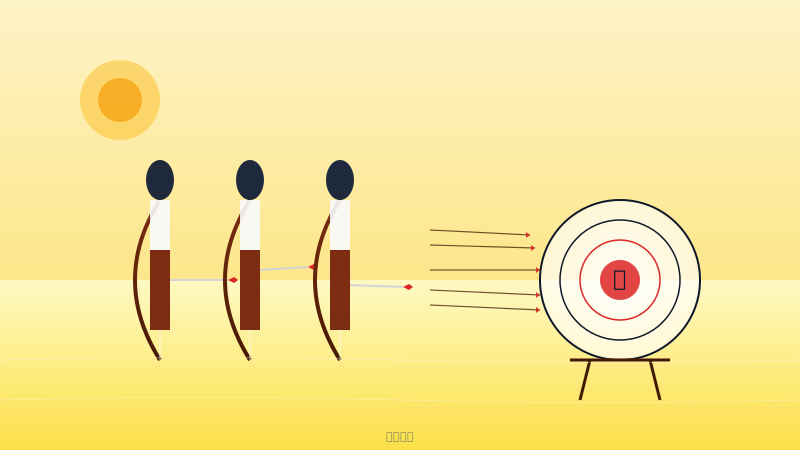
Momote-shiki (sometimes read 'hyakutashiki') is a traditional archery rite performed within the precincts of shrines at the New Year and at the turning points of festivals. The term 'momote' literally means 'one hundred archers,' and originally it was a large-scale ritual in which one hundred archers each shot two arrows—two hundred in all—to drive away evil and to pray for the peace of the year.
Today, securing one hundred archers is difficult, so the form has commonly been adjusted: fifty archers shoot two arrows each, or ten archers shoot ten arrows each, so that the total is 'one hundred.' This preserves the essence of the rite. The important thing is not the number of archers but the very fact that 'one hundred arrows' are loosed.
At the foundation of this rite lies the ancient belief that 'the sound of the bow and the power of the arrow' can physically dispel invisible evil, misfortune, and impurity. The sound of the bowstring, called 'tsuruoto' or 'meigen' (sounding the string), is itself said to possess apotropaic power. The motion of the arrow cutting through the air and piercing the target was a symbol of impaling and destroying evil.
Momote-shiki is performed at shrines throughout the country, but it is especially famous at shrines deeply tied to warrior culture, such as Kamigamo Shrine in Kyoto, Tsurugaoka Hachimangu in Kamakura, Sumiyoshi Taisha in Osaka, and Katori Jingu in Chiba. The date is often set during the New Year's pine-decoration period or in conjunction with each shrine's annual festival, and the rite is beloved as a seasonal feature of the New Year.
This article will explore from multiple angles why the number 'one hundred' was chosen, the mystery of the 'demon' hidden at the center of the target, the differences from other archery rites such as yabusame and hamaya, and the role Momote-shiki has played within Japanese belief and warrior culture.
Why 'One Hundred'? — One Hundred as a Sacred Number and the Idea of Completion
The number 'one hundred' in Momote-shiki carries a meaning far deeper than 'a lot.'
For ancient Japanese, 'momo' (hundred) was one of the special sacred numbers. In Japanese myth, expressions like 'yaoyorozu no kami' (eight million kami) and 'momoshiki no omiya' (the great palace of a hundred decorations) abound, in which 'hundred' or 'eight hundred' represents 'infinite' or 'all.' 'Hundred' was a sacred unit symbolizing 'completeness,' 'totality,' and 'everything' rather than a concrete numerical count.
This sense of number is reflected strongly in the expressions of the Kojiki and Nihon Shoki. For instance, 'momoyasogami' (hundred-eighty kami) means 'many kami,' and a sensibility that finds sacredness in particular numbers—eighty, one hundred and eight, three hundred—has long been deeply rooted in the Japanese mind.
The 'one hundred arrows' of Momote-shiki, based on this sacred-number belief, carry the meaning of 'driving out all evil influences, without omission, completely.' Evil that one or ten arrows could not fully dispel can surely be destroyed by casting the complete number, one hundred—or so it was believed.
It is also notable that 'momo' is the same sound as 'momo' (peach). In Japanese myth, when Izanagi fled from the land of the dead, he repelled the pursuing Yomotsu-shikome by hurling peach fruits, and the peach has long been considered a fruit with strong powers of warding off evil. 'One hundred arrows' and 'the apotropaic peach' were deeply linked both in sound and in belief.
Furthermore, 'hundred' is connected with 'momotaru'—'to be fully filled,' 'to be complete.' To loose one hundred arrows at the start of the new year carried also a cosmic meaning—a prayer that the cycle of the year would 'begin completely and end completely.'
The 'Demon' at the Center of the Target — A Device to Make Evil Visible
The target (mato) of Momote-shiki bears a distinctive design. At many shrines, the character for 'demon' is boldly written at the center of the target. The archer aims at this 'demon' character and looses the arrow, and by piercing the character, the structure dispels evil.
Why a 'demon'? In Japan, the demon (oni) has long stood as a symbol of invisible forces that harm humans—evil influences, calamity, disease, resentment. By writing the character for 'demon' on the target, formless evil is made visible and transformed into a target that can be physically attacked with an arrow.
This idea shares the same logical structure as the call 'oni wa soto, fuku wa uchi' (demons out, fortune in) at setsubun. At setsubun, beans are thrown to drive out the demon (evil); at Momote-shiki, arrows are loosed to pierce the demon (evil). The means differ, but the religious strategy of 'opposing invisible forces of evil with a physical attack' is the same.
Depending on the region, the target's inscription may differ. Some shrines write not 'demon' but 'evil,' 'misfortune,' or 'calamity.' At others, conversely, the auspicious characters 'fortune' or 'longevity' are written, and shooting them is interpreted as 'drawing in good fortune.' This shows that the act of loosing arrows carries the meaning not only of dispelling but also of invoking good fortune.
The spot where the arrow strikes also has religious significance. An arrow that pierces the middle of the 'demon' character is the most auspicious; an arrow that strays from the 'demon' to the rim of the target is said to 'graze the power of the demon and dispel it'; and even if the target is missed entirely, the arrow striking the ground is interpreted as 'purifying the land.' That is to say, wherever the arrow lands, there is some spiritual effect—the rite is generously designed to permit failure.
The Apotropaic Power of Meigen — The Spiritual Power of the Bowstring's Sound Itself
One important element of Momote-shiki is 'meigen' (sounding the string), performed before loosing arrows.
Meigen is the act of drawing and releasing the bowstring without an arrow, and the sharp 'whoosh' of the string itself is said to possess the spiritual power to drive away evil. The belief that 'the sound of the bowstring repels demons' is ancient, and at the imperial court, the rite of meigen was performed at the childbirth of the emperor or members of the imperial family. The purpose was to physically drive away any evil that might surround the newborn through the sound of the string.
In Momote-shiki, before entering the formal archery range, a priest or senior archer performs the rite of meigen to purify the space. Then the archers proceed to loose their arrows in unison. The combination of meigen and 'honsha' (the actual shooting of arrows) completes a comprehensive purification rite from both 'sound' and 'action.'
Belief in warding off evil through sound is of the same lineage as the bells, hand-claps, and drums at shrines. In Japanese Shinto, 'sound' itself is an extremely important ritual element, and different sounds have been used for different purposes—to summon the kami, to delight the kami, to dispel evil. Meigen may be considered the sharpest and most ancient of these 'sounds of purification.'
From a modern scientific perspective too, the sharp sound of a bowstring has fascinating properties. The high-frequency sound generated in an instant has a strong arousing effect on the human brain, sharpening tension and concentration. The moment the sound of meigen is heard, every attendant straightens their back and focuses their consciousness on the sacred time of the rite—this may be a technique of 'purifying the place and switching consciousness' that ancient people discovered empirically.
Differences from Yabusame and Hamaya — Three Forms of Archery Rites
Archery rites of shrines other than Momote-shiki include several, each with different aims and forms. Comparing three representative archery rites reveals the distinctive character of Momote-shiki.
First, 'yabusame.' This is a dynamic rite in which the archer, galloping on horseback, shoots three targets in succession. It became widely known when Minamoto no Yoritomo performed it at Tsurugaoka Hachimangu in the Kamakura period, and it strongly carries the meaning of dedicating the warrior's art of horseback archery to the kami. With the combination of horse and bow, it has a more martial and competitive character.
Second, 'hamaya.' Rather than a rite of loosing arrows, this refers to the arrow itself bestowed at the shrine. People bring hamaya home at the New Year and place them on their household altar or in the alcove of their room to drive away the year's evil. The emphasis is on the spiritual power invested in the arrow as object, and the ritual aspect is weak.
Third, the subject of this article, 'Momote-shiki.' Neither dynamic like yabusame nor concentrated in a single object like hamaya, it is characterized by 'rissha' (standing shooting) performed by many people. The large number of archers and the large number of arrows form the core of the rite.
Summed up, yabusame is 'dedication of martial art,' hamaya is 'a protective amulet,' and Momote-shiki is 'purification by a group.' The distinctiveness of Momote-shiki lies in its 'collectivity' and 'simultaneity'—multiple archers loosing arrows together. This makes it a ritual structure that realizes purification of the entire community rather than the prayer of an individual.
The Fusion of Warrior Culture and Shinto — A History from the Medieval Period
Tracing the history of Momote-shiki reveals a uniquely Japanese history of belief in which warrior culture and Shinto fused together.
The bow has long been regarded as a sacred weapon, and Japanese myth records that kami bore bows at the time of the heavenly descent. But the specific ritual form of 'dispelling evil with one hundred arrows' is said to have been established between the late Heian and the Kamakura periods, when warrior society was being formed.
Minamoto no Yoritomo's large-scale archery rites at Tsurugaoka Hachimangu spread to the whole country the importance of warrior-led shrine ritual. By dedicating their martial arts (especially archery) to the kami, the warriors prayed for victory and at the same time purified their souls. Behind the extreme importance of the way of horseback archery in bushido lay such religious meanings.
From the Muromachi through the Sengoku periods, the custom of warrior families dedicating Momote-shiki to shrines in their domains spread. For warriors, Momote-shiki was a rite that killed two birds with one stone, praying for the peace of all their people while also wishing for their own long-lasting military fortune. With the Edo period, the Tokugawa shogunate's encouragement of martial training led Momote-shiki to take root as an annual event at shrines associated with warrior families throughout the country.
After the Meiji Restoration, warrior society collapsed, but Momote-shiki was carried on as a shrine rite. In the period immediately after World War II, some shrines suspended it under suspicion of ties to militarism, but with the postwar revival of kyudo, it has come to be performed again across the country as a tradition.
In the present-day Momote-shiki, the archers are often high school or university kyudo club members or local enthusiasts, not necessarily descendants of warriors. From a warrior rite, it has been passed down to the present while changing its character into local traditional culture.
The Decorum of Momote-shiki — The Meaning Within Each Movement
The decorum of Momote-shiki has much in common with 'shaho hassetsu' (the eight stages of shooting), which is the foundation of modern kyudo. Archers carry out each refined movement infused with sacred meaning as they loose their arrows.
First is 'ashibumi' (the foot stance). The archer stands sideways toward the target and spreads his feet about shoulder width. This posture means to be firmly connected to the earth and expresses a stable state of mind and body.
Second is 'dozukuri' (forming the trunk). The back is straightened and the center of gravity of the upper body is composed. This is the gesture of establishing within oneself the vertical axis linking heaven and earth, indicating that the archer himself functions as a cosmic 'pillar.'
Third is 'yugamae' (taking up the bow) and 'uchiokoshi' (raising the bow). The bow is taken in hand and slowly raised above the head. This vertical movement is also a ritual gesture of bringing down the power of the heavens to earth.
Fourth is 'hikiwake' (drawing apart) and 'kai' (meeting). The bow is fully drawn, and a moment of stillness is held just before loosing the arrow. 'Kai' is said to be the moment of highest spirituality in kyudo, the realm of 'union of heaven and human' in which the archer's mind and the target become one.
Fifth is 'hanare' (release) and 'zanshin' (lingering mind). The arrow leaves the string and flies toward the target, and the posture is held in stillness afterward. This is a symbolic gesture in which the archer's spirit flies away with the arrow, pierces evil, and returns.
In Momote-shiki, multiple archers perform these movements simultaneously and in perfect unity. At the moment when the will of the community is unified, one hundred arrows cut the air all at once and destroy evil together—this overwhelming visual experience profoundly affects the participants spiritually.
Momote-shiki in the Present — Inheritance as Traditional Culture
In contemporary Japan, Momote-shiki is inherited as an annual event at shrines across the country. It is often performed as the 'yumi-hajime' (first archery of the year) during the New Year period and has become a seasonal scene for those making their first shrine visits of the year.
At Kamigamo Shrine in Kyoto, on January 16 each year, an archery rite called 'busha-shinji' is performed, in the lineage of Momote-shiki. At Tsurugaoka Hachimangu in Kamakura, on January 5, archers in white robes can be seen loosing arrows in what is called 'bujo-hajime-shiki.' The 'Oyumihajime' of Sumiyoshi Taisha is also well known.
At smaller local shrines, the tradition of Momote-shiki is preserved as well, though reduced in scale. The archers are local high school kyudo students or volunteers from the neighborhood, and the event has become a place to reaffirm the bonds of the local community.
Once, while stopping by a regional city on a business trip, I happened upon a small shrine where elderly people and young students were practicing archery together. 'We're getting ready for the Momote-shiki next week,' said someone who seemed to be in charge, with a smile. As I learned, the kyudo club students of the local high school are invited each year to serve as the archers of the Momote-shiki. 'At first they get nervous, but everyone says that after loosing the arrow, they feel happy to have done something for the community,' he said—words that stuck with me. Within the form of a rite, connections between people across generations were being born; I felt I had touched something quietly warm.
Momote-shiki has also attracted attention as a tourism resource. For overseas visitors, the sight of kyudo practitioners loosing arrows with perfectly unified motions is an extremely 'Japanese' and impressive experience. Shrines have responded by preparing English pamphlets and holding briefing sessions to explain the meaning of the rite.
What Momote-shiki Asks of Us Today — The Power of Collective Prayer
Momote-shiki is not the prayer of an individual but a 'collective rite' in which multiple archers loose arrows in unison. This characteristic offers a deep suggestion to contemporary society.
Our time is called the age of individualism, and people's prayers and wishes are increasingly individualized. Shrine visits too have, in many cases, become acts of praying alone for individual wishes. But Momote-shiki rests on the belief that when the entire community performs the same action at the same time for a single purpose (dispelling evil and praying for the peace of the region), it produces a great spiritual effect that an individual cannot achieve.
This is supported to a certain extent by modern psychological research. Performing the same action as a group has been said to generate a strong unity called 'collective flow,' producing psychological and physical benefits for all participants. The unity of a sports team, the exhilaration of a chorus, the spirituality of a martial arts demonstration—all these may be based on the same principle as the collective ritual nature of Momote-shiki.
What Momote-shiki teaches us is that human prayer is not only 'something done alone' but possesses extremely strong power 'as something done together.' At the start of the new year, people of the region gather, loose arrows together, and dispel evil—this form of collective prayer, continuing from ancient times, may offer a kind of salvation precisely to a contemporary society inclined to isolation.
If you have the chance, please observe a Momote-shiki performed at a nearby shrine during the New Year period. When you experience the taut tension of the moment when one hundred arrows are released together, and the satisfying succession of sounds as the arrows strike the targets, you will surely share—even now—the feeling that 'evil is being dispelled,' as the people of a thousand years ago must have felt it.
About the Author
Shrine Secrets Editorial TeamWe uncover the hidden secrets of Japanese shrines and Shinto, making them accessible to everyone.
View author profile →Related Articles
The Mystery of Funadama Belief — A Thousand-Year Prayer of Fishermen Who Believed a Goddess Dwells in the Hull
The Mystery of Miare-no-Shinji — The Midnight Rite at Kamo Shrine That Renews the Birth of the Kami
The Mystery of Aouma-no-Sechie — A Thousand-Year Court Belief That Seeing White Horses in the New Year Dispels Evil
The Mystery of Hohei-shi — The Thousand-Year Institution of Imperial Envoys Offering Heihaku to Shrines