The Mystery of Hollow Sacred Trees — Why Gods Dwell in Empty Ancient Trunks
Why are hollow sacred trees believed to hold extraordinary spiritual power? Explore the faith that sees the darkness within tree cavities as gateways to the divine realm.
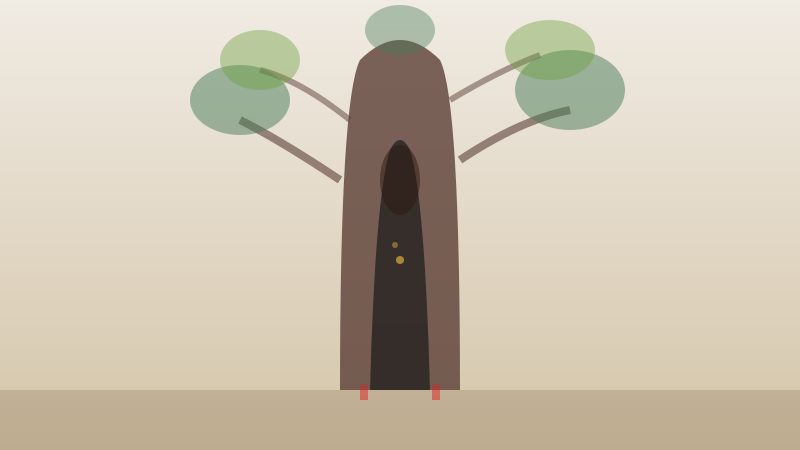
Hollow Means Not 'Empty' but 'Vessel' — The Heart of Yorishiro Philosophy
In Japanese faith, a hollow space is not interpreted as 'a place of nothingness' but as 'a vessel waiting to be filled.' This is deeply connected to the Shinto concept of yorishiro — objects that serve as landing places for invisible divine spirits descending to the earthly realm. Rocks, waterfalls, mirrors, and trees are all classic examples of yorishiro, and they share a common element: each contains an aspect of 'emptiness' within itself.
Gods are inherently formless beings. Precisely because they have no fixed shape, they can descend into empty spaces. Here lies the paradoxical logic that a hollow tree is more fitting as a divine vessel than a solid one. Chapter 11 of Laozi's Tao Te Ching states: 'We shape clay into a pot, but it is the emptiness inside that holds whatever we want.' This passage captures the very essence of the hollow sacred tree. The utility of a vessel lies not in its walls, but in the void they contain.
The shin-no-mihashira (heart pillar) at the center of Ise Grand Shrine's main hall is simply a single pillar standing at the center of an otherwise empty space. Nothing is placed around it — only intentional emptiness extends in all directions. This architecturally embodies the philosophy that 'emptiness' is where the divine resides. Izumo Grand Shrine follows the same principle: a sacred seat is placed at the center of a vast hall, with the surrounding space deliberately left open. Furthermore, the massive fir trees cut from mountains during Suwa Grand Shrine's Onbashira Festival are themselves destined to eventually hollow as their heartwood decays. The hollow sacred tree can be understood as nature's original prototype of this architectural philosophy.
Womb Passage and the Faith of Rebirth — The Maternal Tree
Tainai-kuguri — passing through hollow sacred trees — is a folk practice observed at shrines throughout Japan. The act of passing through a dark cavity symbolizes being born again through the mother's womb. It is a rite of passage for purging impurities and being reborn as a new self — a single act that encapsulates the three stages of rites of passage proposed by anthropologist Arnold van Gennep: separation, transition, and incorporation.
Several sacred sites are renowned for this practice. The great camphor tree at Kinomiya Shrine in Shizuoka Prefecture is said to be over 2,000 years old, with a cavity in its trunk large enough for a person to pass through. Legend holds that walking once around this camphor tree extends one's life by a year, and visitors continuously come to touch the hollow and offer prayers. Near Yakushima's Jomon Cedar stands the 'Wilson Stump,' the remains of a great cedar felled during the era of Toyotomi Hideyoshi. Its interior hollow spans roughly the size of ten tatami mats, and a small shrine is enshrined within. The hollow is famous for its heart-shaped view of the sky when one looks upward from inside — a phenomenon that is no mere coincidence, but rather evidence of a hollow's natural power to move the human heart.
In Yamanashi Prefecture, the grounds of Kitaguchi Hongu Fuji Sengen Shrine contain a 'womb-shaped lava tube' where tree-hollow worship and cave worship merge into a unique sacred site. When ancient lava flows engulfed giant trees and the wood burned away, the voids left behind formed tunnel-like caves — literally, tree hollows transcribed into stone, a miraculous geological formation.
At the foundation of this faith lies reverence for nature's cycle of death and rebirth. Trees continue to live while decaying, producing lush foliage while harboring hollows within. From a biological perspective, even when the interior heartwood is decomposed by fungi, a tree can continue growing for centuries as long as the cambium layer beneath the bark remains healthy. In other words, a hollow sacred tree is, even in scientific terms, an entity that 'lives while harboring death within.'
The Darkness Within and the Other World — Connections to Cave Worship
Hollow sacred trees carry another profoundly important meaning: they are 'gateways to the other world.' In Japanese faith, dark, confined spaces have been considered boundaries between the other world and our own. In the Kojiki and Nihon Shoki myths, the cave where Amaterasu hid — Ama-no-Iwato — was precisely such a dark, enclosed space where a deity concealed herself and then reemerged. The entrance to Yomi-no-kuni (the land of the dead), located at Yomotsu Hirasaka in Shimane Prefecture, also takes the form of a narrow passage between rocks.
The cavity of a sacred tree functions as a space possessing the same sanctity as a cave while remaining above ground. In practice, examples of small shrines built at the base of hollow sacred trees or tiny deity statues placed inside cavities can be found throughout Japan. At Mount Miwa — the sacred body of Omiwa Shrine in Nara Prefecture — shimenawa ropes are stretched across gaps in iwakura (sacred rocks), following the same principle as wrapping shimenawa around the hollow of a sacred tree. Both rock crevices and tree hollows are rifts that lead to 'the other side.'
Remarkably, similar concepts appear in mythologies worldwide. In Norse mythology, the world tree Yggdrasil harbors springs at its roots, and nine worlds are connected through its trunk. In Celtic mythology, hollows in oak trees were believed to be portals to the fairy realm. What distinguishes the Japanese tradition, however, is the practice of stretching shimenawa ropes across the hollow itself, establishing a kekkai (sacred boundary) to manage the interface with the other world. This reflects not mere fear of the unknown, but a respectful engagement with it.
Especially at night, when a hollow sacred tree is illuminated by moonlight, its darkness radiates an uncanny presence. Peering into that darkness, one feels as if something is gazing back. The folklorist Orikuchi Shinobu connected this sensation to the arrival of marebito — mysterious visitors from beyond. Something from the other world peers back at us from the depths of that darkness. Perhaps that intuition is the true nature of the spiritual power that the Japanese have felt from hollow sacred trees for over a thousand years.
The Natural Mechanics of Hollowing — Science Reveals What Lies Inside Giant Trees
The mechanism by which sacred trees become hollow has been thoroughly explained by modern dendrology. The interior of a giant tree's trunk consists of 'heartwood' — a mass of dead cells. While heartwood serves as important structural material supporting the tree, it is no longer living tissue and is therefore vulnerable to fungal invasion. When wood-decay fungi — primarily white rot fungi such as those in the order Polyporales and the species Phellinus — enter through wounds left by broken branches or holes bored by insects, they release enzymes that decompose lignin and cellulose. Over decades to centuries, the heartwood gradually disintegrates, eventually forming a hollow.
What makes this fascinating is the fact that a hollowed tree does not necessarily become weaker. In engineering terms, a hollow pipe has greater bending strength than a solid rod of the same weight. This can be explained by the principle of the 'second moment of area': the farther material is distributed from the center, the greater its resistance to bending forces. This is the same principle that makes bamboo flexible yet resistant to breaking. Indeed, it is not uncommon for hollow giant trees to withstand typhoons and remain standing for centuries. When Typhoon Hagibis (Typhoon No. 19) struck in 2019, felling trees across the country, the great camphor of Kinomiya Shrine stood firm.
Furthermore, the interior of a hollow forms its own unique ecosystem. Animals such as bats, owls, flying squirrels, and geckos take up residence, their droppings decompose to enrich the soil, and leaf mold accumulates on the cavity floor, from which fungi, moss, and new roots emerge. Research by British ecologists has documented hundreds of invertebrate species living within a single ancient hollow tree. Far from being a 'dead space,' a hollow is 'another forest' that nurtures diverse life. Ancient Japanese people sensed vitality within these hollows, and this may well be because they intuitively grasped these ecological realities.
Hollow Sacred Trees Across Japan — Ancient Giants That Carry Faith to the Present
Throughout Japan, numerous sacred trees with hollows survive to this day, continuing as objects of worship. Let us introduce several representative examples.
The great camphor tree at Kamou Hachiman Shrine in Kagoshima Prefecture has been certified as Japan's largest tree by the Ministry of the Environment's Giant Trees Survey. With a trunk circumference of approximately 24.22 meters and an estimated age exceeding 1,500 years, its interior contains a hollow the size of roughly eight tatami mats. A small Inari shrine was once housed within this space. Shimenawa ropes are stretched across the entrance to the hollow, and the cavity itself is treated as sacred ground. Designated as a Special Natural Monument of Japan, it stands as the most iconic example of the unity between hollow and faith.
At Atsuta Shrine in Aichi Prefecture, a sacred tree called the 'Great Camphor' is said to have been planted by the monk Kukai (Kobo Daishi). This camphor also contains a large hollow, and legend holds that a white snake dwells within. White snakes are considered divine messengers, and their presence is seen as proof that the hollow is indeed a dwelling place of the gods. Some visitors recount actually having seen a snake emerge from the depths of the cavity.
The 'Chichibu Cedar' at Takachiho Shrine in Miyazaki Prefecture is a giant cedar estimated to be over 800 years old. A hollow exists at the base of its trunk, and local tradition says that pressing one's ear against this hollow allows you to hear the voice of the gods. It is believed that such legends arose because the hollow functions as a resonance chamber, amplifying the sound of wind and subtle vibrations from moisture flowing through the tree's interior. From an acoustic perspective, cylindrical hollows are known to act as Helmholtz resonators, selectively amplifying specific frequencies.
Conservation and Modern Challenges — Preserving the Legacy
Hollow sacred trees are products of nature, but they are also cultural heritage that has been preserved through human stewardship. In the modern era, however, their conservation faces a variety of challenges.
The most significant issue is the adverse effects of 'cavity filling' treatments conducted in the past. From the mid to late Showa period, filling hollows with concrete or urethane foam was widely practiced as a form of tree surgery. Current research, however, has revealed that this treatment actually weakens trees. The filling material blocks ventilation inside the trunk, trapping moisture and accelerating new decay. Modern arboriculture now recommends leaving hollows open, ensuring proper drainage, and maintaining dry conditions within.
Urbanization-driven changes in groundwater levels and air pollution also affect the health of sacred trees. Paving over root zones and soil compaction from foot traffic accelerate tree decline. Shrines across the country have responded by installing fences around root areas to restrict access and by implementing soil improvement measures. At the great camphor of Kamou, certified arborists conduct regular examinations, monitoring moisture content within the hollow and tracking fungal activity.
What Hollow Sacred Trees Ask of Us — The Source of Japanese Spatial Sensibility
Faith in hollow sacred trees runs deeply parallel to the aesthetics of 'emptiness' in Japanese culture. The spirit of tea ceremony that perceives the universe within the narrow space of a tea room; ink wash painting that imbues blank space with meaning; Noh theater that entrusts emotion to the silence between sounds — all of these are rooted in a distinctly Japanese sensibility that essence resides in 'emptiness' and 'nothingness.' The architect Arata Isozaki used the concept of 'ma' (interval/void) when discussing Japanese architectural space, and the hollow sacred tree is arguably the original archetype of this 'ma.'
If we trace this sensibility to its origins, we likely arrive at the hollow of a sacred tree. Archaeological excavations at the Sannai-Maruyama site from the Jomon period revealed six massive chestnut pillars, each roughly one meter in diameter, arranged in a circle. The space enclosed by these pillars — the 'central void' — may represent the very origin of the Japanese sense of space. While Western churches extend towers toward heaven and express divine glory through magnificent decoration, Japanese shrines welcome the gods by opening up space. At the root of this difference lies the intuition received from hollow sacred trees: that emptiness is fullness.
Even we who live in the modern age feel an inexpressible sense of awe when standing before a hollow sacred tree. When gazing into the dark opening in a massive trunk, we sense not 'nothingness' but 'something.' This sensation is the essence of hollow-tree worship that has shaped the Japanese spirit for thousands of years. The hollow of a sacred tree continues to quietly ask us, even now, to believe in the existence of what cannot be seen.
About the Author
Shrine Secrets Editorial TeamWe uncover the hidden secrets of Japanese shrines and Shinto, making them accessible to everyone.
View author profile →Related Articles
The Mystery of Shrine Gardens and Water — Nature Worship Encoded in Sacred Landscaping
The Mystery of Shrine Curtains — The Sacred Boundary Woven into White Fabric
The Mystery of Genbu Faith: Why the Turtle-Serpent Guardian of the North Appears in Shrines
The Mystery of Shimekiri Rituals: The Sacred Act of Cutting the Shimenawa