The Mystery of Tamayori-hime — The Sea God's Daughter Who Became Mother of the First Emperor
Recorded in the ancient chronicles as the mother of Emperor Jimmu, Tamayori-hime carries in her very name — "she to whom spirits cling" — the echoes of ancient shamanic faith. Explore this enigmatic goddess worshipped across Japan.
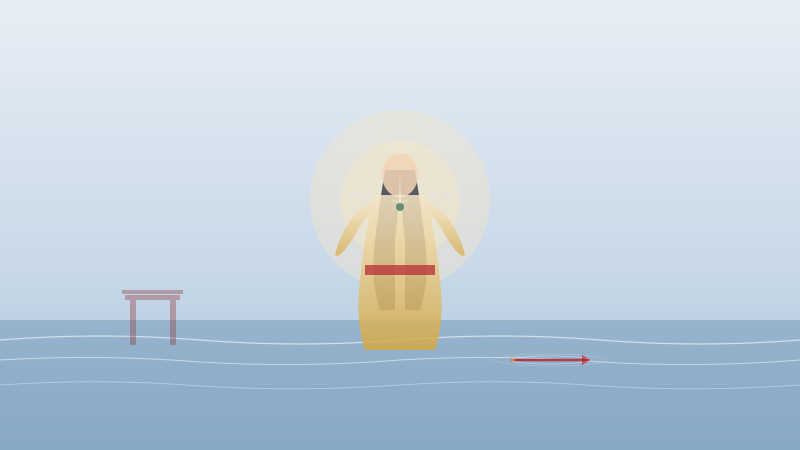
Tamayori-hime in the Ancient Chronicles — The Mother of Emperor Jimmu
The story of Tamayori-hime begins in the palace of the sea god. When Yamasachihiko — son of the heavenly grandchild Ninigi — descended to the undersea realm and was wed to Toyotama-hime, a daughter of the sea god Watatsumi, he eventually returned to the surface with his pregnant wife. On the beach, Toyotama-hime begged him not to look into the birthing hut. Yet curiosity overcame him, and he peered inside to see his wife in her true form — a great crocodile, or dragon. Ashamed, Toyotama-hime returned to the sea, leaving her child behind. In her place, she sent her younger sister, Tamayori-hime, to raise the child on land. This is the mythic framework set out in the chronicles.
The child in question, Ugayafukiaezu, grew into a man and eventually took his aunt — and foster mother — Tamayori-hime as his wife. They had four sons, the youngest of whom would one day become Emperor Jimmu, the legendary founder of the Yamato dynasty. Through this genealogical chain, Tamayori-hime occupies a position of singular importance in the mythic narrative: she is the maternal origin point of the entire imperial line.
At first glance the tale reads as a simple mythological episode, but layered within it are multiple meanings. The marriage of a sea god's daughter to a land-dweller represents a sacred union bringing oceanic power onto terrestrial soil, and the fact that her descendant becomes king signals that Japanese sovereignty is grounded in the sanctity of the sea. The familiar structure of the "forbidden gaze" — the husband who looks when told not to — conveys through the sisters Toyotama and Tamayori a uniquely Japanese perspective on marriage and the boundary between worlds.
The Mystery of the Name "Tamayori" — A Shamaness Who Hosts the Spirits
The key to understanding Tamayori-hime lies in her name itself. In ancient Japan, tama meant "soul" or "spirit," and was closely associated with magatama beads and sacred mirrors as vessels for the spirit. Yori means "to cling to" or "to take up residence." Thus tama-yori literally means "one to whom a spirit attaches" — a figure capable of hosting divine presence. In other words, Tamayori-hime is at once a personal name and a generic term for a shamaness who channels the gods.
In ancient Japanese ritual, a central role was played by female mediums who brought the divine will into the human world by inviting the gods to descend into their bodies. The name Tamayori appears to deify this very function. Indeed, apart from the Tamayori-hime of the imperial genealogy, several other Tamayori figures appear across myth and legend — such as the Ikutama-yori-bime who bore a child to Omononushi of Mount Miwa (the famous "thread-and-spool" tale), and the Tamayori-hime said to be the mother of Kamo Wakeikazuchi.
This strongly suggests that "Tamayori-hime" is less the name of a single individual than a category — a shamaness archetype revered in communities across ancient Japan. The Tamayori-hime of the Jimmu story is the crystallization of this widespread shamanic cult within the mythic framework. Her omnipresence across regional shrines reflects precisely this archetypal breadth.
Tamayori-hime as Mother of Kamo Wakeikazuchi — The Crimson Arrow Legend
One of the most famous Tamayori-hime legends is preserved at Kyoto's Upper and Lower Kamo Shrines. According to a surviving fragment of the Yamashiro Fudoki, the Tamayori-hime of the Kamo clan was playing beside the Semi stream when a crimson-painted arrow floated down from upriver. She retrieved the arrow and placed it on the shelf in her room, whereupon she became pregnant and gave birth to a son. That son was Kamo Wakeikazuchi — "Kamo Young-Thunder-God" — who became both god of thunder and god of harvest, and the ancestor deity of the Kamo clan.
This story has a striking internal structure. The arrow, carried by the flowing water, is a yorishiro — a vessel for divine presence. By receiving the arrow, the maiden conceives the divine child. Once again the essence of tama-yori — "receiving and hosting a spirit" — is present in its purest form. Pregnancy through a sacred object delivered from an otherworldly realm is a mythic expression of the shamaness's function.
The precincts of Shimogamo Shrine enshrine both Tamayori-hime and her father, Kamotaketsunumi-no-Mikoto. The Aoi Matsuri held each May is among the oldest continuously observed festivals in Japan, with roots that reach back to the ancient rituals of welcoming these Kamo deities. Walking through Kyoto, one can sense — in the murmur of a brook, in a votive arrow hanging on a plaque — the breath of this legend fifteen centuries old.
One spring morning, I happened to walk through the Tadasu no Mori forest path leading to Shimogamo Shrine. Nothing dramatic happened, but the air felt unusually clear and the stream beside the path sounded different somehow — alive, almost attentive. Listening to it, I caught myself thinking, for no good reason, that perhaps the morning she found the arrow looked like this one. That kind of small imaginative slip — not belief, exactly, but feeling the possibility of a scene — is among the gifts shrines quietly offer to those who visit them without hurry.
Shrines Dedicated to Tamayori-hime — A Network of Sea-Peoples' Faith
Shrines dedicated to Tamayori-hime are found throughout Japan. Prominent examples include Shimogamo Shrine in Kyoto, Aoshima Shrine in Miyazaki, Yatsushiro Shrine in Kumamoto, Tamatare-gu in Fukuoka, and Tamahime Shrine in Okayama. The distribution is particularly dense in western Japan, and many of these shrines stand close to the sea or along rivers — overlapping geographically with the ancient sphere of the ama, the sea-peoples of archaic Japan.
The ama were a seafaring population who traveled widely along the currents of the Japan Sea and the Pacific, venerating the sea god Watatsumi as their ancestral kami. Because Tamayori-hime is Watatsumi's daughter, it is believed that various ama clans came to enshrine her as their tutelary goddess. Mapping the shrines that enshrine Tamayori-hime reveals something resembling the sea-routes of ancient Japan.
The coastal region of Miyazaki, where Aoshima Shrine stands, overlaps geographically with the setting of the Yamasachihiko and Toyotama-hime myths — and local tradition holds that Tamayori-hime raised Ugayafukiaezu here alongside her sister. In Fukuoka, the very name "Tamatare" — literally "spirit-hanging" — hints at the shamanic ritual of summoning divine presence, making Tamatare-gu one of the central sites of Tamayori veneration in Kyushu. Visiting such shrines in succession reveals a goddess whose influence far exceeds her appearance as a single character in the chronicles.
Goddess of Safe Childbirth, Child-Rearing, and Matchmaking — Faith Alive Today
As the mother who raised Emperor Jimmu and gave birth to Kamo Wakeikazuchi, Tamayori-hime is widely venerated today as a deity of safe childbirth, child-rearing, and matchmaking. At Shimogamo Shrine, a small shrine dedicated to matchmaking called Aioi-no-Yashiro stands near her main sanctuary, together with a mysterious pair of sakaki trees that merge at the roots and then branch out again — a natural image of sacred union symbolizing the goddess's matchmaking power.
It is common for expectant mothers to visit shrines enshrining Tamayori-hime to pray for safe delivery. The virtue of a mother goddess who successfully raised the founder of a dynasty is felt as a supportive presence for modern parents facing the challenges of bringing new life into the world. Many families also choose her shrines for the hatsumiyamairi (first shrine visit) and shichi-go-san rites.
For today's worshippers, Tamayori-hime is not a distant mythological figure but a symbol of maternal gentleness, the tender care of raising a child, and the love that binds a family together. Even in a highly rationalized contemporary society, in moments as elemental as the arrival of a new baby or the weaving of family bonds, the ancient prayer to the goddess retains a surprising immediacy.
What the Faith of Tamayori-hime Reveals About Japanese Views of Women and Motherhood
Tamayori-hime's story illuminates the close relationship between womanhood and sanctity in early Japan. In Shinto thought, women have long held pivotal roles as those who hear the voice of the kami and host divine power. Amenouzume dancing before the rock cave, shamanic queens such as Himiko, and Tamayori-hime herself — all attest to women as mediators between the divine and human realms.
Remarkably, Tamayori-hime is never portrayed as a powerful ruler or a warrior goddess. She is "the one who receives," "the one who nurtures," "the one who connects." Receptivity, nurture, mediation — these virtues may seem passive at first glance, but they are in fact deeply active forces that sustain a community from below. The posture of a shamaness receiving divine presence is also the posture of deep receptivity toward others, carrying an ethical depth that resonates with modern life.
The duality of Tamayori-hime — both the ancestor of an imperial line and the everyday mother raising a child — reflects a Japanese religious sensibility that refuses to separate the sacred from the mundane. To know Tamayori-hime is not merely to memorize a mythological detail; it is to understand how Japanese culture has long braided together femininity, motherhood, and sanctity into a single resonant thread.
Visiting Tamayori-hime Today — A Quiet Pilgrimage
When visiting a shrine dedicated to Tamayori-hime, I would gently recommend choosing a calm weekday morning rather than a grand festival day. Places such as the Tadasu no Mori of Shimogamo, the strange washboard-rock coast of Aoshima, or the quiet inner precincts of Tamatare-gu reveal their true atmosphere precisely in hours unburdened by crowds.
Tamayori-hime never reveals herself, leaves behind no grand exploits, and enters the chronicles only as one who welcomes the gods and raises a child. For that reason, the shrines dedicated to her call less for loud prayer than for a quiet hand-clap and an attentive silence. The murmur of a stream, the rustle of the forest, the faint fragrance drifting from inside the sanctuary — it is within such delicate presences that Tamayori-hime can be felt.
In ordinary family conversation, people sometimes say things like, "Our ancestors are watching over us." Trace that feeling back far enough, and you arrive at the faith of goddesses like Tamayori-hime — "she to whom spirits cling." To learn the names of the kami enshrined at a Shinto shrine is to slowly remember where we come from and what, across centuries, we have chosen to hold dear. Keep the name Tamayori-hime in mind on your next shrine visit, and there will surely be something new to discover.
About the Author
Shrine Secrets Editorial TeamWe uncover the hidden secrets of Japanese shrines and Shinto, making them accessible to everyone.
View author profile →Related Articles
The Mystery of Kakebotoke — The Circular Metal Plaques That Preserve the Memory of Shinto-Buddhist Fusion
Voices of the Age of Gods — How Sound and Vibration Reveal Shinto Cosmology
The Mystery of Kishōbun — Sacred Oaths Sealed with Blood Before the Gods
The Mystery of Obake-Tourou: The Giant Stone Lanterns That Tower Over Shrine Grounds