The Mystery of Kiyari-uta — The Sacred Work Song That Carries the Gods Into Shrine Timbers
When sacred timbers are hauled from the mountains to a shrine, workers chant together in a song called Kiyari-uta. Far from mere labor song, it is the ritual itself — binding gods and humans, and moving immense beams. Explore its origins, structure, and enduring meaning today.
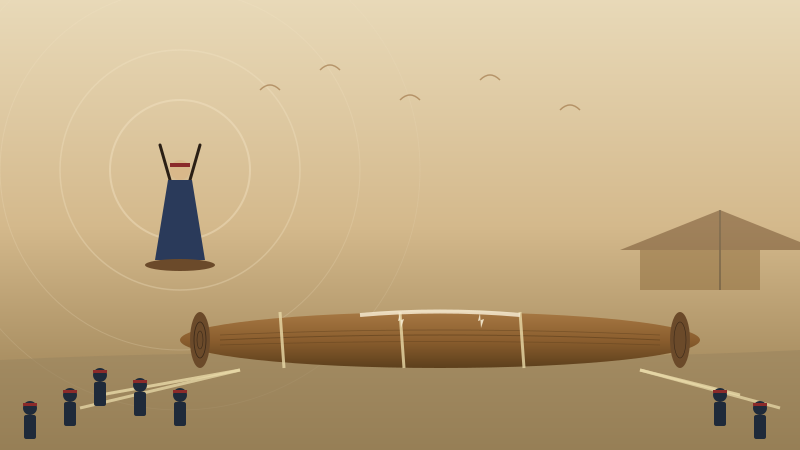
What Is Kiyari-uta? The Voice That Calls the Gods Into Moving Wood
Kiyari-uta is a distinctive Japanese work song in which a lead singer emits a long, high call, and a chorus of haulers answers in unison, all while dragging massive timbers or stones in a coordinated group. It has been sung for centuries in the construction and rebuilding of shrines, in the hauling of sacred trees, in the building of festival floats, and even in the acrobatic ladder displays of Edo's firefighters — wherever heavy, dangerous work required many bodies to move as one.
The bond with shrine tradition is particularly strong in events such as the Okihiki at the Ise Grand Shrine, held as part of the Shikinen Sengu rebuilding; the Onbashira festival at Suwa Taisha; and similar timber-hauling rites around the country. Enormous cypress or fir logs are dragged by hand from the mountain road down to the shrine grounds. A lead singer — the kiyari-shi — opens with a resonant, soaring call like "Iya—are—ha—yooi—yana—," and hundreds of haulers grip the thick rope and synchronize their step. If the voices align, the strength converges on the rope; if they fracture, the timber refuses to move. The song is a technology for harmonizing human breath, and simultaneously an incantation that calls the kami.
Origins — The Ancient Invention of "Voice as One"
Kiyari-uta's origins are not clearly documented, but fragments of evidence suggest that ancient Japan already regarded coordinated voices as sacred in both labor and ritual. In the Kojiki, Okuninushi summons the gods of various regions when building the land, and Emperor Jimmu's expedition chants as one body on its eastward march. The collective voice itself was thought to give shape to divine intention.
In the Nara period, colossal works such as the Daibutsuden of Todaiji and the construction of Heijo-kyo required moving immense timbers and stones. The labor groups organized for this work surely kept time with calls of some kind. By the Heian period, the Engi-shiki had codified the cutting and transport of shrine timbers, indicating that a ritual system for sacred wood-moving was already in place.
The word kiyari literally means "to send the wood" — to dispatch it, to move it along. This is not merely physical transport. It carries the sense of sending the divine spirit dwelling in the wood to its new abode. A tree felled from the mountain is understood as a portion of the body of the mountain kami; to handle it roughly is to invite a curse. This awe is precisely what gave the solemn tone to kiyari melodies. The song is a dignified protocol for soothing the tree's spirit while it is moved.
Structure — The Call and Response of Leader and Chorus
Kiyari-uta rests on a simple yet extraordinarily powerful musical structure: one lead singer, many responders. The lead stands high, projecting a high-pitched melody designed to travel. The haulers, hearing that voice, answer in a short, low phrase in unison.
At the Ise Okihiki, a long call of "Iya—are—ha—yooi—ya—na—" is met with "Yo-i, yo-i" or "Enya—." At Suwa's Onbashira, a call of "Yoi-sa, yoi-sa" receives "Ei-yo—." Between each exchange, the rope is pulled together. The song is not background music. It is the extended form of the command — the very thing that produces force.
What is striking is that each region and shrine has its own melody. Ise has its tune, Suwa has its tune, the Edo firefighters theirs. Each reflects a local landscape and faith. The lead singer is not merely a timekeeper but the bearer of the "vocal memory" of that land. Because the melody is passed from master to apprentice orally, with no fixed score, when a line of transmission dies, the tune is lost. The aging of kiyari-shi and the shortage of successors across Japan today make this an urgent cultural issue.
The Ise Okihiki — A Song Revived Once Every Twenty Years
Ise Grand Shrine rebuilds its sanctuaries every twenty years, and the preparation includes a long sequence of ceremonies. Among them, the Okihiki is a grand public ritual in which faithful from across Japan gather in Ise and haul the new timbers by hand. After a formal Okihiki-zome ceremony, multiple sessions of hauling proceed until all the great pieces are delivered to the shrine.
The Ise kiyari has been guarded for generations by the people of the shrine domain. It is characterized by soaring high tones and a deliberately unhurried pace. The opening call of "Iya—oo—oo—, yooi—ya—na—" directs the application of pulling force, and at the same time serves as a formal greeting to the tree-kami: "We are now about to escort you to the shrine." According to tradition, if the melody falters the timber suddenly feels heavier — so inseparable are song and labor.
When I watched footage of an Okihiki on a regional television program once, I was, frankly, moved by the voice of the lead singer on the other side of the screen. Even through a microphone, it felt unpretentious and at the same time utterly taut, and the effort of hundreds of haulers breathing as a single body reached me through my spine. This was not merely the transport of heavy wood; it was unmistakably a rite. Whenever people, matter, and voice tremble to the same rhythm, something genuinely sacred rises in the space. Every time I hear a kiyari, that realization returns.
The Onbashira of Suwa — A Kiyari of Risk and Descent
The Onbashira festival of Suwa Taisha, held once every six years by Japanese counting, is famed as a rite in which enormous fir logs are cut from the mountain and erected at the four corners of the shrine. Its most dramatic moment, the Kiotoshi, sends the logs plunging down a slope of more than thirty-five degrees with parishioners still straddling them. Running through every phase of the festival is the distinctive Suwa kiyari melody.
Suwa's kiyari reaches an even sharper, higher register than Ise's, with calls that almost cry out: "Yo—i—sa—, yo—i—te—ko—sho—." Just before the Kiotoshi descent, as tension peaks, only the lead singer's voice rings through the valley. At that instant, the air of the whole place tightens, and in the next breath the great log goes thundering down. Voice as signal, as prayer, and as farewell rite — the essence of kiyari-uta is concentrated in that moment.
Suwa kiyari lyrics weave together many wishes — "the heart of the kami receiving the pillar," "the safety of the haulers," "the fertility of the region." No ordinary work song reaches this depth. After the festival, the lead singers are said to speak with quiet pride of how their voice contributed to the success of the rite — a pride rooted in a ritual tradition more than a thousand years old.
Edo Firefighters and Kiyari — A Song That Spread Into Popular Culture
Kiyari-uta did not belong solely to shrine precincts. It was deeply woven into the popular culture of Edo, especially among the machi-bikeshi, the city's firefighters. At a fire, firefighters used great ladders and tobiguchi hooks to pull down burning eaves, coordinating their actions with a signature call. In the New Year's public display of Dezome-shiki, the men steadying the ladder at its base sang kiyari to regulate the breath of the acrobat balancing at its top.
Edo kiyari carries a lighter, more stylish cadence than shrine kiyari, intertwined with the aesthetics of the matoi standard-bearers. A celebratory kiyari — "Yari-masho, yari-masho, o-rei ni mairi-masho" — is still performed today at house-raising ceremonies, ridgepole rites, and store openings. Even where the ritual background is not consciously remembered, the fundamental intuition is the same: when something important is moved, or a new space is consecrated, human hearts should be synchronized through voice. Beneath this lies the old idea from shrine kiyari — that voice ties together people, matter, and kami.
Kiyari-uta Today — Disappearing and Being Renewed
In an age of machinery, the kiyari-uta has almost vanished from everyday labor. Cranes and trucks now carry the beams, and hundreds of haulers on a single rope are no longer necessary. But the voice and the melody survive — narrowly — through shrine rites, local festivals, and the efforts of preservation societies.
At Ise's Okihiki, at Suwa's Onbashira, at countless float-pullings, ground-breaking ceremonies, and ridgepole rites, today's kiyari-shi work to protect the old melodies and pass them to the next generation. Increasing numbers of kiyari traditions are being designated as intangible folk cultural properties, and preservation societies now visit elementary schools to teach children how to sing. Digital recordings are being made, yet the heart of the matter is still the lived experience of voices sounding toward other voices. A recording alone cannot teach the body that single instant when feet, rope, and timber converge.
On a family outing to a festival, we happened to observe a kiyari rehearsal. Watching children tentatively answer "Enya—" after an adult lead, I was struck by the ordinary fact that a voice is being handed, person to person, down the generations. An older relative beside us murmured, "There used to be a kiyari in every neighborhood," and the expression on his face stayed with me afterward. A quiet, unspoken adult hope — to keep even a small warmth of what is being lost — was clearly present in the room.
What Kiyari-uta Teaches Us — Voice, Work, and the Kami as One
Studying kiyari-uta offers deep insight into the relationship among "voice," "work," and "kami" in Japanese culture. Western frameworks tend to separate labor and prayer into distinct domains. In kiyari, however, the aligning of voices is at once a calling of the gods, a making of the work, and a binding of the people. Three things move simultaneously.
This logic carries straight into modern teamwork and organizational life. Aligning voice, breath, and timing is a matter of physical efficiency, but also a gesture that raises the sacredness of a space. The ceremonial greetings at the start of meetings, the morning call at construction sites, the shouted cadence at the opening of a workday — these are the shadows of that older practice. Kiyari-uta is one of the few cultural treasures that still lets us feel the full-body version of this vanishing sensibility.
The next time you encounter a kiyari-uta at a shrine rebuilding or festival, listen carefully. In the instant when one long, high call draws out an answer from a great crowd, and a heavy beam begins to inch forward, a uniquely Japanese form of time is flowing — a time in which kami, people, and matter all sit within a single breath. When, even briefly, you share the memory of a voice sung for more than a thousand years, something genuinely sacred will rise in you as well.
About the Author
Shrine Secrets Editorial TeamWe uncover the hidden secrets of Japanese shrines and Shinto, making them accessible to everyone.
View author profile →Related Articles
The Mystery of Kougoishi — Ancient Stone Lines Sleeping in the Mountains That Tell of a Lost Sacred Realm
The Mystery of Kamimukae-sai — The Sacred Night When All Gods Gather on Izumo's Inasa Beach
The Mystery of Tamayori-hime — The Sea God's Daughter Who Became Mother of the First Emperor
The Mystery of Kakebotoke — The Circular Metal Plaques That Preserve the Memory of Shinto-Buddhist Fusion