The Mystery of Tezutsu Hanabi — The Fiery Shrine Offering Where a Single Worshipper Holds a Cylinder of Sparks
Imagine a man cradling a bamboo cylinder against his body while a torrent of sparks pours from above his head. Tezutsu hanabi, centered in the Mikawa region, is not a tourist fireworks show but a shrine offering. Here we trace its origins, the link with Tokugawa Ieyasu, and the prayer it carries into the present.
What Is Tezutsu Hanabi? Fireworks Held in a Single Person's Arms
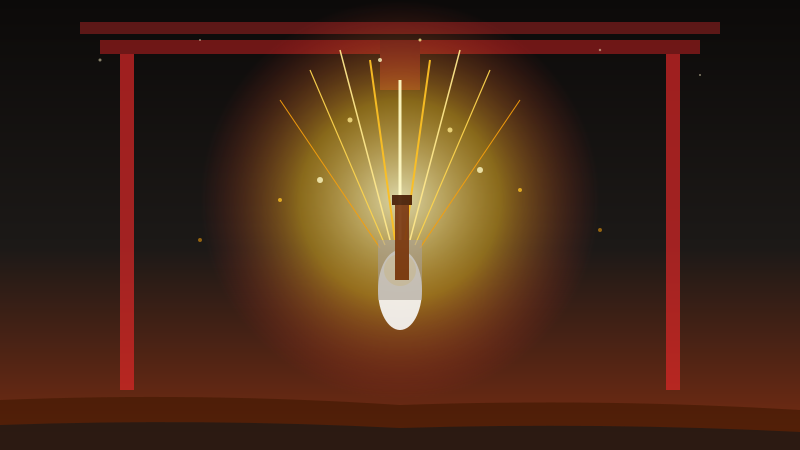
A summer night in a shrine precinct, a vermilion torii gate floating in the dark. In front of it stands a single man dressed in white, cradling a long bamboo cylinder against his hip. The instant of ignition: a torrent of sparks bursts from the mouth of the cylinder, climbs far above the man's head, and paints the night sky in gold. Sparks rain onto his shoulders, his back, even his feet, but the man does not move. He simply continues to hold the cylinder. This is the scene of tezutsu hanabi, a tradition centered in the Mikawa region of Aichi Prefecture.
Tezutsu hanabi is fundamentally different from a tourist fireworks display. First, the cylinder filled with gunpowder is held directly by a single human being. Second, it is not a commercial show but a sacred offering to a shrine. Third, the people who hold the cylinder, called age-te ("the lifters"), are local parishioners. They purify themselves at the shrine and earn the right to stand once a year before the kami with a cylinder in their arms. The column of sparks rises several meters and at its largest can reach more than ten, burning for about one minute. While that storm of sparks falls all around him, the age-te is expected to maintain his stance to the very end.
The phrase "life on the line" is not exaggeration. Each year's tezutsu requires more than half a year of preparation: the mixing of the powder, the selection of bamboo, the conditioning of the body. Why have the people of Mikawa accepted such labor and risk to keep offering this fire to their shrines? The answer lies in the unusual history that bound gunpowder and shrines together in the late Sengoku and Edo periods.
Origins — Tokugawa Ieyasu, the Mikawa Gunners, and Toshogu Devotion
To understand tezutsu hanabi, one cannot ignore the regional character of Mikawa, the homeland of Tokugawa Ieyasu, and the gunpowder culture of the Sengoku era. Mikawa had long been home to a strong gunner culture; in the Sengoku era, small lords serving figures like Takeda Shingen and Imagawa Ujizane developed their own techniques for making gunpowder. After Ieyasu's unification of the country and the arrival of peace, those skills shifted away from war and into shrine offerings and local festivals.
This is especially evident in the Toshogu cult that worships Ieyasu as a kami. After his death, Toshogu shrines were established across Japan, and parishioners in Mikawa devised their own ritual of offering gunpowder as part of the rites that honored him. What began as something close to simple smoke signals or basic fireworks was refined, over the course of the Edo period, into the distinctive style of holding a bamboo cylinder and lifting sparks into the air. Yoshida Shrine in Toyohashi (today including Yoshida Shrine and Hada Hachimangu) is known as one of the birthplaces of tezutsu hanabi, and even now, in its July festival, hundreds of cylinders are offered each year.
Tezutsu hanabi is a rare ceremony in which three threads — the gunner culture of the warrior class, the offering culture of the shrine, and the local pride of land tied to Ieyasu — are woven into a single cord. If festival fireworks for tourism are "art that draws pictures in the night sky," tezutsu hanabi is, by contrast, "the warrior's spirit cradled around fire and offered to the kami" — an intensely religious and bodily act.
How a Cylinder Is Made — Half a Year's Work in a Single Tube
The bamboo cylinder of a tezutsu carries far more craft than its appearance suggests. The most suitable material is a hachiku-type bamboo two or three years old, with long internodes, carefully selected from local groves. After cutting, the inside of the bamboo is smoothed; the outside is then bound tightly with rope. This binding is reinforcement to prevent the cylinder from splitting and scattering during combustion. Some age-te will write their family crest or the name of the shrine on top of the rope.
The powder is mixed according to traditional formulas handed down regionally, and the loading of the cylinder is done by the age-te himself under the supervision of a licensed pyrotechnician. The powder is layered in stages: the upper layer produces the rising sparks, the lower layer produces the final hane ("jump") of sound and light. Each cylinder holds roughly one to two kilograms of powder and burns for about a minute.
The age-te begins his preparations at the shrine half a year in advance. He learns the handling of powder and bamboo, reviews past accident cases, conditions his body and mind, and steadies himself for the day. Each cylinder is a single-use object; after the offering, it is either burned within the precinct or kept by the age-te as a personal memento. Each one carries a half-year of one person's prayer and preparation — a literal handmade offering.
The Stance of the Age-te — What It Means Not to Move
What strikes anyone who witnesses tezutsu hanabi most deeply is the stance of the age-te while sparks pour over him. He drops his hips, sets his feet about shoulder-width apart, supports the cylinder with his left hand, and stabilizes it with his right. His gaze is set somewhat into the distance; his expression is steady; even as sparks pour past his face he keeps blinking to a minimum. That stillness alone is enough to take the audience's breath away.
The age-te's costume strongly underscores its character as a sacred rite. A white headband, white under-robe, white leg coverings, white tabi — white is the color of purity, the proper attire for one who stands before the kami. Before stepping forward, the age-te performs a misogi at the shrine, is purified with salt, and receives the priest's harae. The very act of being bathed in sparks is one form of prayer; by accepting pain and danger, he burns away sin and impurity. That structure is woven through the rite.
Not moving has a technical meaning as well. Any wavering of the arms holding the cylinder will send sparks straight into the age-te's own face or neck. Any disturbance of the feet will leave him unable to absorb the impact when the final hane fires from the cylinder's base, and he can fall. The unmoving stance is at once a non-negotiable safety technique and a complete physical expression of submission to the kami.
Beyond Mikawa — Where Tezutsu Hanabi Is Practiced Today
The heartland of tezutsu hanabi is still the eastern half of Aichi Prefecture, especially Toyohashi, Toyokawa, Shinshiro, and Gamagori — corresponding to the old province of Mikawa. The Gion Festival of Yoshida Shrine in Toyohashi, the annual rites of Toga Shrine in Toyokawa, the powder festival of Yamaga Mikatahara Shrine in Shinshiro — all are major regional rites in which hundreds of cylinders are offered between summer and autumn. The Toyohashi Gion Festival in particular draws large crowds, and the line of age-te in the night precinct, with column after column of fire rising one after another, makes for a summer scene that does not easily leave the memory.
In recent years, age-te trained in Mikawa have increasingly been invited to perform offerings at festivals in Shizuoka, Tokyo, and elsewhere in the Kanto region. Even so, anyone who handles powder is bound by strict legal regulation; this is not something one can simply decide to do. The work must be done under a licensed pyrotechnician with a valid powder-handling certificate, with permits from the local fire authority, and with rigorous safety protocols.
In an era of declining birth rates and aging populations, the shortage of age-te is a serious concern. Half a year of preparation, the handling of powder, participation in a sacred rite — none of these are sustainable without a certain margin in daily life. At the same time, in some regions municipalities and shrines are actively training younger age-te and seeing the rite as a pillar that holds local community together. Each region is now finding its own path between tradition and modern conditions.
From Personal Experience — One Cylinder on a Summer Night
At the end of summer some years ago, I happened to be in the Tokai region for work, and a local acquaintance invited me to drop in at the eve festival of a nearby shrine. It was a small festival not listed in any guidebook, but several hundred parishioners and locals had gathered. The summer-night warmth, the voices of insects, and the smell of someone's incense mingled together, oddly, in the precinct.
A little after eight in the evening, a man in white slowly stepped out in front of the haiden. He was perhaps in his late forties. His face held both tension and a calmer kind of settledness. After receiving the priest's purification, he cradled a thick bamboo cylinder against his hip and let out a deep breath. A beat of silence, and then ignition.
The next instant, a torrent of golden sparks roared up into the night. The sparks rose far above his head, and I could clearly see the embers falling onto his shoulders, his chest, his arms. And yet, the man did not move. The whole audience held its breath and simply watched. After about a minute the burn finished, the final hane echoed across the precinct, and almost without thinking I had brought my hands together. This is not entertainment, this is a real prayer — that thought reached me, almost through the skin, in that moment. Later I was told that the age-te had taken on the role this year in place of his recently passed father. There is someone here cradling fire for his family — that fact stayed with me, alongside the air of that summer night, for a long time afterward.
Fire and Shinto — Why Flame Has Always Been Held Sacred
At the heart of tezutsu hanabi lies the sacredness of fire in Shinto. Fire is one of Shinto's most primal elements, traceable back as far as the birth of Hi-no-Kagutsuchi-no-Kami in the Izanagi-Izanami myth. Fire burns away impurity, purifies space, and calls down the kami; this belief still runs through such modern observances as the burning of old amulets at otakiage, the New Year sagicho or dondo-yaki bonfires, fire-walking rites, and the goma fires of esoteric Buddhism.
Tezutsu hanabi is one of the most dramatic embodiments of this sacred fire. Using the artificial tool of gunpowder, a human being offers fire through his own body. The age-te's body becomes a yorishiro that links flame and kami. To stand under the rain of sparks may seem dangerous in modern terms, but in Shinto it is also one of the most carefully chosen postures for facing the kami at the closest possible distance.
What decisively distinguishes tezutsu hanabi from tourist fireworks is precisely this physicality. If lifted-up fireworks are something thrown at the sky to be admired from afar, tezutsu hanabi is something a human being takes onto his own body. The meaning of drawing close to the kami, the weight of risking one's life — the deepest form refined over long centuries by Japanese ritual culture is concentrated in this single minute of burning.
On Watching Tezutsu Hanabi Today — Between Safety and Faith
Even with modern safety equipment and strict gunpowder regulations, tezutsu hanabi still carries some real risk: burns to the age-te, injuries to spectators, surprise misfires. Hosting shrines and municipalities institute meticulous safety measures every year and run the events in close cooperation with fire and police authorities. As a visitor, please always remain inside the designated viewing area and avoid interfering with the age-te or the rite itself.
Why then, even so, do we go to see it? One reason may be that this is a rare place where one can encounter, with one's own eyes, a kind of "faith embodied in the flesh" that is steadily being lost in modern life. Not a ritual that can be completed inside a smartphone, but the sweat-soaked, fire-bathed, half-year-prepared real prayer of the people of a particular place — opportunities to see this directly are becoming fewer year by year.
Tezutsu hanabi faces another wave of evolution. The aging of the age-te corps, regional depopulation, ever-tightening powder regulation — every one of these is a serious challenge. At the same time, female age-te, participation by people from abroad, and the spread of inheritance through social media are opening new possibilities. If you find yourself in the Tokai region in summer, please look up the festival calendar of a nearby shrine. In a single minute of fire, a thousand years of prayer, half a year of preparation, and one person's love for their family rise together — and you will be able to see all of that with your own eyes.
About the Author
Shrine Secrets Editorial TeamWe uncover the hidden secrets of Japanese shrines and Shinto, making them accessible to everyone.
View author profile →Related Articles
The Mystery of Kutsu-oto — The Wooden Footsteps of Shrine Ritual and the Sacred Walk That Calls the Kami
The Mystery of Kuwabara, Kuwabara — The Charm Against Lightning, Sugawara no Michizane, and the Shrine Belief Behind It
The Mystery of Tebasami — The Tiny Carvings Wedged Beside Shrine Pillars and the Quiet Prayer of the Master Carpenters
The Mystery of the Omizutori Rite — Drawing Sacred Water Once a Year and the Prayer That Calls in the Spring