The Mystery of Shrines and Fault Lines — Why Sacred Sites Cluster Above Active Geological Faults
Many ancient shrines sit near active fault lines. We explore the fascinating intersection of geology and faith in the placement of Japan's sacred sites.
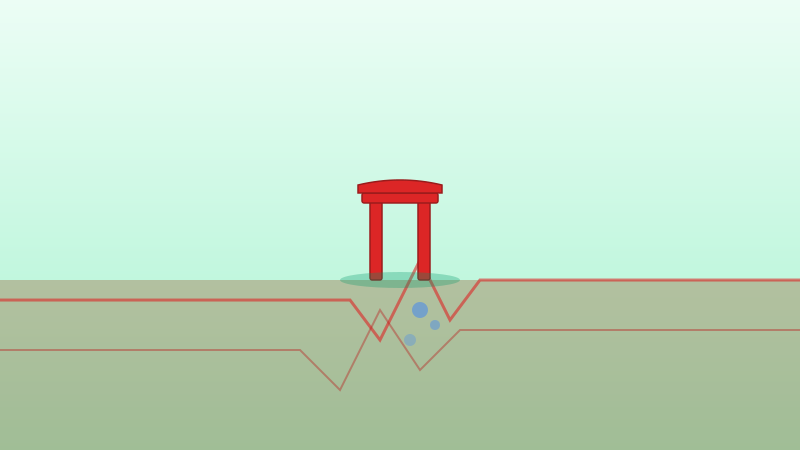
Fault Lines and Sacred Springs Determined Holy Ground — How Underground Waterways Guided Shrine Placement
One of the most striking characteristics of fault zones is that deep underground water rises easily to the surface. Fractures in bedrock created by tectonic activity become natural conduits, pushing mineral-rich water from depths of several hundred meters up to ground level. For ancient peoples, places where pure water flowed ceaselessly represented the living force of the earth itself — proof that divine beings dwelled within the land. Water sustained rice cultivation and determined the survival of entire settlements, so abundant spring sites were naturally venerated as sacred ground.
The sacred Mitarashi Pond at Kashima Jingu is known to produce approximately 400,000 liters of spring water daily. This water source is deeply connected to the underground aquifer system of the Kashima-Katori fault zone, and geological surveys have confirmed that deep water rising through the fault's fractured bedrock feeds the pond from below. The Isuzu River flowing through Ise Jingu is likewise fed by waterways closely associated with the Median Tectonic Line. The purification waters where visitors cleanse their hands have flowed uninterrupted for thousands of years. At Sai Shrine near Omiwa Shrine at the foot of Mount Miwa, the medicinal well still draws visitors seeking its "divine water that heals all ailments," but geologically this water is deep groundwater that has risen through the Miwa Fault. The fact that its temperature remains nearly constant year-round further confirms its deep subterranean origin.
Remarkably, water emerging from fault zones tends to have higher mineral content than ordinary groundwater. Rich in dissolved calcium, magnesium, silicon, and vanadium, these waters have accumulated centuries of testimonials about health improvements from those who drank them. Modern water quality analyses have also reported cases where fault-zone springs contain dissolved hydrogen with antioxidant properties and trace elements believed to be involved in immune function. The fact that ancient people could recognize "this water is special" without scientific instruments speaks to their extraordinary powers of observation. The religious concept of goshinzui (divine water) and the geological reality of deep groundwater from fault systems were describing the same phenomenon in entirely different languages.
The Striking Alignment of the Median Tectonic Line and Sacred Sites — A 1,000-Kilometer Shrine Line
The Median Tectonic Line, stretching approximately 1,000 kilometers across the Japanese archipelago from east to west, is Japan's largest fault system. Formed roughly 100 million years ago, this structure divides southwestern Japan into the Inner Zone and the Outer Zone, with geology, topography, and even vegetation changing dramatically at the boundary. An astonishing number of renowned shrines line up along or near this structure: Suwa Taisha in Nagano, Toga Shrine in Aichi, Ise Jingu in Mie, Omiwa Shrine in Nara, Niutsuhime Shrine in Wakayama, Oasahiko Shrine in Tokushima, and Tosa Shrine in Kochi. When connected on a map, these sites trace a line that nearly overlaps with the Median Tectonic Line itself.
Geologist Yoshiyuki Tatsumi has pointed to the unique topographic characteristics of fault zones as the reason sacred sites concentrate along the Median Tectonic Line. The southern side (Outer Zone) consists of high-pressure metamorphic rocks of the Sanbagawa Belt, while the northern side (Inner Zone) is composed of high-temperature metamorphic rocks of the Ryoke Belt, creating abrupt changes in terrain at the boundary. Places where mountains meet plains, where rock types suddenly change, where groundwater concentrates and springs forth — these topographic boundaries were naturally perceived by ancient peoples as the threshold between this world and the next, making them sacred ground.
Particularly noteworthy is the case of Niutsuhime Shrine. Known as the tutelary deity of Mount Koya, this shrine sits at one of the rare locations where the Median Tectonic Line is directly exposed at the surface. Researchers have suggested that this unique geological environment may have influenced Kukai's decision to establish Mount Koya as the sacred center of Shingon Buddhism. It is no coincidence that many locations along the Median Tectonic Line remain popular as power spots today. Geomagnetic anomalies are sometimes observed in fault zones, and their potential subtle effects on the human body are being studied. The experience of "feeling something" when standing at these locations is a phenomenon that science cannot entirely dismiss.
Earth Tremors and the Origins of Sacred Rock Worship — The True Nature of Divinity in Stone
Another critical feature of fault zones is frequent micro-seismic activity. Micro-earthquakes registering below intensity 1 are imperceptible to ordinary people. However, ancient miko priestesses and shamans in trance states may have perceived these subtle vibrations as manifestations of the earth's power. Modern research has suggested that low-frequency vibrations around 7 hertz — a frequency band close to the Schumann resonance — can synchronize with human brainwaves, inducing altered states of consciousness similar to deep meditation. Experiences of divine possession in fault zones may have a physical basis rooted in these phenomena.
Even more noteworthy are the massive rock formations exposed at the surface by fault activity. Fault movements can thrust underground bedrock upward, bringing rock types completely different from the surrounding geology to the surface. For example, a massive granite boulder might suddenly appear in an area dominated by sedimentary rock — such geological anomalies appeared to ancient peoples as yorishiro, vessels for divine spirits born from the earth itself. Geologists have pointed to this process as the likely origin of iwakura, the ancient practice of worshipping sacred stones. At Omiwa Shrine in Nara, Mount Miwa itself is venerated as a divine body, and numerous boulders exposed by fault activity are scattered throughout the mountain, each archaeologically confirmed as a site of ancient ritual worship.
The Suwa region, famous for the Onbashira Festival of Suwa Taisha, sits at a geological singularity where the Median Tectonic Line intersects with the Itoigawa-Shizuoka Tectonic Line. Because these two major faults converge here, crustal movement is particularly vigorous, and Lake Suwa itself is a structural lake formed by fault subsidence. The omiwatari phenomenon, in which ice on the lake surface heaves upward during winter, is believed to involve subtle geothermal variations transmitted from faults beneath the lakebed. The kaname-ishi at Kashima Jingu — a massive stone said to extend deep into the earth and believed to suppress earthquakes — is very likely an outcrop of the Kashima-Katori fault system. Ancient peoples stood in awe of places where the earth trembled, viewing them as locations where gods moved, and enshrined deities there to pacify the earth's power.
The Special Magnetic Fields of Fault Zones and Sacred Site Experiences — Science Decodes the Mystical
Fault zones can generate localized magnetic field anomalies through rock fracturing and underground water flow. This occurs through phenomena known as the piezoelectric and piezomagnetic effects: when quartz-rich rocks are subjected to pressure, they emit electrical signals that alter the surrounding magnetic field. Canadian neuroscientist Michael Persinger experimentally demonstrated that specific magnetic field patterns could stimulate the human temporal lobe, potentially inducing sensations resembling mystical experiences. Approximately 80 percent of his test subjects reported sensing the presence of another being — a finding that sparked considerable debate. Nevertheless, the hypothesis that the magnetic environment of fault zones could affect human perception has continued to be explored by multiple researchers.
The commonly reported experiences at Japanese shrines — "the air feels different" or "I sense a purifying presence" — may not be mere placebo effects. Radon gas emissions are known to increase in fault zones, and the ionic composition of the air can differ from surrounding areas. Indeed, places with high radon concentrations, such as Arima Onsen and Misasa Onsen, have been used as therapeutic retreats since ancient times. Additionally, negative ions generated by underground water flow, the piezoelectric effect from quartz contained in crushed fault-zone rock, and faint electromagnetic radiation from the decay of radioactive elements in the stone may combine to create an atmosphere unique to each location.
Ancient peoples lacked scientific measuring instruments, but they are believed to have sensitively detected these environmental differences through bodily sensation. Shrine priests and miko priestesses in particular, spending their daily lives immersed in sacred sites, may have developed heightened sensitivity to these subtle environmental changes over time. The fact that many places modern people call power spots are located in fault zones may be the result of rational selection backed by these physical factors.
Global Sacred Sites Share the Fault Line Connection — A Universal Geological Intuition
The relationship between shrines and fault lines is not a phenomenon limited to Japan. The ancient Greek Temple of Delphi was built at the intersection of two fault lines. A 2001 investigation by geologist Jelle Zeilinga de Boer and his colleagues revealed that the oracle Pythia entered her trance state by inhaling ethylene gas rising from the faults. The sacred sites of Sedona, revered by Native Americans, are also situated on fault zones, where dramatic red sandstone layers exposed by fault movement have been venerated as the dwelling place of spirits.
Similar patterns appear at Hindu sacred sites in India. Numerous pilgrimage destinations — Badrinath, Kedarnath, Amarnath, and others — cluster along the fault zones of the India-Eurasia plate boundary that formed the Himalaya Mountains. These hot spring sites are considered by Hindus to be places where Shiva's energy manifests on Earth. The Temple Mount in Jerusalem is also situated near the Dead Sea Transform fault system, and the fact that sacred sites of all three Abrahamic religions coincide with a geological singularity is worthy of attention.
These examples from around the world demonstrate that the connection between faults and sacred sites is a universal phenomenon not confined to any particular culture. Fault zones, where the earth's energy concentrates, have stimulated human spiritual sensitivity across cultures and eras, consistently being chosen as holy ground. Japanese shrines represent one of the most systematically expressed examples of this geological intuition shared by all humanity. The Japanese archipelago sits at the convergence of four tectonic plates, making it one of the most geologically active regions on Earth, and the extraordinary density of faults may be one reason the country has approximately 80,000 shrines.
Ancient Wisdom Illuminated by Modern Science — Where Disaster Prevention Meets Faith
The relationship between shrine locations and fault lines not only testifies to ancient people's remarkable ability to sense nature but also contributes to modern disaster prevention science. Professor Makoto Okamura of Kochi University conducted research overlaying shrine location data onto geological maps, demonstrating that shrine placement can serve as a valuable clue for identifying previously unknown active faults. It is remarkable that shrines built over 1,000 years ago point to the same conclusions as cutting-edge geological surveys.
The fact that shrines on fault lines often carry beliefs about calming earthquakes seems paradoxical from a scientific perspective. Yet in the logic of faith, enshrining the most powerful gods at the most dangerous locations to control calamity represents a concept at the very heart of the Japanese view of nature. The legend of Kashima Jingu's Takemikazuchi-no-Kami pinning down the giant earthquake-causing catfish can be interpreted as a mythological expression of the seismic risk inherent in fault zones. During the 2011 Great East Japan Earthquake, major ground fissures appeared around the kaname-ishi at Kashima Jingu — an event that inadvertently confirmed the shrine stands directly above an active fault.
Intriguingly, along coastal areas with recorded tsunami damage, many ancient shrines are built above the tsunami inundation line. Research in the Tohoku region found that the vast majority of shrines listed in the Engishiki — a document compiled over 1,000 years ago — were located outside the tsunami inundation zones of the 2011 disaster. This suggests that ancient people encoded their tsunami experience into shrine placement as accumulated wisdom: a warning to never build below a certain elevation. Shrines served simultaneously as places of worship and as ancient disaster records.
Standing Above a Fault Line — A New Perspective on Sacred Pilgrimages
Knowing the relationship between shrines and fault lines can profoundly transform the experience of visiting them. When you stand before the kaname-ishi at Kashima Jingu, become aware of the active fault running deep beneath your feet. When you visit Suwa Taisha, sense that you are standing at a geological singularity where two great faults intersect. When you purify your hands in the Isuzu River at Ise Jingu, consider that this water has traveled for thousands of years from the depths of the Median Tectonic Line to reach you.
What modern geology has revealed about the relationship between faults and sacred sites proves how remarkably accurate ancient people's intuitions were. In an age without scientific knowledge or measuring instruments, the ability to read the earth's subtle signals — the temperature of spring water, the types of rock, the texture of the air, the faint vibrations felt through the body — and determine that a place was special represents a skill of dialogue with nature that modern humans are gradually losing.
Shrines are not merely religious facilities; they are places where you can physically experience the geological uniqueness of the Japanese archipelago. These sacred sites, built upon the scars of active faults, are crystallized wisdom of a people who have coexisted with nature's fury for millennia. Faith and science are not opposing forces but two paths that arrived at the same truth through different methods. The relationship between shrines and fault lines stands as perhaps the most elegant proof of this principle.
About the Author
Shrine Secrets Editorial TeamWe uncover the hidden secrets of Japanese shrines and Shinto, making them accessible to everyone.
View author profile →Related Articles
The Mystery of Amano-Iwato and World Darkness Myths — How Humanity Prayed When the Sun Vanished
The Mystery of Menkake Gyoretsu — The Eerie Masked Procession of Kamakura's Ancient Festival
The Mystery of Narukama Shinji — Divining the Gods' Will Through the Sound of a Boiling Cauldron
The Mystery of Waniguchi — The Sacred Metal Gong That Bridges Shinto and Buddhism