The Mystery of Narukama Shinji — Divining the Gods' Will Through the Sound of a Boiling Cauldron
In the Narukama ritual, priests heat rice in an iron cauldron and divine fortune from its sound. Explore the origins and mechanics of this ancient Shinto oracle.
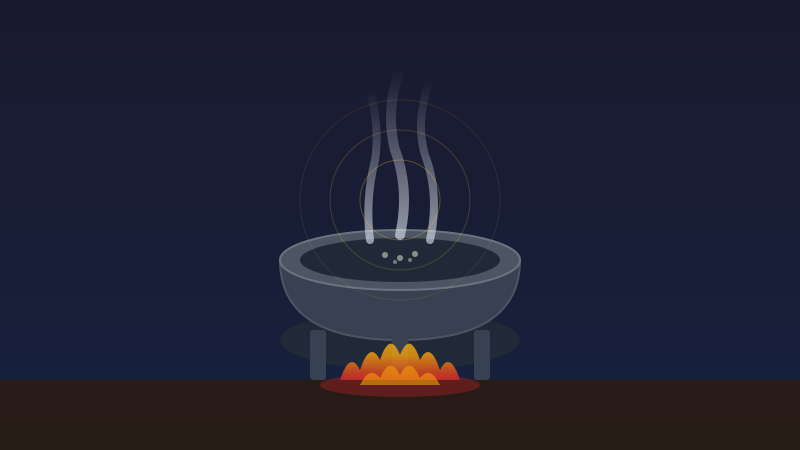
The Origins — Kibitsu Shrine and the Legend of Ura
The most famous origin of the Narukama Shinji traces back to the legend of Ura (also called Onra) at Kibitsu Shrine in Okayama Prefecture. According to ancient lore, a fearsome ogre named Ura — said to have crossed over from the Korean kingdom of Baekje — possessed advanced ironworking technology and built a mountain fortress to dominate the surrounding Kibi region. The imperial court dispatched the hero Kibitsuhiko-no-Mikoto to subjugate him, and after a fierce battle, Kibitsuhiko severed Ura's head. Yet even after being beheaded, Ura's head continued to groan and wail for thirteen years without ceasing.
Desperate, Kibitsuhiko received a message in a dream from Ura's spirit: "Have my wife, Asohime, cook rice in the cauldron hall. I shall convey fortune and misfortune through the sound it makes." When this was done as instructed, the cauldron began to produce mysterious sounds, and the Narukama ritual was born. This legend is widely believed to be the prototype of the famous Momotaro (Peach Boy) folk tale. What makes the story distinctly Japanese is not simply the slaying of a demon, but the decision to incorporate the defeated enemy's spiritual power into sacred practice rather than destroying it. This reflects the broader Shinto concept of goryo shinko — the belief that vengeful spirits can be pacified and transformed into protective deities. At Kibitsu Shrine today, the cauldron hall is designated a nationally Important Cultural Property preserving Muromachi-period architecture, and priestesses called Asome still interpret the cauldron's voice using techniques passed down through generations.
The Step-by-Step Ritual — Inside the Cauldron Hall
Understanding how the Narukama Shinji actually unfolds brings the tradition vividly to life. At Kibitsu Shrine, the process begins when a visitor submits a request at the shrine office and writes down the matter they wish to ask about. After a priest recites a formal prayer, the visitor is led into the cauldron hall.
Inside, the centerpiece is a large iron cauldron roughly sixty centimeters in diameter, set upon a traditional hearth. The Asome priestess first fills the cauldron with water and lights a wood fire beneath it. As the water approaches boiling, she places a bamboo steamer filled with unpolished brown rice on top of the cauldron. At this point, the heavy wooden doors of the hall are closed, and the dim interior fills with rising steam.
Then the cauldron begins to speak. At first, a low rumble resonates through the hall, gradually transforming into a higher-pitched, ringing tone. This sonic progression is the heart of the ritual. A loud, sustained sound signifies good fortune, while a weak, brief one suggests misfortune — but the actual interpretation is far more nuanced than this. The Asome reads the speed at which the sound builds, the fluctuations in its middle passages, and the length of its lingering echo, weaving these elements together to convey the will of the gods. The entire session takes approximately twenty to thirty minutes, during which the visitor sits in stillness, listening intently to the sound while simultaneously turning inward.
The Science of the Sound — Acoustic Analysis of a Sacred Phenomenon
How can the sounds of the Narukama Shinji be explained from a scientific perspective? From the standpoint of acoustic engineering, the phenomenon can be understood as a resonance event within an iron vessel. When water inside an iron cauldron is heated, steam bubbles collide with the inner walls, generating vibrations. These vibrations propagate through the entire body of the cauldron, and when they align with the natural resonant frequency of the iron, the distinctive sound emerges.
The addition of unpolished rice or azuki beans alters the sound in ways that physics can account for. The grains disrupt the flow of steam, changing the pattern of bubble formation and thereby shifting the frequency and amplitude of the resonance. The thickness and shape of the cauldron, the iron's chemical composition, water temperature, fire intensity, and even external conditions like ambient temperature and humidity — countless variables influence the sound. It is therefore entirely predictable from a scientific standpoint that no two performances ever produce exactly the same result.
Particularly noteworthy are the experiments conducted by researchers at institutions such as Okayama University to reproduce the Narukama phenomenon in laboratory settings. While these experiments confirmed that iron cauldrons do indeed produce resonant sounds, they reported difficulty in fully replicating the solemn, enveloping quality heard inside an actual shrine cauldron hall. The wooden architecture of the hall appears to function as a natural concert hall, reflecting and amplifying the sound in ways a laboratory cannot replicate. Even when science can explain the mechanism, it seems the experiential quality created by the sacred space itself eludes mathematical capture.
Narukama Traditions Across Japan — Regional Variations of Cauldron Faith
The Narukama Shinji is by no means unique to Kibitsu Shrine. It represents a broadly distributed belief system that has been transmitted across Japan in various forms.
At Sada Shrine in Shimane Prefecture, a Narukama rite is performed during the Kamiari Festival held each November. The Izumo region calls the tenth lunar month "Kamiarizuki" — the month when the gods are present — as all the deities of Japan are believed to gather there. It is during this sacred period that the cauldron's voice is consulted to learn the intentions of the assembled gods. Records also show that Shimogamo Shrine in Kyoto once performed Narukama rites as part of its New Year ceremonies.
In Shikoku, shrines such as Tamura Shrine in Kagawa and Oasahiko Shrine in Tokushima preserve similar cauldron-related rituals. In Kyushu, particularly in Miyazaki Prefecture, a related practice known as "yudate shinji" (boiling water rites) uses the sounds and splashing of vigorously boiling water for divination. In these rituals, a priestess dips bamboo grass into scalding water and scatters the droplets, and those who are splashed receive purification. Like the Narukama Shinji, these rites treat the power of boiling water as a medium for divine will.
While the names and specific procedures differ by region, the fundamental principle remains the same: listening for the voice of the gods in the sounds born where fire, water, and metal (or earthenware) meet. Rather than arising independently in each locale, this belief system most likely spread from ancient ironworking and rice-cultivation cultures, adapting to local customs and landscapes as it traveled across the Japanese archipelago.
Sound and Shinto — Why Sound Becomes the Voice of the Gods
To truly understand the Narukama Shinji, one must appreciate the special status of sound within Shinto thought. In Shinto, sound is not merely a physical phenomenon but an entity believed to carry spiritual power.
The most familiar example is the practice of clapping hands (kashiwade) at a shrine's worship hall. The two sharp claps serve both to announce one's presence to the deity and to dispel malevolent influences through the power of the sound itself. Ringing bells, striking drums, chanting prayers aloud — Shinto rituals are invariably accompanied by sound. This is closely connected to the concept of kotodama (the spiritual power of words), the belief that spoken sounds carry sacred energy.
The ancient chronicles Kojiki and Nihon Shoki contain numerous myths in which sound plays a pivotal role. When the sun goddess Amaterasu concealed herself in the Rock Cave of Heaven and plunged the world into darkness, the assembled gods sang, danced, and made a tremendous commotion to lure her back out. Here, sound is depicted as the decisive force that shatters darkness and restores light. The storm sounds of Susanoo, the stomping feet of Ame-no-Uzume, the melodies of sacred kagura music — all of these form the archetype of the Japanese belief that humans and gods communicate through sound.
The Narukama Shinji stands as an exceptionally pure expression of this faith in the spiritual power of sound. What makes it unique is that the sound is not intentionally produced by human voice or instrument, but arises as a natural phenomenon from the cauldron itself. It is precisely because the sound transcends human agency that it can be received as the authentic voice of the divine.
The Narukama Shinji Today — Timeless Prayer and New Meaning
Far from fading into obscurity, the Narukama Shinji continues to attract fresh interest in the modern era. Kibitsu Shrine offers individual Narukama sessions by reservation, drawing a steady stream of visitors year-round who come to hear the cauldron at life's turning points — school entrance exams, job searches, marriages, childbirth, relocations. Applications reportedly surge during exam season and the job-hunting period.
In recent years, the growing interest in mindfulness and meditation has led many to reframe the Narukama Shinji as an immersive "sound meditation" experience. Sitting in the dim cauldron hall, releasing mental noise, and focusing solely on the cauldron's voice for twenty minutes creates a space for deep introspection rarely found in daily life. Many who have experienced the ritual report that "while listening to the cauldron, the answer I was looking for became clear within myself."
In an age that prizes scientific certainty, why do people still turn their ears to an iron cauldron? Perhaps because at the crossroads of life where rational analysis alone cannot provide an answer, there persists a universal human longing to hear the voice of something greater than oneself. Beyond whether the divination proves accurate, the very act of sitting quietly and listening may function as a device for hearing one's own inner voice.
The Narukama Shinji is a rare and living ceremony that continues to bridge humans and the divine through sound — the most primal of all senses. The simple fact that the cauldron has kept ringing for over a thousand years speaks more eloquently than any words to the enduring power of this sacred rite.
About the Author
Shrine Secrets Editorial TeamWe uncover the hidden secrets of Japanese shrines and Shinto, making them accessible to everyone.
View author profile →Related Articles
The Mystery of Waniguchi — The Sacred Metal Gong That Bridges Shinto and Buddhism
The Mystery of Bowing at Shrines — The Shinto Philosophy of Reverence Hidden in a Simple Gesture
The Mystery of Tachimono: Why Japanese Worshippers Give Up What They Love to Pray at Shrines
Ghost Stories of Shrines: The Eerie Legends Born Where the Sacred Meets the Supernatural