The Mystery of Waniguchi — The Sacred Metal Gong That Bridges Shinto and Buddhism
Discover the secrets of the waniguchi, the flat metal gong hung at shrine worship halls. Learn how this sacred instrument carries the memory of Japan's Shinto-Buddhist fusion.
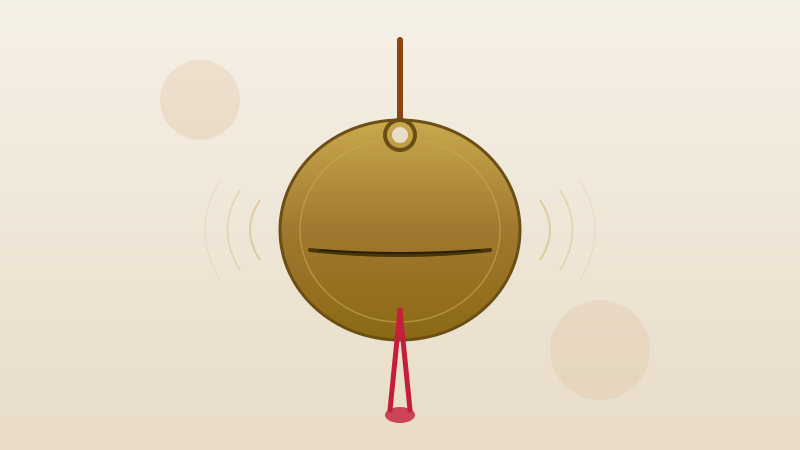
What Is a Waniguchi — Structure and Origin of the Name
A waniguchi is a flat, hollow, disc-shaped metal instrument ranging in size from about 15 centimeters in diameter for the smallest examples to over one meter for the largest. Its most distinctive feature is a horizontal slit — or "mouth" — running along its bottom edge. The name literally means "crocodile mouth," referring to the resemblance of this opening to a gaping jaw. The instruments are primarily cast in bronze (an alloy of copper and tin), and many surviving examples bear elaborate surface decorations including lotus patterns, arabesque scrollwork, and Sanskrit characters.
Worshippers strike the gong using a woven cloth cord — called the waniguchi-himo — that hangs from the instrument. These cords are typically braided from red or white fabric, though some shrines use thick hemp ropes. The proper technique is not to swing the cord and release it, but to grip it firmly and strike it directly against the metal surface. Unlike a bell that is shaken, the waniguchi produces its distinctive deep resonance through the direct impact on its bronze face.
Buddhist Origins — The Lineage of Esoteric Ritual Gongs
The origins of the waniguchi trace back to the Heian period (794–1185). It is believed to have evolved from the konkuu, a type of ritual gong used in esoteric Buddhist temples. The konkuu itself descended from the kenti, a percussion instrument used in Indian Buddhist monasteries to summon monks to assembly, which traveled to Japan via China. In Japan, the konkuu was adopted by Shingon and Tendai esoteric Buddhist temples as a signal to mark the beginning of sutra recitation and memorial services.
During the late Heian period, the konkuu gradually evolved into a flatter, more portable form — the prototype of the waniguchi. Among the oldest surviving examples are a waniguchi at Munakata Taisha in Fukuoka Prefecture bearing an inscription dated to the third year of Kenkyuu (1192), and early Kamakura-period pieces held at Kumano Hayatama Taisha in Wakayama Prefecture. These waniguchi bear the names of their donors and dedicatory prayers, testifying to the depth of faith among the people of that era.
The Kamakura through Muromachi periods (roughly 1185–1573) marked the golden age of waniguchi production, with outstanding pieces created across the country. As casting technology advanced, waniguchi decoration became increasingly refined. Surviving masterpieces include instruments engraved with passages from Buddhist sutras and those bearing raised relief carvings of dragons and phoenixes — works of exceptional artistic value.
Shinbutsu Shuugou and the Spread to Shrines — How a Buddhist Tool Took Root in Shinto
The waniguchi found its way into Shinto shrines through shinbutsu shuugou — the uniquely Japanese phenomenon of Shinto-Buddhist syncretism. This was the fusion of indigenous Shinto belief with imported Buddhism, resulting in a worldview in which kami and Buddhas were worshipped as one. Beginning in the Nara period, this current of thought was systematized during the Heian period as honji suijaku — the theory that Buddhas and bodhisattvas manifested themselves as Japanese kami to save the people of Japan.
Under this theological framework, Buddhist temples were built within shrine precincts (jinguuji), and Shinto shrines were enshrined within temple compounds (chinjusha). It was not uncommon for monks to chant sutras before kami altars, or for Shinto priests to attend Buddhist ceremonies. In this environment, the waniguchi passed naturally from temple to shrine.
The syncretism was especially deep at mountain worship sites. At sacred centers of Shugendou — the tradition of ascetic mountain practice — such as the Kumano Sanzan, Dewa Sanzan, and Hikosan, a distinctive religious world emerged in which kami and Buddhas were completely intertwined. The waniguchi became an indispensable tool at these sites of prayer. The sound of a waniguchi struck by mountain ascetics at their remote training grounds was believed to carry supernatural power capable of crossing the boundary between the mundane world and the spirit realm.
Surviving the Great Separation of Shinto and Buddhism
The Shinbutsu Bunri decree issued in 1868 was a policy designed to forcibly sever the thousand-year fusion of Shinto and Buddhism. Buddhist elements were purged from shrines across the nation — statues were removed, monks were forced to return to lay life. The wave of haibutsu kishaku (the "abolish Buddhism" movement) that followed led to the destruction and burning of countless Buddhist statues, ritual implements, and scriptures. The five-story pagoda of Koufukuji was put up for sale, and entire great temples like Uchiyama Eikyuuji vanished completely — irreparable losses to Japan's cultural heritage.
Yet remarkably, the waniguchi survived in many shrines. Several factors explain this. First, the act of pulling a cord to produce a sound was functionally identical to ringing a shrine bell. When government inspectors surveyed shrines, many classified the waniguchi as "a ritual noisemaker for worship" rather than a Buddhist implement. Second, the waniguchi was made of sturdy metal and could not be easily destroyed like a wooden statue. Third, in small rural shrines, local parishioners often did not recognize the waniguchi as Buddhist in origin, so it was quietly exempted from removal.
Thus the waniguchi survived the most turbulent religious upheaval in Japanese history. Ironically, having its Buddhist origins forgotten was precisely what saved it.
The Acoustics of Sacred Sound — How Waniguchi Differ from Bells
Strike a waniguchi and you will hear something unmistakably different from a shrine bell. This acoustic difference arises directly from structural differences. A suzu bell contains a small metal clapper called a zetsu inside; when shaken, the clapper strikes the inner wall to produce a high-frequency sound. The waniguchi, by contrast, is a hollow resonating body that vibrates as a whole, producing a lower fundamental frequency enriched with complex overtones.
From an acoustical engineering perspective, the waniguchi produces a fundamental frequency in the range of approximately 100 to 300 hertz, overlaid with multiple harmonics that create its characteristically layered resonance. Sound in this frequency band falls within the range where human hearing is most sensitive, and it also attenuates relatively slowly in air, allowing it to carry over great distances. The esoteric Buddhist practitioners of old may have understood these physical properties through centuries of experiential knowledge.
If the bright, clear tone of the suzu is a sound that "summons the kami," then the deep resonance of the waniguchi is a sound that "purifies the space and carries prayers outward." In esoteric Buddhism, the sound of the konkuu was believed to shatter worldly delusions and spread the Buddha's teachings across all realms. That belief lives on in every strike of the waniguchi.
Masterpieces and Cultural Properties — A Journey to Discover Waniguchi
Today, more than thirty waniguchi have been designated as Important Cultural Properties across Japan, preserving the finest medieval metalwork for future generations. Let us introduce some notable examples.
Kasuga Taisha in Nara Prefecture preserves a magnificent waniguchi from the Kamakura period. Its surface is adorned with exquisite lotus-and-arabesque patterns, and its inscription dates it to the Kenchou era (1249–1256). The waniguchi at Kumano Hayatama Taisha in Wakayama Prefecture is particularly renowned as an Important Cultural Property of near-National Treasure status, representing the highest level of Kamakura-period casting technique.
In the Touhoku region, the waniguchi at Dewa Sanzan Shrine in Yamagata Prefecture is famous, serving as precious historical evidence of the flourishing Shugendou faith at this mountain sanctuary. In Kyuushuu, ancient waniguchi survive at Usa Jinguu in Ooita Prefecture and Munakata Taisha in Fukuoka Prefecture, bearing witness to the history of Shinto-Buddhist syncretism in western Japan.
If you find a waniguchi at a shrine, take a moment to examine its surface closely. The inscriptions and decorative patterns etched into the metal hold the concentrated wishes of those who dedicated it and the skill of the artisans who forged it. And as you listen to its deep, reverberating tone, you may sense the original landscape of Japanese faith — one in which gods and Buddhas were honored without division — rippling outward with the sound. The waniguchi carries within its bronze body the memory of a thousand years of dialogue between kami and Buddha, and it resonates still.
About the Author
Shrine Secrets Editorial TeamWe uncover the hidden secrets of Japanese shrines and Shinto, making them accessible to everyone.
View author profile →Related Articles
The Mystery of Bowing at Shrines — The Shinto Philosophy of Reverence Hidden in a Simple Gesture
The Mystery of Tachimono: Why Japanese Worshippers Give Up What They Love to Pray at Shrines
Ghost Stories of Shrines: The Eerie Legends Born Where the Sacred Meets the Supernatural
The Mystery of Momote-shiki — The Sacred Shrine Archery Rite That Pierces Evil with a Hundred Arrows