The Mystery of Kamimukae-sai — The Sacred Night When All Gods Gather on Izumo's Inasa Beach
Each year in the lunar tenth month, myriad gods are said to gather in Izumo for the Kamiarizuki season. The Kamimukae-sai performed on Inasa Beach at its opening is a living ritual that makes Japanese myth feel immediate and real.
What Is Kamiarizuki? A Nationwide Council of Gods Rooted in Japanese Myth
The belief underlying Kamiarizuki is deeply tied to the structure of Japanese mythology. According to the Kojiki and Nihon Shoki, after completing the creation of the land, Okuninushi-no-Mikoto ceded the visible realm of political affairs to the descendants of the heavenly deities and withdrew into Izumo, where he took charge instead of the "unseen matters" — kakurigoto. These unseen matters include the bonds between people, the unfolding of life encounters, the invisible ties of destiny.
Each year, in the tenth lunar month, the gods of the nation are said to gather at Izumo Taisha to hold council under Okuninushi on precisely these unseen matters. Who will be united with whom, what work-relationships will be formed, what illnesses and recoveries will visit which people — such pivotal threads of life are said to be discussed in the divine deliberations called kamuhakari.
As a result, outside Izumo, the gods are briefly absent and the month is therefore "Kannazuki" — the month without gods. Within Izumo, the reverse holds, and the month becomes "Kamiarizuki" — the month with gods. This belief emerges clearly in written sources from the Heian period onward, but it reflects a much older reality: Izumo was a major religious center in ancient Japan, and shrine networks across the archipelago maintained connections with it. Some scholars read the myth of the "transfer of the land" as preserving memories of early political and religious consolidation rather than as mere storytelling.
Inasa Beach — The Setting of the Land-Transfer Myth and the Gate of the Gods
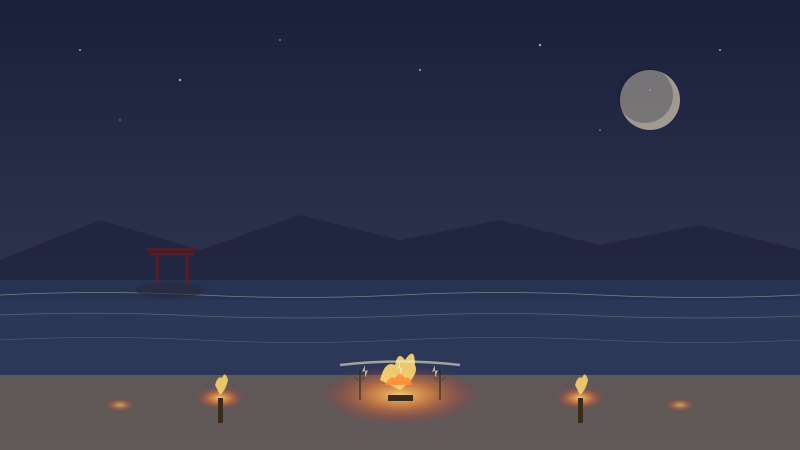
The stage for the Kamimukae-sai is Inasa Beach, a long strand facing the Japan Sea on the western edge of the city of Izumo. According to the chronicles, this beach is where Takemikazuchi, the messenger of the heavenly gods, confronted Okuninushi and demanded the transfer of the land. It has been regarded as sacred since ancient times. Just offshore stands Bentenjima, a small rocky islet crowned by a torii gate. When the winter sun sinks into the Japan Sea, the torii on Bentenjima becomes a gate floating in a field of gold, a sight of quiet power.
Inasa Beach is considered the "gate of the gods" for both geographical and mythological reasons. Izumo's western coast lay at a crossroads of ancient maritime traffic, receiving cultural currents from the continent and the Korean peninsula. In the old Japanese worldview, in which "the gods arrive from across the sea," it was natural to imagine the deities of the nation converging upon Izumo by sea and stepping ashore on Inasa Beach.
On the night of the Kamimukae-sai, visitors from all over Japan line the beach, silently listening to the waves as they await the arrival of the gods. The evening of the tenth lunar month, standing at the threshold of winter, is filled with a cold and clear air, and the flicker of pine torches in the dark is an image that can scarcely have changed for a thousand years.
The Sequence of the Ritual — A Sea Serpent Leads the Gods Ashore
The Kamimukae-sai is performed on the night of the tenth day of the tenth lunar month. A large sacred shimenawa rope is strung across the ritual ground, and a bonfire is lit. Around seven in the evening, priests in formal vestments assemble on the beach and recite norito prayers. Then, the myriad deities from across the nation are believed to descend into a himorogi — a sakaki branch prepared as a vessel for the divine presence.
Leading the gods in their arrival is the so-called Ryuja-shin, the sea-serpent deity. The Ryuja-shin is associated with a species of sea snake that sometimes washes ashore on the Japan Sea coast around this season. Since ancient times, the people of Izumo have regarded these stranded serpents as the divine guides that lead the gods ashore, carefully offering them to shrines such as the inner precinct of Izumo Taisha.
After the ritual, the gods — now housed in the himorogi — are carried in procession from Inasa Beach along roughly one kilometer of streets to Izumo Taisha. This route is called the Kamimukae no Michi, the "path for welcoming the gods." Paper lanterns are lit at the eaves of old houses along the way, and the procession passes in hushed solemnity. At the head walk priests bearing sakaki branches, torches lighting the night road. Late in the evening, the gods are received into the precincts of Izumo Taisha, where the Kamimukae Shinji is performed in the worship hall — opening a week of Kamiari ceremonies.
I remember one visit to Inasa Beach on the night of the Kamimukae-sai some years ago. The cold salt wind, the sound of waves, the shadows of pines thrown by the bonfire — nothing supernatural, honestly. Yet simply watching other visitors standing still, hands clasped silently, I felt an unexpected warmth rise in my chest. Perhaps the point is not whether one believes in the gods or not, but the astonishment of realizing that the same prayer has been offered on this same beach for over a thousand unbroken years. That alone can move you.
A Week of Kamiarisai — The Gods in Council at the Great Shrine
Following the Kamimukae-sai, from the eleventh to the seventeenth of the lunar tenth month, a series of rites unfolds at Izumo Taisha. Together these are called the Kamiarisai — "the festival of the gods in residence." On the eleventh, the grand Enmusubi Taisai is held, a ceremony praying that the assembled gods will weave good bonds into the lives of the petitioners. During this week, priests and pilgrims from all over Japan converge on Izumo, and the normally serene precincts of the Great Shrine take on an extraordinary animation.
The buildings that serve as the "lodgings" of the visiting gods are the Juku-sha — the nineteen shrines. Two long, narrow shrine buildings flank the main sanctuary on its east and west sides, and they are said to house the myriad deities throughout the Kamiarisai. Their doors, closed during the rest of the year, are opened only during this week, allowing worshippers to pay their respects to the lodged gods.
During Kamiarisai, the people of Izumo have traditionally observed a period of restraint. They avoided loud noises, refrained from boisterous drinking, and kept their days quiet, so as not to disturb the council of the gods. This period was called Oimi-san, and the entire region was treated as existing in a special time of communion with the divine. Even today, many locals still avoid holding weddings or raucous events during this week.
Karasade-sai — The Ritual of Bidding the Gods Farewell
After a week of deliberation, the gods depart Izumo on the seventeenth of the lunar tenth month. The ceremony marking their departure is the Karasade-sai. A priest knocks on the doors of the worship hall and calls out three times, "O-tachi, O-tachi" — "Depart, depart" — formally announcing the gods' leave-taking. With these words, the myriad deities are understood to return to their home shrines throughout Japan.
The Karasade-sai has a particularly interesting second stage. At Mankusen Shrine in the Hikawa district of Izumo City, a Karasade-sai is held on the twenty-sixth, and this is considered the final ritual of Kamiarizuki. After leaving Izumo Taisha, the gods are said to hold one last farewell banquet at Mankusen Shrine before scattering back across the nation. A single religious cycle that does not conclude at one shrine but radiates outward into a network of associated sites illustrates the depth and reach of Izumo's sacred calendar.
The movement of welcoming, hosting, and sending off the gods mirrors the Japanese sensibility toward honored guests — marebito — who arrive from afar. Once a year, deities are received from distant places, not with ostentation but with quiet respect, a properly prepared council space, and a careful farewell. A delicate and warm etiquette — the same courtesy the Japanese have long extended to both humans and gods — lives on in these rites.
Visiting the Kamimukae-sai — Between Pilgrimage and Tourism
The Kamimukae-sai has become better known to tourists in recent years, and Inasa Beach now draws sizeable crowds each autumn. But a visit calls for a certain attitude. First and foremost, this is a solemn nighttime ritual performed by the sea. Loud conversation and excessive photography — especially flash photography — can disrupt an atmosphere that has been held for over a millennium. Observing in silence is itself a form of participation.
Dress warmly. The entrance of winter on the Japan Sea coast brings cold gusts off the water, and Inasa Beach has little shelter from wind. Arriving early and spending unhurried time by the sea, breathing in rhythm with other visitors, is far more rewarding than hurrying in at the last moment.
Lodging tends to be concentrated in the city of Izumo, and accommodation fills months in advance during Kamiarisai. When walking the Kamimukae no Michi along with the procession, keep out of its direct path, step aside as priests and the divine presence pass, and remember that you are a guest at something larger than a spectacle.
Once, when my family was discussing where to take a memorable trip, I suggested the Kamimukae-sai. Standing together on that dark beach, listening to the waves and watching the torchlight, the hours we spent there became a memory unlike any ordinary sightseeing. The sensation of being not a "spectator" but a small participant in something ancient is surprisingly rare in modern travel, and worth seeking out.
What Kamiarizuki Offers the Modern World — Reverence for Bonds and the Unseen
The deeper message the Kamimukae-sai offers today goes beyond preserving an old rite. It is the insight that our lives are woven from countless threads of "bonds" we did not choose alone. The belief that gods hold a council to determine the bonds between human beings cannot be verified by science. And yet every one of us lives, demonstrably, within a web of connections far larger than our own agency.
We encounter good bonds and difficult ones. All of them are shaped by something beyond our isolated will, something flowing through a wider current. For more than a thousand years, the Japanese have entrusted this intuition to the narrative of Kamiarizuki. The image of the gods gathering in council at Izumo is, in a sense, a cultural symbol for the reverence a society can pay to the mystery of human connection.
Modern societies emphasize efficiency and rational control, sometimes treating relationships as objects of management and optimization. Yet standing on the Izumo coast in the tenth lunar month, listening to the dark waves and watching torchlight flicker, one is reminded that the bonds between people are deeper and quieter than calculation can reach.
Once a year, the Kamimukae-sai reopens questions we rarely pause to ask: What are bonds? How do we live in relation to an unseen world? On a faraway shore, on a cold dark beach, priests raise torches again tonight and welcome the gods from the sea. Simply imagining that scene is enough to remind us — gently, quietly — that our own lives, too, rest upon a great many unseen threads.
About the Author
Shrine Secrets Editorial TeamWe uncover the hidden secrets of Japanese shrines and Shinto, making them accessible to everyone.
View author profile →Related Articles
The Mystery of Tamayori-hime — The Sea God's Daughter Who Became Mother of the First Emperor
The Mystery of Kakebotoke — The Circular Metal Plaques That Preserve the Memory of Shinto-Buddhist Fusion
Voices of the Age of Gods — How Sound and Vibration Reveal Shinto Cosmology
The Mystery of Kishōbun — Sacred Oaths Sealed with Blood Before the Gods