The Mystery of Kemari Shinji — How the Heian Aristocrats' Ball Game Became a Millennial Offering to the Gods
Kemari shinji is the ritual in which kemari players in white robes continually kick a deerskin ball before the gods. We unravel why a game transmitted from China became an offering to the deities, why it has been performed for more than a millennium at Shiramine Jingu and Shimogamo Jinja, the identity of the kemari deity Seidai-myojin, the secret traditions of the Asukai and Namba houses, and the spirit of kemari being rediscovered today.
What Is Kemari Shinji — An Elegant Ball Sport That Has Endured at Shrines for a Thousand Years
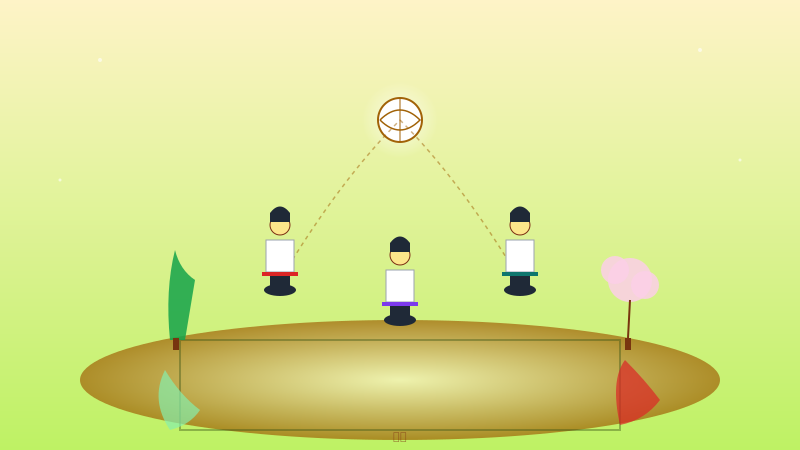
In the precincts of Shiramine Jingu in the Kamigyo ward of Kyoto, or before the romon gate of Shimogamo Jinja (Kamomioya Jinja) in the Sakyo ward, on certain days each year eight men in eboshi caps and white suikan robes line up on the round playing field called the marinwa. With elegant, quiet movements, they begin to kick a deerskin ball among themselves. This is kemari shinji, the kemari ritual.
Kemari is a ball game transmitted from ancient China to Japan, where it became wildly popular among Heian aristocrats. Yet it is no mere game. The aspect of "shinji" — a ritual offered to the deities within the precincts of a shrine — has been carried on continuously for more than a millennium. Today only a limited number of shrines preserve this ritual, opening it to the public on a few precious occasions each year as a form of traditional culture.
The most distinctive feature of kemari shinji is that "there is no winner." Unlike baseball or soccer, this is not a competitive game. The aim is to keep the ball aloft as long and as beautifully as possible without letting it fall — a discipline of "cooperation." Eight kemaribito (kemari players) form a circle and pass the ball among themselves. The image is not athletic competition but "a moving prayer" or "a norito of the body" — a solemn performance offered to the gods.
Kemari Transmitted From China — Arriving Around the Taika Reform
The origins of kemari trace back to China's Spring and Autumn and Warring States period (8th to 3rd centuries BCE). Originally part of military training, this ball game called cuju developed into a court entertainment from the Han through the Tang dynasties. It is thought to have arrived in Japan in the 6th to 7th centuries. The Nihon Shoki records that in 644, Naka no Oe no Ōji (later Emperor Tenji) and Nakatomi no Kamatari played kemari in the precincts of Hokoji (Asuka-dera), and this is said to have been the spark of the Taika Reform.
According to that account, during a kemari game, Naka no Oe's shoe came off, and Nakatomi no Kamatari picked it up and presented it to him. From this courtesy a friendship grew that led ultimately to the overthrow of the Soga clan and the Taika Reform. The fact that a political event that reshaped Japanese history was born on a kemari ground shows that this ball game was not mere entertainment — it functioned as a venue for political and social interaction.
In the Heian period, kemari became an explosive fashion in aristocratic society. Together with waka poetry and ritual music and dance, it was positioned as "essential cultivation for nobility," and great houses such as the Fujiwara dedicated themselves to mastering its skills. Fujiwara no Narimichi (1097–1162) was called the "saint of kemari," a legendary master who is said to have kicked a thousand consecutive days and even kicked the ball while walking on the railing of Kiyomizu-dera.
The Appearance of Seidai-myojin — The Moment Kemari Became a Shinji
The decisive moment in which kemari turned from a noble game into an offering to the gods came in the late Heian period. It was the appearance of Seidai-myojin, the guardian deity of kemari.
According to tradition, after Fujiwara no Narimichi had practiced for many years, on the day he completed a thousand days of practice, three small deities are said to have emerged from inside the ball itself. They named themselves Shunyoka, Kaanrin, and Shuen, and together they were known as Seidai-myojin, the guardian deity of kemari. From this point onward, kemari took on the character of a shinji honoring Seidai-myojin and was no longer simply a game.
Seidai-myojin is enshrined today at Jishu-sha, a subordinate shrine within the precincts of Shiramine Jingu in Kyoto's Kamigyo ward. Shiramine Jingu primarily venerates Emperor Sutoku and Emperor Junnin, but because the site once held the residence of the Asukai family — the head house of kemari — Seidai-myojin is enshrined there as the local guardian deity. Offering kemari is a direct act of dedication to Seidai-myojin, and members of the kemari preservation society continue to hold the ritual regularly.
The Asukai and Namba Houses — Two Great Lineages of Kemari
From the late Heian into the Kamakura period, kemari became especially prized within the court aristocracy, and two major lineages took shape: the Asukai and the Namba.
The Asukai house descended from the Fujiwara, building its reputation in the dual paths of waka and kemari. In the way of waka, Asukai Masatsune (1170–1221) is known as one of the editors of the Shinkokin Wakashu, and in the way of kemari, the family transmitted its house-secret techniques generation by generation. Shiramine Jingu now stands on the site of the former Asukai residence and inherits the right to enshrine Seidai-myojin as the local guardian deity.
The Namba house was likewise a celebrated kemari lineage, forming a school distinct from the Asukai. Each had its own etiquette, technique, and costume, and through mutual rivalry the kemari tradition was refined to extraordinary sophistication. After the Meiji Restoration the families became kazoku peers, and after the postwar abolition of the peerage, their work has continued through the kemari preservation society.
The family transmissions cover not only technique but "the construction of the marinwa," "the materials and craft of the ball," "the fine differences in costume," "the manner of kicking," and "the ritual order." Such oral teachings were passed only within the household as secret transmissions, preserving a continuity that has lasted for more than a thousand years.
The Structure of the Marinwa — Four Sacred Trees at the Corners
The marinwa, the playing ground for kemari, has a distinctive structure. It is a flat square of about fifteen meters per side, with hard, prepared earth and no spread of gravel. The soil must be neither too soft nor too hard, and a marinwa beaten down by years of use is considered ideal.
Four species of tree are planted at the corners. These shikiboku trees are designated as: pine at the northeast, cherry at the southeast, willow at the southwest, and maple at the northwest. Each represents one of the four seasons, and the placement reflects an onmyodo arrangement of the four cardinal directions of the universe. The branches and leaves of these trees gently cover the airspace above the marinwa, also serving the practical role of softening wind and sunlight during play.
The ball is ideally kicked into the air above the center of the marinwa, and each of the eight players catches the ball at his position before passing it on. The ideal height is about five to seven meters — neither too low nor too high, drawing a beautiful arc that is pleasing to the eye. The kemaribito do not "contest" the ball but cooperate to keep it from falling — that is the original spirit.
What the Ball Really Is — A Sacred Sphere of Deerskin
The ball used in kemari is a craftwork made by the most painstaking handwork. The material is deerskin, sometimes horsehide. Two pieces of leather are joined together with internal stuffing and shaped into a sphere. The diameter is about twenty centimeters, the weight roughly 150 to 200 grams — slightly smaller and lighter than a modern soccer ball.
Making a single ball takes months. A specialist marishi finishes each one entirely by hand. The leather is polished smooth and often coated white with pigment, while balls used at the most important shinji may be embellished with gold or silver leaf. The interior is packed with wheat straw, horsehair, or cotton wool to give the ball its proper bounce.
The ball is treated as a "sacred object." Before use it is purified with salt, and at offering rituals it is treated as one of the offerings on the altar. After the ritual, balls are stored as treasures of the shrine, and balls worn out by years of play are burned in a shoonou ceremony of fire-purification within the precincts. The ball itself is a vessel of belief — not merely a "ball," but a yorishiro that may receive the deities.
The Aesthetics of the Costume — Eboshi and Suikan as Marks of Rank
The robes the kemaribito wear are a special form of suikan, derived from the daily dress of Heian aristocrats. The suikan is broad-sleeved and easy to move in — among traditional Japanese garments, it is one of the most athletic. The base color is white, and each house is distinguished by the colors of its collar and cuffs.
On the head sits an eboshi, a part of the formal dress of Heian aristocrats, fixed under the chin with a cord so that it does not fall. To drop the eboshi during play is a serious failure, and the kemaribito strives to maintain his posture even amid vigorous activity, ensuring the eboshi stays in place.
On the feet are special leather shoes called kamokutsu. Softer than ordinary footwear, they allow the toes to feel the ball with great delicacy. This is the heart of kemari technique: a culture of "the touch of the foot" that controls the ball through fine sensation, entirely different from the instep kick of modern soccer.
For major shinji the costume may be specially commissioned, and a kemaribito with long service may be granted the honor of wearing a costume handed down through the family. Even the costume itself carries "rank," used differently according to the importance of the ritual.
Shiramine Jingu and Shimogamo Jinja — The Two Great Sites of Kemari Shinji
The two principal shrines where kemari shinji can be seen today are Shiramine Jingu and Shimogamo Jinja in Kyoto, each preserving its own traditions and schedule.
At Shiramine Jingu, kemari is offered in association with the spring grand festival on April 14, the Seidai-myojin festival on July 7, and the imperial festival on November 23 (Labor Thanksgiving Day). The Seidai-myojin festival on July 7 is the most important shinji, dedicated directly to the guardian deity of kemari, with members of preservation societies from across the country gathering. The marinwa is set up before the Jishu-sha shrine, and for thirty minutes to an hour, kemaribito in white robes continue to kick the ball — a precious occasion in which the noble pastime of a thousand years ago is revived in the present.
At Shimogamo Jinja, kemari is offered at the New Year ceremony on January 4, in connection with the Aoi Matsuri events in May, and at the autumn meigetsu kangensai music festival in October. The expansive marinwa before the romon gate is larger than that at Shiramine Jingu, and the offering takes place under the gaze of larger crowds. The kemari hajime ritual on January 4 is featured in nationwide news as a New Year sight, and is one of the symbols of Kyoto's New Year culture.
Kemari is also offered on special occasions at Kasuga Taisha in Nara, Ise Jingu in Mie, and Meiji Jingu in Tokyo, providing rare opportunities to encounter kemari shinji outside Kyoto.
The Spirit of Shinji — No Contest, Only Offering
To say it again: the most essential spirit of kemari shinji is that "it does not contest victory or defeat." From the perspective of modern sports culture this may feel strange, but it expresses the very heart of Japan's ancient ritual sensibility.
What is offered to the gods does not pursue victory or records but "beauty," "harmony," and "continuity." The measure is how long and how elegantly eight people can keep the ball aloft together. If even one person grows careless or tries to show off his technique, the ball falls. This is not individual play but a "collective prayer" achievable only through the harmony of all participants.
The gestures of the kemaribito follow a unique etiquette. He never shouts when kicking, but utters low calls of "ya" or "ou." These signal direction to the others and also serve as a kind of norito addressed to the deity. Voice, footwork, the swirl of robes, the arc of the ball — when all of these align as one current, kemari rises beyond a ball game and becomes "a moving shinji."
The first time I saw kemari shinji was at a small shrine I happened to enter on the way back from a Kyoto trip. There were almost no tourists. I stopped only because I noticed people gathered in white robes, and the time that followed — only the soft cries of the players, the white arc of the ball, and the muffled sound of feet on earth — was strangely quiet, as if the flow of time had slowed. I remember thinking, "So a shinji can be this still." Later, when a priest told me "this offering has no winner," I realized I had stepped a little outside the modern habit of always competing.
Kemari Reborn in the Present — The Preservation Society and International Exchange
After the Meiji Restoration, with the dissolution of the aristocratic order, kemari declined sharply and at one point faced the threat of extinction. In the Taisho era a kemari preservation society was founded, and after the war activity continued mainly in Kyoto. Today, as the publicly authorized Kemari Hozonkai foundation, it has been officially recognized by the city of Kyoto as a traditional cultural form.
The society passes on not only technique but also costume, ball-making, ritual order, and oral tradition — preserving the entirety of kemari culture. Workshops and viewing events are held for the public so that this thousand-year-old shinji can be conveyed to the future.
In recent years, kemari has begun to travel abroad. It is performed at events introducing Japanese culture, and audiences from soccer-playing countries take great interest in "the football of Japan a thousand years ago." Comparative research with ancient Chinese cuju has advanced, and kemari is helping to clarify the genealogy of ball-game cultures across East Asia.
Kemari shinji is not merely an "old ritual." It is a rare cultural heritage that has preserved, for more than a thousand years, Japan's distinctive ritual conviction that "offering to the gods does not require winning," the foundational social value that "the harmony of the group surpasses individual honor," and the core of Japanese embodied culture that "the sacred is reached through the most delicate sensations of the body." The next time you have the chance to visit Kyoto, look up the schedules of Shiramine Jingu and Shimogamo Jinja and try to see this "moving prayer" with your own eyes. You will likely be surprised by the existence of a third kind of physical culture, neither sport nor performance.
About the Author
Shrine Secrets Editorial TeamWe uncover the hidden secrets of Japanese shrines and Shinto, making them accessible to everyone.
View author profile →Related Articles
The Mystery of the Toshigami-dana — The New Year-Only Household Shrine and the Faith Hidden in the Eho-dana
The Mystery of the Oak at Shrines — Sacred Leaves That Hold Offerings and the God Who Dwells in Them
The Mystery of Shrine Plaques — Word Spirits and Authority Inscribed on the Hengaku Above Torii and Halls
The Mystery of Shrine Ceiling Paintings — Dragons and Flowers Above Worshippers and the Faith They Carry