The Mystery of the Toshigami-dana — The New Year-Only Household Shrine and the Faith Hidden in the Eho-dana
The toshigami-dana and eho-dana are temporary household altars set up only for the few days of New Year. Why did Japanese homes need this provisional shrine, separate from the permanent kamidana? We explore regional variations, the ritual of facing the year's auspicious direction, and the heart of a New Year tradition that is quietly vanishing today.
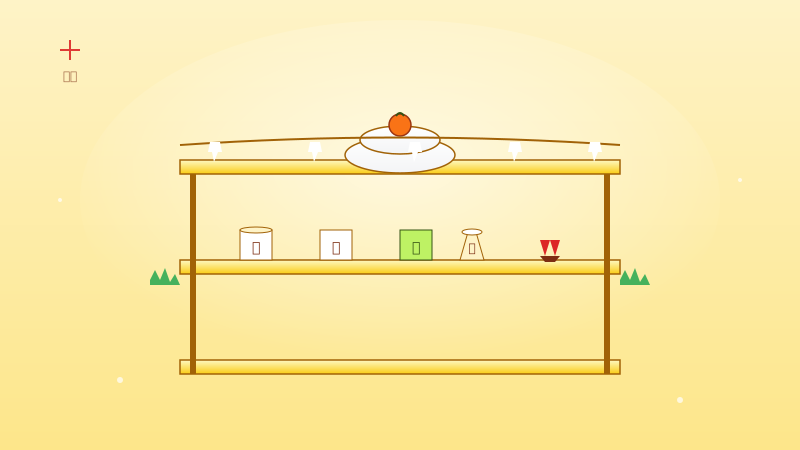
What Is the Toshigami-dana — A Provisional Household Altar That Appears Only at New Year
Japanese homes traditionally maintain a permanent kamidana, a household shrine that enshrines the talisman of Ise Jingu and the local guardian deity. This is a place of daily worship, a household sanctuary that watches over family safety and prosperity throughout the year. Yet from antiquity, traditional Japanese houses have set up, separate from this permanent kamidana, a temporary altar called toshigami-dana or eho-dana, used only during the few days of New Year.
The toshigami-dana is a dedicated place to welcome Toshigami-sama, the year god, who comes to each home at the start of every new year. The year god is believed to bring that year's harvest, health, and good fortune to the household, a deity formed where Japan's ancient ancestor worship and agricultural faith merge. Unlike the local guardian deity or Ise enshrined on the permanent kamidana, the year god is a "visiting deity who stays only once a year," so a dedicated provisional altar has long been prepared specifically for this purpose.
The location of the toshigami-dana varies by region and household, but it is generally placed at the tokonoma alcove, above the entrance, in a high spot in the kitchen, or beside the permanent kamidana. The form ranges from elaborate three-tiered wooden structures to a single simple shelf affixed to a wall. What is shared is that it is "only for New Year," "specifically for the year god," and "installed and removed within the matsu-no-uchi period" (typically until January 7, sometimes the 15th).
The Name Eho-dana — A Shrine Facing the Year's Auspicious Direction
One regional name for the toshigami-dana is eho-dana, used mainly in the Kansai area. The term means "a shelf set up facing the eho — the direction in which the deity Toshitokujin resides that year."
The concept of eho derives from onmyodo cosmology. According to the ten heavenly stems (kinoe, kinoto, hinoe, hinoto, tsuchinoe, tsuchinoto, kanoe, kanoto, mizunoe, mizunoto), the direction in which Toshitokujin resides changes each year. This direction is called eho, and depending on the stem, it falls on one of four directions slightly off-center: ENE-by-E, WSW-by-W, SSE-by-S, or NNW-by-N. In 2026, for instance, the eho is NNW-by-N.
The eho-dana is repositioned annually to face this auspicious direction. Rather than placing it in the same spot each year, its orientation within the room is adjusted to align with the current year's eho. This is rooted in the belief that the year god (or Toshitokujin) arrives from the eho. It can be seen as preparing a fresh "main entrance for the deity" inside the home each year.
This is the same logic behind eating ehomaki sushi rolls while facing the year's eho on Setsubun. In the original tradition, this directional faith was not limited to a single seasonal sushi but suffused the entire framework of New Year household ritual. Today, the concept of eho is most often known only through ehomaki, but it was once a major directional belief embedded in the heart of New Year worship.
Why Set It Up Separately From the Permanent Kamidana — The Etiquette of Visiting Deities
A modern person might ask: "Why not just enshrine the year god together with the other deities on the permanent kamidana?" In ancient Japanese belief, however, deities have been understood in two types — "resident" and "visiting" — and distinguishing between them lies at the very heart of ritual practice.
Resident deities, such as Amaterasu of Ise Jingu or the local guardian deity, watch over the home and the land throughout the year. These are enshrined on the permanent kamidana and receive daily veneration. Visiting deities are those who come only at specific times: the year god, the field god, the marebito visitor god, and so on. Because they are honored within a temporal arc of "welcome, sojourn, send-off," a dedicated provisional altar is required.
This belief in visiting deities sits at the deepest layer of Japanese ritual thought. The folklorist Origuchi Shinobu identified the essence of Japanese deities as "beings who come from outside," calling them marebito. The toshigami-dana is precisely the household practice of marebito belief, an apparatus designed to welcome with utmost respect the visiting deity who arrives only once a year.
Kadomatsu pine decorations, shimekazari rope ornaments, and kagamimochi rice cakes — every New Year decoration belongs to the same belief system as the toshigami-dana. The kadomatsu is a marker so the year god does not lose its way; the shimekazari is a barrier strung within the home; the kagamimochi is the deity's vessel and offering. All function together as careful preparations for welcoming the visiting year god.
How to Build a Toshigami-dana — Traditional Structure and Offerings
The traditional structure varies in detail by region and household, but the general form can be described as follows. The basic shape is a "three-tier shelf" or "two-tier shelf," made of unpainted hinoki cypress or sugi cedar — natural pale wood. The reason for unpainted wood is the philosophy of tokowaka, eternal renewal: the year god should be welcomed each year with fresh, clean wood.
The top tier holds the five basic offerings: kagamimochi, sake, salt, rice, and water. Because the kagamimochi is regarded as the year god's vessel, it is the most important offering. The middle tier carries auspicious items symbolizing longevity, prosperity, and abundant harvest: pine, plum, daidai bitter orange, dried persimmon, kelp, dried squid, candied small sardines (tazukuri). The bottom tier is left clear as a space for clapping the kashiwade hands of worship, or holds small objects representing the ages or numbers of family members.
A shimenawa rope is hung around the shelf, with shide paper streamers, forming a barrier. This separates the toshigami-dana from ordinary living space and purifies it as a sacred zone where the year god dwells. Urajiro fern leaves are sometimes added on either side, symbolizing pure-hearted sincerity through the white undersides of the leaves.
On New Year's morning, the offerings are replaced with fresh ones. The previous offerings, called sage-zen, are then eaten by the family, who incorporate the year god's power into their bodies. This is the original meaning of ozoni soup and osechi cuisine: the modern form of a ritual in which the family communes with the deity by sharing the deity's leftover meal.
Regional Diversity — Neiwai-dana, Toshitoku-dana, and O-toshi-dana
Names and forms vary widely across regions. In Kansai, toshitoku-dana; in parts of Tohoku, toshigami-sama-no-tana; in Kyushu, toshigami-dana; in the Chugoku region, otoshi-dana — a richly regional family of names.
In the mountains of Gifu and parts of Nagano, a unique form called neiwai-dana survives. This altar is for spending New Year's Eve as a whole family in front of it, a place of "the prayer of crossing the year" where everyone stays awake to welcome the year god. The custom of keeping a lamp burning all night and gathering as a family until dawn is the very heart of the Japanese New Year culture that whole-heartedly hosts the visiting deity.
In Okinawa and Amami, a fusion of the hi-nu-kan hearth deity belief and the toshigami-dana custom produces a distinct form, in which the year god's vessel is placed at the kitchen hearth, fire and year being honored together as a single cycle. This shows a separate line of development from the toshigami-dana of the main islands.
In the old houses of Tohoku, the custom of "setting the shelf facing the daikoku-bashira central pillar" merges with architectural belief: the central pillar functions as the corridor through which the year god enters. This is a fine example of how the structure of the dwelling itself is designed as ritual space, embodying the way traditional Japanese architecture refuses to separate living and sacred spaces.
I remember a New Year's Eve at my grandparents' house, when the family gathered in front of the candle on the toshigami-dana. As a child, I had no idea what the shelf was for and thought it was "just a decoration," but when my grandfather said quietly, "This is where we welcome the year god, so lower your voice while it is here," the very air seemed to shift one step. Perhaps before the shelf itself, the way the family adjusted their bearing in front of it became my first true experience of ritual.
Until Matsu-no-uchi Ends — The Etiquette of Setup and Removal
The toshigami-dana is normally installed on December 28 or 30. There is a folk belief that "the 29th brings hardship, and the 31st is a one-night decoration that brings bad luck," so these days are traditionally avoided. The head of the household or eldest member performs ritual hand-washing first and assembles the altar in a state of purity.
The matsu-no-uchi period varies by region: in Kanto, it ends on January 7; in Kansai, it often ends on January 15 (Koshogatsu). During this period, fresh water and food are offered each morning, and the family gathers in worship. Some households take care to avoid quarrels or impure speech inside the home so that the atmosphere remains conducive to the year god's stay.
When matsu-no-uchi ends, the toshigami-dana is dismantled. Offerings and shimekazari are burned in the small New Year fire festivals known as sagicho or dondoyaki, and the smoke sends the year god back to the heavens. The wooden shelf itself is stored in a clean place for the following year, or in some homes is rebuilt from scratch annually.
This full cycle of setup, sojourn, and removal forms the complete structure of visiting-deity belief. The year god does not reside in the home; it visits and departs, and that brief sojourn is the very engine that transforms New Year into a "special, sacred time."
A Vanishing Tradition — Toshigami-dana Amid Urbanization and the Nuclear Family
Since the high-growth era of postwar Japan, changes in housing, the spread of nuclear families, and shifts in religious consciousness have rapidly reduced the number of households that maintain a toshigami-dana. In modern urban apartments and condominiums, traditional tokonoma alcoves and spacious entrances are rare, making it physically harder to find space for such an altar.
The disappearance of inherited knowledge is also a major factor. Oral wisdom passed from grandparents to parents to children — "the etiquette of setting up a toshigami-dana" — is being lost as nuclear families displace extended households and as local communities weaken. Today, many in the younger generation have never even heard the word toshigami-dana.
But it has not disappeared entirely. In old rural homes, in families that emphasize Shinto ritual, and in households connected to shrines, traditional toshigami-dana are still set up. In simplified forms — "adding extra New Year offerings beside the regular kamidana" or "placing a small kagamimochi at the entrance" — the core of visiting-deity belief continues to live in modern homes.
During the rush of late December, I sometimes recall my grandmother's house at New Year. A small wooden shelf set up on the tatami, kagamimochi and urajiro placed on it, a taut shimenawa overhead. The sense that "another place" had been born inside the house was definitely inscribed on my body back then. My current condominium has neither tokonoma nor toshigami-dana, but every time I see the small kagamimochi at the entrance, the memory of "that other place" returns quietly. Even when the form shrinks, the inner etiquette of receiving a visiting deity may not be quite so easy to lose.
Reviving the Toshigami-dana for Modern Life — Practices Even Small Homes Can Adopt
A full reproduction of the traditional toshigami-dana may be impractical, but a simplified version suited to modern living is entirely achievable. Cleanse one corner of a living room shelf, lay a white cloth, and place small vessels of kagamimochi, sake, salt, rice, and water — that alone makes a respectable "contemporary toshigami-dana." The essential point is to preserve the heart of visiting-deity belief: "setting aside a dedicated place for a limited period."
In an apartment, choose places that are not normally cluttered with everyday items: the top of an entrance shoe cabinet, a sideboard in the living room, a dresser in the bedroom. A spot where things are placed all year cannot become a "special space" for receiving the year god, so location matters.
For direction, think about the year's eho. Adjust the shelf's orientation or the front of the altar so it faces toward the auspicious direction of that year, and you draw closer to the proper eho-dana form. Eho changes annually, so the same spot may be the wrong way some years; in modern homes a perfect alignment is often impossible, and an effort to be aware of it is enough.
Follow tradition for setup and removal: install on December 28 or 30, remove on January 7 in Kanto or January 15 in Kansai. When dismantling, eat the offerings as a family. Bring shimekazari and pine to a nearby shrine's sagicho or dondoyaki fire festival in the proper way, or, if no such festival is held in your area, return them to a shrine's old talisman box, or purify with salt and dispose with gratitude.
What the Toshigami-dana Tells Us About the Heart of Japanese New Year
This small provisional altar reminds us that the Japanese New Year is not merely "a turning point of the calendar" but "a sacred ritual period for welcoming and seeing off a deity." Today, the year-end and New Year are often treated simply as a holiday, but the original New Year was the most important ritual time of the year, when family and community together welcomed a once-a-year visiting deity.
At the root of visiting-deity belief lies the temporal sense that "the deity comes from afar, stays for a while, and departs again." This is a fundamentally different conception from a Western absolute deity who is "always with us," and it is a uniquely Japanese worldview that grasps the relationship between deity and human as "a repetition of hospitality and parting." The toshigami-dana was the device that, in the most private of spaces — the home — confirmed this worldview once a year.
This coming New Year, if you have the room at home, consider trying a modest toshigami-dana. It does not need to be perfect. A white cloth, a small kagamimochi, a vessel of pure water — that is enough. What matters is the consciousness of "welcoming the year god." That small provisional sanctuary recovers a quiet ritual time within the rush of modern life, and functions as a careful boundary that re-binds family and the new year. The toshigami-dana is the household wisdom that has preserved the heart of Japan's vanishing New Year culture in its humblest possible form.
About the Author
Shrine Secrets Editorial TeamWe uncover the hidden secrets of Japanese shrines and Shinto, making them accessible to everyone.
View author profile →Related Articles
The Mystery of the Oak at Shrines — Sacred Leaves That Hold Offerings and the God Who Dwells in Them
The Mystery of Shrine Plaques — Word Spirits and Authority Inscribed on the Hengaku Above Torii and Halls
The Mystery of Shrine Ceiling Paintings — Dragons and Flowers Above Worshippers and the Faith They Carry
The Mystery of Yabusame — Prayers and History Embedded in the Sacred Ritual of Mounted Archery