The Mystery of Kougoishi — Ancient Stone Lines Sleeping in the Mountains That Tell of a Lost Sacred Realm
Across Kyushu and the Seto Inland Sea, vast lines of cut stones wrap the midsections of certain mountains. Are they ancient fortresses or boundaries of forgotten shrines? This unresolved riddle remains one of Japanese archaeology's deepest mysteries.
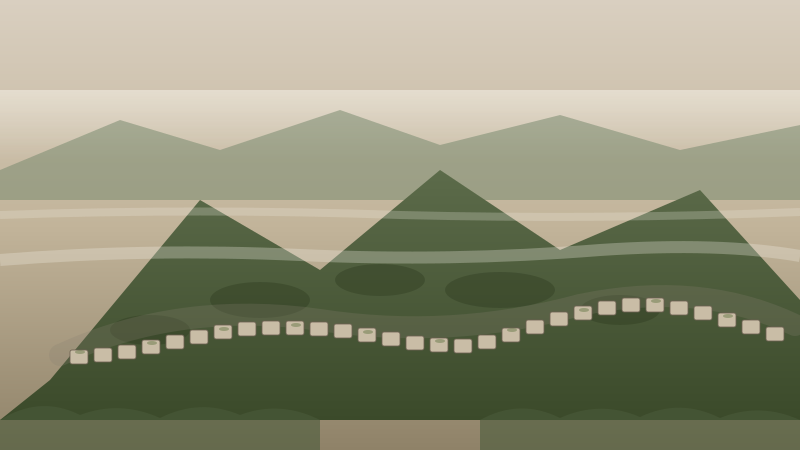
What Are Kougoishi? Mysterious Stone Lines That Encircle Mountains
Kougoishi are enigmatic lines of dressed stones found at the midpoint of mountains across northern Kyushu and along the Seto Inland Sea. At elevations of roughly 200 to 400 meters, carefully cut granite blocks are set side by side in a continuous line, wrapping entire mountains like a sacred belt. Sites identified so far include Korayama and Otsuboyama in Fukuoka, Obikumayama in Saga, Kikuchi-jo in Kumamoto, Oni-no-jo in Okayama, and Kiyama in Kagawa — more than a dozen in total.
Each cut stone is sixty centimeters to over a meter in length and can weigh several hundred kilograms. In valleys, the stones are stacked multiple courses deep and combined with water gates; along ridgelines, they run for long stretches following the contour lines. The total length at a single site ranges from two to over six kilometers. How, and above all why, ancient people carried out such monumental earthworks in such inconvenient mountain locations remains one of Japan's deepest archaeological puzzles.
Even the name is unsettled. From the late Edo through the Meiji period, local people in the Tsukushi region called the stone lines "the stones where gods are enshrined in their basket." The academic term kougoishi came into use only in 1898, when Kobayashi Shojiro introduced the Korayama site in a paper. Before that, for the local communities, these stones were objects of reverential awe — a sacred boundary not to be disturbed casually.
The Great Debate — Sacred Precinct or Ancient Fortress?
For over a century, Japanese archaeology has argued over the nature of the kougoishi. The debate pivots on two positions: the "sacred precinct theory" and the "mountain fortress theory."
The sacred precinct theory, advanced by early scholars such as Kobayashi Shojiro and Kita Sadakichi, holds that the kougoishi are the developed form of the himorogi or iwasaka — the primitive sacred enclosures that marked the boundary of a deity's mountain before shrine architecture existed. In ancient Japan, a mountain or a particular boulder itself was the vessel of the kami. The stone lines, in this reading, were enormous barrier devices that separated the sacred mountain from the profane world below. This view gains support from the fact that the stones are placed at a height easily seen from the villages below, that the valley water gates seem designed to "close" the mountain, and that the layout shows little obvious military logic.
The mountain fortress theory, reinforced in the late Taisho and early Showa periods by scholars such as Sekino Tadashi and Mikami Tsugio, argues instead that the kougoishi are Korean-style mountain fortresses — military installations built in the late seventh century using peninsular techniques. After the disastrous defeat at the Battle of Hakusukinoe in 663, the Yamato court braced for a possible invasion by Tang and Silla forces and constructed a string of fortifications across Tsushima, Dazaifu, and the Seto Inland coasts. Forts such as Ono-jo, Kii-jo, and Yashima-jo are documented in the Nihon Shoki, but the kougoishi sites are not mentioned in any surviving text. They may, in other words, be a "phantom fortress network" that history simply forgot to record.
Excavations since the late Showa period have produced strong physical evidence for the fortress theory: rammed-earth ramparts sitting atop the stone footings, post holes for wooden palisades, and foundation stones of gatehouses. The current consensus leans toward a military function. But two questions remain stubbornly open. Why were these structures never recorded in the chronicles, and why have they been treated as sacred rather than as military ruins?
Between Kami and Soldier — The Ancient Gaze of Ambiguity
The fascination of the kougoishi lies in their refusal to fit neatly into one category. In ancient Japan, the line between sacred space and military stronghold was far more porous than we imagine today. A mountain could be the seat of a god and a strategic lookout at the same time. Shrine precinct and castle perimeter frequently overlapped.
Mount Miwa of Omiwa, Okinoshima of Munakata, Moriyasan of Suwa — each is a sacred mountain, but each also held strategic value. To enshrine a kami on a peak was to declare it politically as "our sacred territory," and to build a boundary there was to defend both sanctity and land against hostile powers. The kougoishi most likely served both purposes at once, rather than being purely one or the other.
For the people who set these stones, the act of placing them was itself a ritual — a way of summoning the deity and securing the land. The walls of a mountain fortress were never merely walls. They were a declaration: "Beyond this line lies the seat of our gods; do not violate it." As Hakusukinoe receded into history and peace returned, the military function was forgotten while the memory of a sacred boundary lingered in local lore. That may be why the stones continued to be called "stones of the gods" long after their original purpose had slipped away.
Walking the Site — What the Stones Actually Convey
I once walked a kougoishi site in person, a simple tourist map from the local visitor center in hand, climbing a steep cedar slope. At the edge of my vision, suddenly, evenly spaced blocks of granite appeared, half buried, dusted with lichen, shoulders wet with moss. Each one clearly had been placed with intention, not dropped there by nature.
When I laid my hand on one, I felt something strange. The stone was cold, and yet somehow it did not push me away. I stood there, uncertain whether I was an intruder or a guest, and walked slowly along the line of stones for a while. Once human voices faded and only the wind remained, it struck me that these stones were not only "placed by someone long ago" but also "still waiting for someone." I would leave the academic verdict to scholars — the theories of precinct or fortress. The weight of a stone that has stood in that forest for nearly fourteen centuries was plenty, beyond argument.
Walking back, I mentioned to my family who had come along that "each stone must remember the names of the people who carried it." Who did the hauling, which songs they sang to keep rhythm, in what season they set the block down — an immense labor history, wholly unrecorded, lies quietly under the moss. Even just imagining it connected the ancient and the present in a way no signboard could.
Representative Sites — Each with Its Own Character
The major kougoishi sites each carry a different personality. Korayama Kougoishi in Kurume, Fukuoka, wraps the midsection of the mountain upon which Kora Taisha — traditionally the highest-ranked shrine of ancient Tsukushi — is enshrined. The stones may trace the boundary of the sacred territory of Kora-tamatare-no-mikoto, the presiding deity.
Oni-no-jo in Soja, Okayama, is entangled with the legend of the Momotaro ogres. Its imposing circuit of 2.8 kilometers and the reconstructed west gate leave a powerful impression of a fortress, while the Ura legend of a battle with the ogres reminds visitors that this has always been a place of awe.
Otsuboyama Kougoishi in Takeo, Saga, is where the 1962 excavation first revealed rammed earth and palisade post holes, effectively tipping the academic argument toward the fortress theory. Kikuchi-jo in Yamaga, Kumamoto, preserves the octagonal foundation stones characteristic of Korean-style ancient castles, showing the state-led nature of these constructions. Visiting several in succession reveals that "kougoishi" as a category hides a real diversity of setting, construction, and folklore.
What Kougoishi Ask of Us Today — Imagination for Invisible Boundaries
Kougoishi pose a distinctive question to us today: how do we relate to invisible boundaries? The stone lines themselves are physical and visible, but the boundary they mark — between kami and people, friend and foe, sacred and profane — was always an abstract line, only ever truly visible in the mind.
Modern society defines boundaries with law and survey — national borders, property lines, zoning codes. But the boundaries inside us — "this much I want to protect," "that far I do not want others to come" — remain invisible. The ancients chose to express these invisible lines through enormous physical stones. The labor of placing each block was, in itself, a bodily ritual of boundary-drawing, impressed on the community without ever needing to be articulated in words.
Standing before a kougoishi, you are asked: what domain do you wish to protect? What place do you hold inviolable? And how do you show that boundary to others? Even now that the mountain-fortress theory is broadly accepted, the fact that these stones have always been called "stones of the kami" seems to point back to the weight of these questions.
Vanishing Remains and the Questions That Endure
One final note about the present. Many kougoishi sites are threatened by development and by neglected forests. Some have become inaccessible as mountain trails fall into disrepair; others have been toppled by landslides; a few have suffered looting. Sites designated as national historic monuments are still protected, but the unregistered ones depend on small groups of local volunteers.
Meanwhile, new digital techniques — three-dimensional scanning and LiDAR surveys that can read terrain through forest canopy — have opened the possibility of discovering missed extensions of known stone lines or entirely unknown sites. Science will continue to advance, yet the question "what exactly were the kougoishi?" is unlikely ever to be definitively answered.
Perhaps the fact that no final answer will ever arrive is precisely the virtue of these ruins. Not "precinct or fortress," but an era in which ritual and defense, sacred and profane, kami and soldier dissolved together into a single line of stones — the kougoishi preserve the memory of that age. If you ever have the chance, go and see them. When you lay a hand on a moss-covered block, something that cannot be reduced to theory is almost certain to remain with you.
About the Author
Shrine Secrets Editorial TeamWe uncover the hidden secrets of Japanese shrines and Shinto, making them accessible to everyone.
View author profile →Related Articles
The Mystery of Kamimukae-sai — The Sacred Night When All Gods Gather on Izumo's Inasa Beach
The Mystery of Tamayori-hime — The Sea God's Daughter Who Became Mother of the First Emperor
The Mystery of Kakebotoke — The Circular Metal Plaques That Preserve the Memory of Shinto-Buddhist Fusion
Voices of the Age of Gods — How Sound and Vibration Reveal Shinto Cosmology